

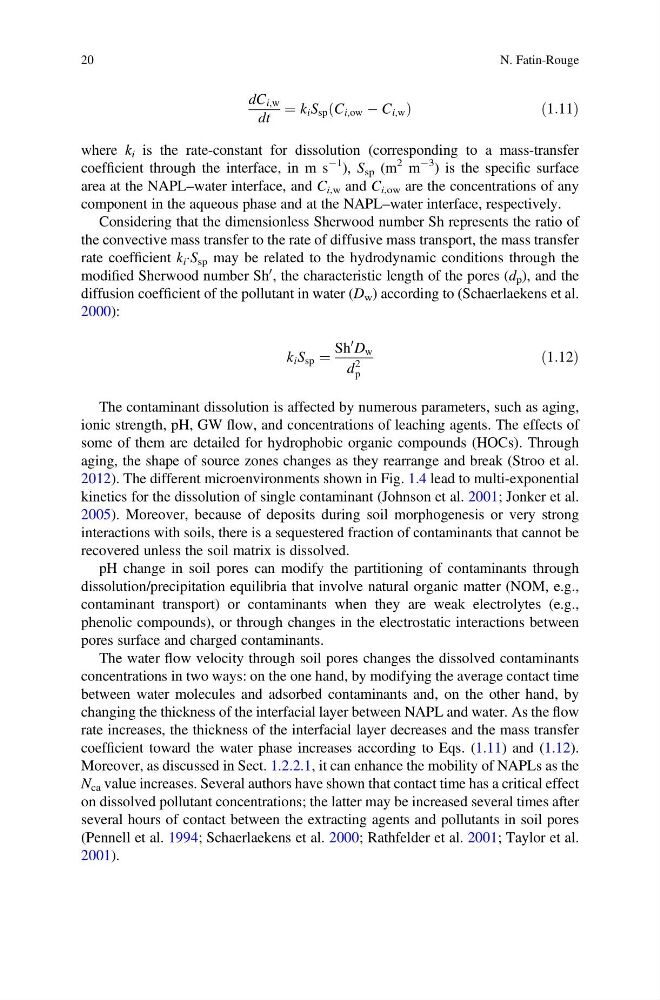
dC i,w
dt
¼ k i S sp C i,ow À C i,w
ð
Þ
ð 1:11Þ
where k i is the rate-constant for dissolution (corresponding to a mass-transfer
coefficient through the interface, in m s
À1 ), S sp (m
2 m
À3 ) is the specific surface
area at the NAPL–water interface, and C i,w and C i,ow are the concentrations of any
component in the aqueous phase and at the NAPL–water interface, respectively.
Considering that the dimensionless Sherwood number Sh represents the ratio of
the convective mass transfer to the rate of diffusive mass transport, the mass transfer
rate coefficient k i ÁS sp may be related to the hydrodynamic conditions through the
modified Sherwood number Sh
0 , the characteristic length of the pores (d p ), and the
diffusion coefficient of the pollutant in water (D w ) according to (Schaerlaekens et al.
2000):
k i S sp ¼
Sh
0 D w
d
2
p
ð1:12Þ
The contaminant dissolution is affected by numerous parameters, such as aging,
ionic strength, pH, GW flow, and concentrations of leaching agents. The effects of
some of them are detailed for hydrophobic organic compounds (HOCs). Through
aging, the shape of source zones changes as they rearrange and break (Stroo et al.
2012). The different microenvironments shown in Fig. 1.4 lead to multi-exponential
kinetics for the dissolution of single contaminant (Johnson et al. 2001; Jonker et al.
2005). Moreover, because of deposits during soil morphogenesis or very strong
interactions with soils, there is a sequestered fraction of contaminants that cannot be
recovered unless the soil matrix is dissolved.
pH change in soil pores can modify the partitioning of contaminants through
dissolution/precipitation equilibria that involve natural organic matter (NOM, e.g.,
contaminant transport) or contaminants when they are weak electrolytes (e.g.,
phenolic compounds), or through changes in the electrostatic interactions between
pores surface and charged contaminants.
The water flow velocity through soil pores changes the dissolved contaminants
concentrations in two ways: on the one hand, by modifying the average contact time
between water molecules and adsorbed contaminants and, on the other hand, by
changing the thickness of the interfacial layer between NAPL and water. As the flow
rate increases, the thickness of the interfacial layer decreases and the mass transfer
coefficient toward the water phase increases according to Eqs. (1.11) and (1.12).
Moreover, as discussed in Sect. 1.2.2.1, it can enhance the mobility of NAPLs as the
N ca value increases. Several authors have shown that contact time has a critical effect
on dissolved pollutant concentrations; the latter may be increased several times after
several hours of contact between the extracting agents and pollutants in soil pores
(Pennell et al. 1994; Schaerlaekens et al. 2000; Rathfelder et al. 2001; Taylor et al.
2001).
20
N. Fatin-Rouge
dt
¼ k i S sp C i,ow À C i,w
ð
Þ
ð 1:11Þ
where k i is the rate-constant for dissolution (corresponding to a mass-transfer
coefficient through the interface, in m s
À1 ), S sp (m
2 m
À3 ) is the specific surface
area at the NAPL–water interface, and C i,w and C i,ow are the concentrations of any
component in the aqueous phase and at the NAPL–water interface, respectively.
Considering that the dimensionless Sherwood number Sh represents the ratio of
the convective mass transfer to the rate of diffusive mass transport, the mass transfer
rate coefficient k i ÁS sp may be related to the hydrodynamic conditions through the
modified Sherwood number Sh
0 , the characteristic length of the pores (d p ), and the
diffusion coefficient of the pollutant in water (D w ) according to (Schaerlaekens et al.
2000):
k i S sp ¼
Sh
0 D w
d
2
p
ð1:12Þ
The contaminant dissolution is affected by numerous parameters, such as aging,
ionic strength, pH, GW flow, and concentrations of leaching agents. The effects of
some of them are detailed for hydrophobic organic compounds (HOCs). Through
aging, the shape of source zones changes as they rearrange and break (Stroo et al.
2012). The different microenvironments shown in Fig. 1.4 lead to multi-exponential
kinetics for the dissolution of single contaminant (Johnson et al. 2001; Jonker et al.
2005). Moreover, because of deposits during soil morphogenesis or very strong
interactions with soils, there is a sequestered fraction of contaminants that cannot be
recovered unless the soil matrix is dissolved.
pH change in soil pores can modify the partitioning of contaminants through
dissolution/precipitation equilibria that involve natural organic matter (NOM, e.g.,
contaminant transport) or contaminants when they are weak electrolytes (e.g.,
phenolic compounds), or through changes in the electrostatic interactions between
pores surface and charged contaminants.
The water flow velocity through soil pores changes the dissolved contaminants
concentrations in two ways: on the one hand, by modifying the average contact time
between water molecules and adsorbed contaminants and, on the other hand, by
changing the thickness of the interfacial layer between NAPL and water. As the flow
rate increases, the thickness of the interfacial layer decreases and the mass transfer
coefficient toward the water phase increases according to Eqs. (1.11) and (1.12).
Moreover, as discussed in Sect. 1.2.2.1, it can enhance the mobility of NAPLs as the
N ca value increases. Several authors have shown that contact time has a critical effect
on dissolved pollutant concentrations; the latter may be increased several times after
several hours of contact between the extracting agents and pollutants in soil pores
(Pennell et al. 1994; Schaerlaekens et al. 2000; Rathfelder et al. 2001; Taylor et al.
2001).
20
N. Fatin-Rouge