

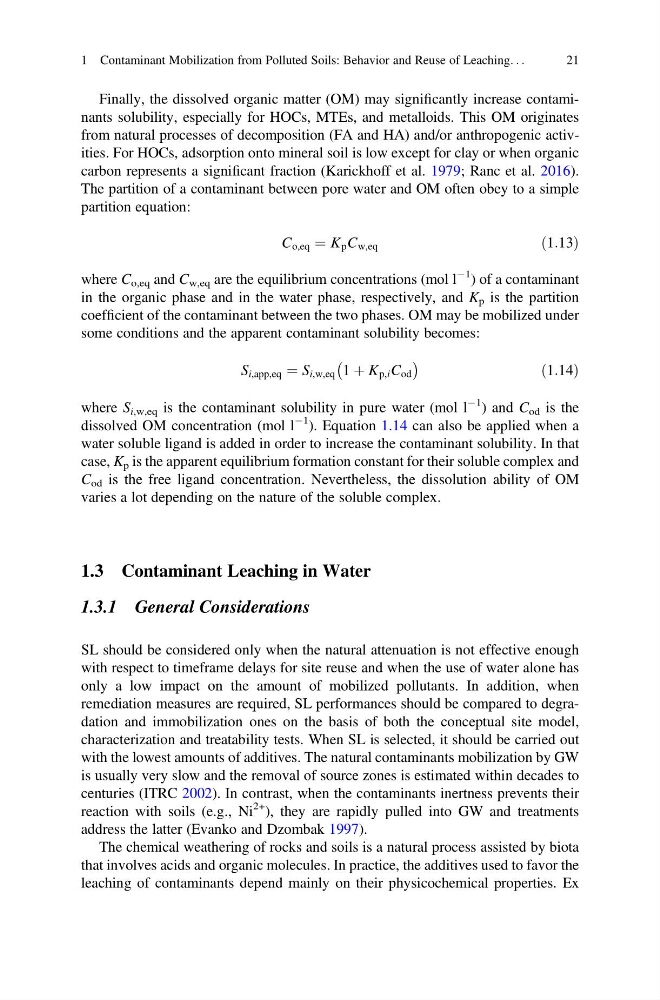
Finally, the dissolved organic matter (OM) may significantly increase contaminants solubility, especially for HOCs, MTEs, and metalloids. This OM originates
from natural processes of decomposition (FA and HA) and/or anthropogenic activities. For HOCs, adsorption onto mineral soil is low except for clay or when organic
carbon represents a significant fraction (Karickhoff et al. 1979; Ranc et al. 2016).
The partition of a contaminant between pore water and OM often obey to a simple
partition equation:
C o,eq ¼ K p C w,eq
ð1:13Þ
where C o,eq and C w,eq are the equilibrium concentrations (mol l
À1 ) of a contaminant
in the organic phase and in the water phase, respectively, and K p is the partition
coefficient of the contaminant between the two phases. OM may be mobilized under
some conditions and the apparent contaminant solubility becomes:
S i,app,eq ¼ S i,w,eq 1 þ K p,i C od
À
Á
ð1:14Þ
where S i,w,eq is the contaminant solubility in pure water (mol l
À1 ) and C od is the
dissolved OM concentration (mol l
À1 ). Equation 1.14 can also be applied when a
water soluble ligand is added in order to increase the contaminant solubility. In that
case, K p is the apparent equilibrium formation constant for their soluble complex and
C od is the free ligand concentration. Nevertheless, the dissolution ability of OM
varies a lot depending on the nature of the soluble complex.
1.3 Contaminant Leaching in Water
1.3.1 General Considerations
SL should be considered only when the natural attenuation is not effective enough
with respect to timeframe delays for site reuse and when the use of water alone has
only a low impact on the amount of mobilized pollutants. In addition, when
remediation measures are required, SL performances should be compared to degradation and immobilization ones on the basis of both the conceptual site model,
characterization and treatability tests. When SL is selected, it should be carried out
with the lowest amounts of additives. The natural contaminants mobilization by GW
is usually very slow and the removal of source zones is estimated within decades to
centuries (ITRC 2002). In contrast, when the contaminants inertness prevents their
reaction with soils (e.g., Ni
2+ ), they are rapidly pulled into GW and treatments
address the latter (Evanko and Dzombak 1997).
The chemical weathering of rocks and soils is a natural process assisted by biota
that involves acids and organic molecules. In practice, the additives used to favor the
leaching of contaminants depend mainly on their physicochemical properties. Ex
1 Contaminant Mobilization from Polluted Soils: Behavior and Reuse of Leaching. . .
21
from natural processes of decomposition (FA and HA) and/or anthropogenic activities. For HOCs, adsorption onto mineral soil is low except for clay or when organic
carbon represents a significant fraction (Karickhoff et al. 1979; Ranc et al. 2016).
The partition of a contaminant between pore water and OM often obey to a simple
partition equation:
C o,eq ¼ K p C w,eq
ð1:13Þ
where C o,eq and C w,eq are the equilibrium concentrations (mol l
À1 ) of a contaminant
in the organic phase and in the water phase, respectively, and K p is the partition
coefficient of the contaminant between the two phases. OM may be mobilized under
some conditions and the apparent contaminant solubility becomes:
S i,app,eq ¼ S i,w,eq 1 þ K p,i C od
À
Á
ð1:14Þ
where S i,w,eq is the contaminant solubility in pure water (mol l
À1 ) and C od is the
dissolved OM concentration (mol l
À1 ). Equation 1.14 can also be applied when a
water soluble ligand is added in order to increase the contaminant solubility. In that
case, K p is the apparent equilibrium formation constant for their soluble complex and
C od is the free ligand concentration. Nevertheless, the dissolution ability of OM
varies a lot depending on the nature of the soluble complex.
1.3 Contaminant Leaching in Water
1.3.1 General Considerations
SL should be considered only when the natural attenuation is not effective enough
with respect to timeframe delays for site reuse and when the use of water alone has
only a low impact on the amount of mobilized pollutants. In addition, when
remediation measures are required, SL performances should be compared to degradation and immobilization ones on the basis of both the conceptual site model,
characterization and treatability tests. When SL is selected, it should be carried out
with the lowest amounts of additives. The natural contaminants mobilization by GW
is usually very slow and the removal of source zones is estimated within decades to
centuries (ITRC 2002). In contrast, when the contaminants inertness prevents their
reaction with soils (e.g., Ni
2+ ), they are rapidly pulled into GW and treatments
address the latter (Evanko and Dzombak 1997).
The chemical weathering of rocks and soils is a natural process assisted by biota
that involves acids and organic molecules. In practice, the additives used to favor the
leaching of contaminants depend mainly on their physicochemical properties. Ex
1 Contaminant Mobilization from Polluted Soils: Behavior and Reuse of Leaching. . .
21