

follows a two-step process: at first, the formation of weak outer-sphere complexes
through electrostatic interactions followed by inner-sphere complexes. The latter are
stronger but rate-limited by the dissociation of water molecule from the first coordination shell of the metal ion (Wilkins 1991). The main processes for pollutants
mobilization from sources zones are the leaching by means of runoff and infiltrations, the dissolution in water, the volatilization and for soils, the erosion, and the
wind transport. Because natural concentrations of extracting agents are usually low
in runoff water and in GW, chemical additives are often added to enhance the
pollutants mobilization.
1.2.2.3 Contaminant Transfer into the Aqueous Phase
Kinetics of contaminant transfer are limiting for the mobilization. The transfer of
contaminants from NAPLs toward the aqueous phase is ruled by the mechanism of
dissolution. By considering that the equilibrium of dissolution is reached, the
concentration of each NAPL component in the aqueous solution, C i,w,eq , is given
by the Raoult law:
C i,w,eq ¼ X i a i S i,w
ð1:9Þ
where Χ i is the mole fraction of any NAPL component, a i is its activity coefficient in
the NAPL (often assumed to be 1), and S i is its solubility in pure water (mol l
À1 ).
Although NAPLs are often complex mixtures molecules which follow different
dissolution kinetics in the water phase, the use of the Raoult law is common in
literature, but in that case, during the NAPL dissolution, the mole fraction of each
component is changing like its chemical composition.
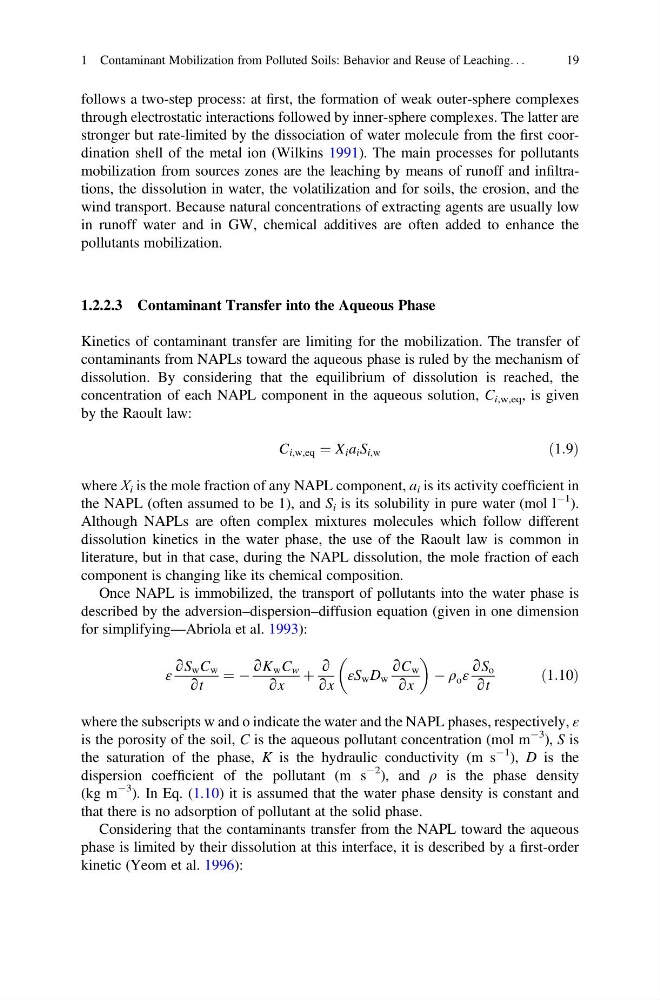
Once NAPL is immobilized, the transport of pollutants into the water phase is
described by the adversion–dispersion–diffusion equation (given in one dimension
for simplifying—Abriola et al. 1993):
ε
∂S w C w
∂t
¼ À
∂K w C w
∂x
þ
∂
∂x
εS w D w
∂C w
∂x
À ρ o ε
∂S o
∂t
ð1:10Þ
where the subscripts w and o indicate the water and the NAPL phases, respectively, ε
is the porosity of the soil, C is the aqueous pollutant concentration (mol m
À3 ), S is
the saturation of the phase, K is the hydraulic conductivity (m s
À1 ), D is the
dispersion coefficient of the pollutant (m s
À2 ), and ρ is the phase density
(kg m
À3 ). In Eq. (1.10) it is assumed that the water phase density is constant and
that there is no adsorption of pollutant at the solid phase.
Considering that the contaminants transfer from the NAPL toward the aqueous
phase is limited by their dissolution at this interface, it is described by a first-order
kinetic (Yeom et al. 1996):
1 Contaminant Mobilization from Polluted Soils: Behavior and Reuse of Leaching. . .
19
through electrostatic interactions followed by inner-sphere complexes. The latter are
stronger but rate-limited by the dissociation of water molecule from the first coordination shell of the metal ion (Wilkins 1991). The main processes for pollutants
mobilization from sources zones are the leaching by means of runoff and infiltrations, the dissolution in water, the volatilization and for soils, the erosion, and the
wind transport. Because natural concentrations of extracting agents are usually low
in runoff water and in GW, chemical additives are often added to enhance the
pollutants mobilization.
1.2.2.3 Contaminant Transfer into the Aqueous Phase
Kinetics of contaminant transfer are limiting for the mobilization. The transfer of
contaminants from NAPLs toward the aqueous phase is ruled by the mechanism of
dissolution. By considering that the equilibrium of dissolution is reached, the
concentration of each NAPL component in the aqueous solution, C i,w,eq , is given
by the Raoult law:
C i,w,eq ¼ X i a i S i,w
ð1:9Þ
where Χ i is the mole fraction of any NAPL component, a i is its activity coefficient in
the NAPL (often assumed to be 1), and S i is its solubility in pure water (mol l
À1 ).
Although NAPLs are often complex mixtures molecules which follow different
dissolution kinetics in the water phase, the use of the Raoult law is common in
literature, but in that case, during the NAPL dissolution, the mole fraction of each
component is changing like its chemical composition.
Once NAPL is immobilized, the transport of pollutants into the water phase is
described by the adversion–dispersion–diffusion equation (given in one dimension
for simplifying—Abriola et al. 1993):
ε
∂S w C w
∂t
¼ À
∂K w C w
∂x
þ
∂
∂x
εS w D w
∂C w
∂x
À ρ o ε
∂S o
∂t
ð1:10Þ
where the subscripts w and o indicate the water and the NAPL phases, respectively, ε
is the porosity of the soil, C is the aqueous pollutant concentration (mol m
À3 ), S is
the saturation of the phase, K is the hydraulic conductivity (m s
À1 ), D is the
dispersion coefficient of the pollutant (m s
À2 ), and ρ is the phase density
(kg m
À3 ). In Eq. (1.10) it is assumed that the water phase density is constant and
that there is no adsorption of pollutant at the solid phase.
Considering that the contaminants transfer from the NAPL toward the aqueous
phase is limited by their dissolution at this interface, it is described by a first-order
kinetic (Yeom et al. 1996):
1 Contaminant Mobilization from Polluted Soils: Behavior and Reuse of Leaching. . .
19