

S i ¼
V i
V v
ð1:2Þ
where V i and V v are the volume filled by the phase liquid i and the porous volume,
respectively.
The interfacial tension γ, is defined as the energy (N m
À1 or mJ m
À2 ) required to
make a unit surface (dS) at the interface between two nonmiscible phases, according
to:
δW ¼ γdS
ð1:3Þ
Lowering the γ-value promotes NAPL emulsification.
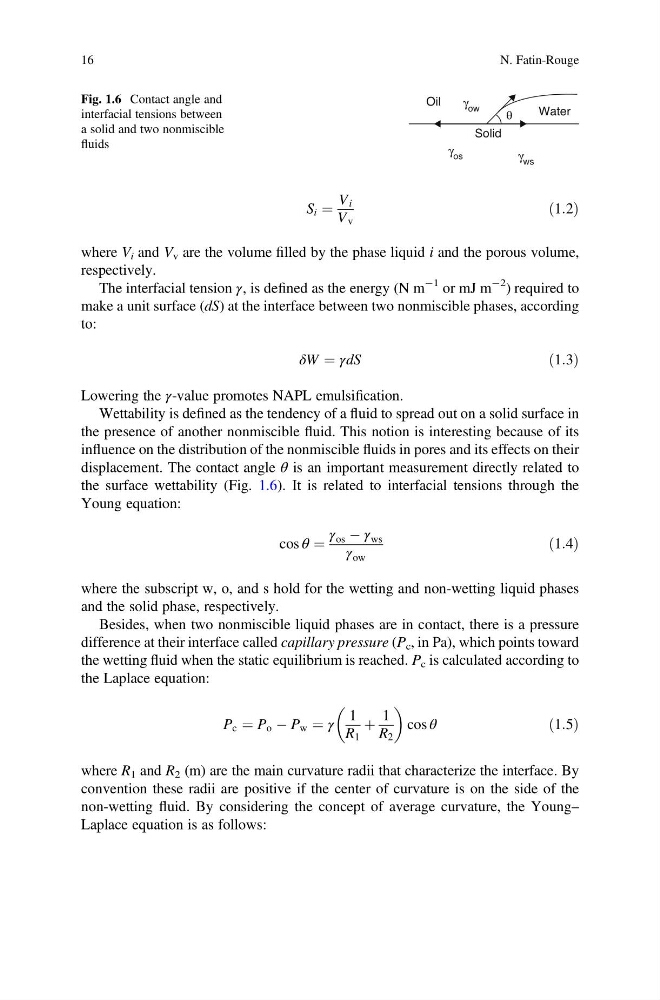
Wettability is defined as the tendency of a fluid to spread out on a solid surface in
the presence of another nonmiscible fluid. This notion is interesting because of its
influence on the distribution of the nonmiscible fluids in pores and its effects on their
displacement. The contact angle θ is an important measurement directly related to
the surface wettability (Fig. 1.6). It is related to interfacial tensions through the
Young equation:
cos θ ¼
γ os À γ ws
γ ow
ð1:4Þ
where the subscript w, o, and s hold for the wetting and non-wetting liquid phases
and the solid phase, respectively.
Besides, when two nonmiscible liquid phases are in contact, there is a pressure
difference at their interface called capillary pressure (P c , in Pa), which points toward
the wetting fluid when the static equilibrium is reached. P c is calculated according to
the Laplace equation:
P c ¼ P o À P w ¼ γ
1
R 1
þ
1
R 2
cos θ
ð1:5Þ
where R 1 and R 2 (m) are the main curvature radii that characterize the interface. By
convention these radii are positive if the center of curvature is on the side of the
non-wetting fluid. By considering the concept of average curvature, the Young–
Laplace equation is as follows:
Oil
γ ow
γ os
γ ws
θ
Water
Solid
Fig. 1.6 Contact angle and
interfacial tensions between
a solid and two nonmiscible
fluids
16
N. Fatin-Rouge
V i
V v
ð1:2Þ
where V i and V v are the volume filled by the phase liquid i and the porous volume,
respectively.
The interfacial tension γ, is defined as the energy (N m
À1 or mJ m
À2 ) required to
make a unit surface (dS) at the interface between two nonmiscible phases, according
to:
δW ¼ γdS
ð1:3Þ
Lowering the γ-value promotes NAPL emulsification.
Wettability is defined as the tendency of a fluid to spread out on a solid surface in
the presence of another nonmiscible fluid. This notion is interesting because of its
influence on the distribution of the nonmiscible fluids in pores and its effects on their
displacement. The contact angle θ is an important measurement directly related to
the surface wettability (Fig. 1.6). It is related to interfacial tensions through the
Young equation:
cos θ ¼
γ os À γ ws
γ ow
ð1:4Þ
where the subscript w, o, and s hold for the wetting and non-wetting liquid phases
and the solid phase, respectively.
Besides, when two nonmiscible liquid phases are in contact, there is a pressure
difference at their interface called capillary pressure (P c , in Pa), which points toward
the wetting fluid when the static equilibrium is reached. P c is calculated according to
the Laplace equation:
P c ¼ P o À P w ¼ γ
1
R 1
þ
1
R 2
cos θ
ð1:5Þ
where R 1 and R 2 (m) are the main curvature radii that characterize the interface. By
convention these radii are positive if the center of curvature is on the side of the
non-wetting fluid. By considering the concept of average curvature, the Young–
Laplace equation is as follows:
Oil
γ ow
γ os
γ ws
θ
Water
Solid
Fig. 1.6 Contact angle and
interfacial tensions between
a solid and two nonmiscible
fluids
16
N. Fatin-Rouge