

P c ¼
2γ
R
cos θ
ð1:6Þ
where R is the average curvature radius at the interface (m).
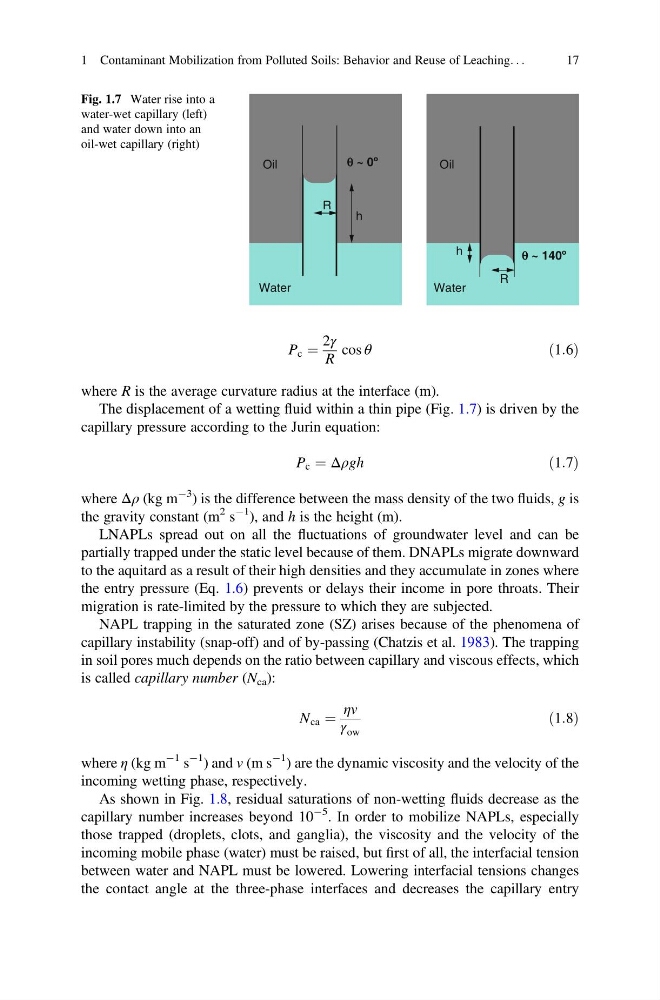
The displacement of a wetting fluid within a thin pipe (Fig. 1.7) is driven by the
capillary pressure according to the Jurin equation:
P c ¼ Δρgh
ð1:7Þ
where Δρ (kg m
À3 ) is the difference between the mass density of the two fluids, g is
the gravity constant (m
2 s
À1 ), and h is the height (m).
LNAPLs spread out on all the fluctuations of groundwater level and can be
partially trapped under the static level because of them. DNAPLs migrate downward
to the aquitard as a result of their high densities and they accumulate in zones where
the entry pressure (Eq. 1.6) prevents or delays their income in pore throats. Their
migration is rate-limited by the pressure to which they are subjected.
NAPL trapping in the saturated zone (SZ) arises because of the phenomena of
capillary instability (snap-off) and of by-passing (Chatzis et al. 1983). The trapping
in soil pores much depends on the ratio between capillary and viscous effects, which
is called capillary number (N ca ):
N ca ¼
ηv
γ ow
ð1:8Þ
where η (kg m
À1 s
À1 ) and v (m s
À1 ) are the dynamic viscosity and the velocity of the
incoming wetting phase, respectively.
As shown in Fig. 1.8, residual saturations of non-wetting fluids decrease as the
capillary number increases beyond 10
À5 . In order to mobilize NAPLs, especially
those trapped (droplets, clots, and ganglia), the viscosity and the velocity of the
incoming mobile phase (water) must be raised, but first of all, the interfacial tension
between water and NAPL must be lowered. Lowering interfacial tensions changes
the contact angle at the three-phase interfaces and decreases the capillary entry
Oil
Oil
R
R
Water
Water
h
h
q ~ 0º
q ~ 140º
Fig. 1.7 Water rise into a
water-wet capillary (left)
and water down into an
oil-wet capillary (right)
1 Contaminant Mobilization from Polluted Soils: Behavior and Reuse of Leaching. . .
17
2γ
R
cos θ
ð1:6Þ
where R is the average curvature radius at the interface (m).
The displacement of a wetting fluid within a thin pipe (Fig. 1.7) is driven by the
capillary pressure according to the Jurin equation:
P c ¼ Δρgh
ð1:7Þ
where Δρ (kg m
À3 ) is the difference between the mass density of the two fluids, g is
the gravity constant (m
2 s
À1 ), and h is the height (m).
LNAPLs spread out on all the fluctuations of groundwater level and can be
partially trapped under the static level because of them. DNAPLs migrate downward
to the aquitard as a result of their high densities and they accumulate in zones where
the entry pressure (Eq. 1.6) prevents or delays their income in pore throats. Their
migration is rate-limited by the pressure to which they are subjected.
NAPL trapping in the saturated zone (SZ) arises because of the phenomena of
capillary instability (snap-off) and of by-passing (Chatzis et al. 1983). The trapping
in soil pores much depends on the ratio between capillary and viscous effects, which
is called capillary number (N ca ):
N ca ¼
ηv
γ ow
ð1:8Þ
where η (kg m
À1 s
À1 ) and v (m s
À1 ) are the dynamic viscosity and the velocity of the
incoming wetting phase, respectively.
As shown in Fig. 1.8, residual saturations of non-wetting fluids decrease as the
capillary number increases beyond 10
À5 . In order to mobilize NAPLs, especially
those trapped (droplets, clots, and ganglia), the viscosity and the velocity of the
incoming mobile phase (water) must be raised, but first of all, the interfacial tension
between water and NAPL must be lowered. Lowering interfacial tensions changes
the contact angle at the three-phase interfaces and decreases the capillary entry
Oil
Oil
R
R
Water
Water
h
h
q ~ 0º
q ~ 140º
Fig. 1.7 Water rise into a
water-wet capillary (left)
and water down into an
oil-wet capillary (right)
1 Contaminant Mobilization from Polluted Soils: Behavior and Reuse of Leaching. . .
17