

1.2.2.1 Behavior of NAPLs
NAPLs may be composed of organic, organometallic, or inorganic contaminants and
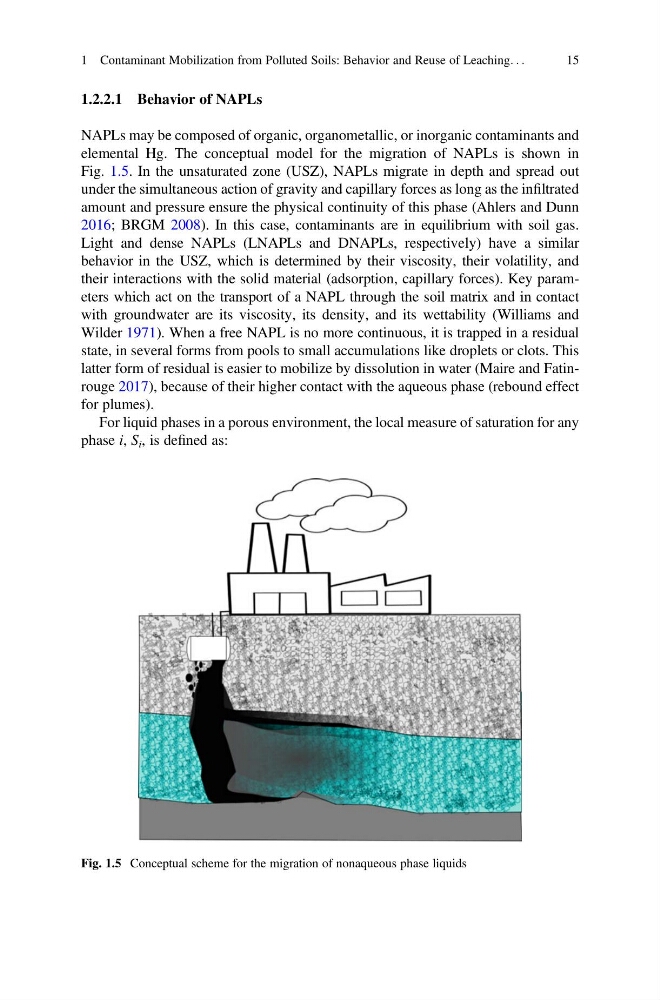
elemental Hg. The conceptual model for the migration of NAPLs is shown in
Fig. 1.5. In the unsaturated zone (USZ), NAPLs migrate in depth and spread out
under the simultaneous action of gravity and capillary forces as long as the infiltrated
amount and pressure ensure the physical continuity of this phase (Ahlers and Dunn
2016; BRGM 2008). In this case, contaminants are in equilibrium with soil gas.
Light and dense NAPLs (LNAPLs and DNAPLs, respectively) have a similar
behavior in the USZ, which is determined by their viscosity, their volatility, and
their interactions with the solid material (adsorption, capillary forces). Key parameters which act on the transport of a NAPL through the soil matrix and in contact
with groundwater are its viscosity, its density, and its wettability (Williams and
Wilder 1971). When a free NAPL is no more continuous, it is trapped in a residual
state, in several forms from pools to small accumulations like droplets or clots. This
latter form of residual is easier to mobilize by dissolution in water (Maire and Fatinrouge 2017), because of their higher contact with the aqueous phase (rebound effect
for plumes).
For liquid phases in a porous environment, the local measure of saturation for any
phase i, S i , is defined as:
Fig. 1.5 Conceptual scheme for the migration of nonaqueous phase liquids
1 Contaminant Mobilization from Polluted Soils: Behavior and Reuse of Leaching. . .
15
NAPLs may be composed of organic, organometallic, or inorganic contaminants and
elemental Hg. The conceptual model for the migration of NAPLs is shown in
Fig. 1.5. In the unsaturated zone (USZ), NAPLs migrate in depth and spread out
under the simultaneous action of gravity and capillary forces as long as the infiltrated
amount and pressure ensure the physical continuity of this phase (Ahlers and Dunn
2016; BRGM 2008). In this case, contaminants are in equilibrium with soil gas.
Light and dense NAPLs (LNAPLs and DNAPLs, respectively) have a similar
behavior in the USZ, which is determined by their viscosity, their volatility, and
their interactions with the solid material (adsorption, capillary forces). Key parameters which act on the transport of a NAPL through the soil matrix and in contact
with groundwater are its viscosity, its density, and its wettability (Williams and
Wilder 1971). When a free NAPL is no more continuous, it is trapped in a residual
state, in several forms from pools to small accumulations like droplets or clots. This
latter form of residual is easier to mobilize by dissolution in water (Maire and Fatinrouge 2017), because of their higher contact with the aqueous phase (rebound effect
for plumes).
For liquid phases in a porous environment, the local measure of saturation for any
phase i, S i , is defined as:
Fig. 1.5 Conceptual scheme for the migration of nonaqueous phase liquids
1 Contaminant Mobilization from Polluted Soils: Behavior and Reuse of Leaching. . .
15