

1.2.2 Overview of the Various States of Contaminants,
Mechanisms, and Extraction Kinetics
Soil matrix properties which influence contaminant transport and transfer are porosity, permeability, chemical composition (inorganic and organic components), pH,
and redox potential (BRGM 2008). Soil matrix permeability, porosity, and the
specific surface area of soil particles play an essential role on the occurrence of
contaminant–soil interactions. Contaminants are partitioned between different
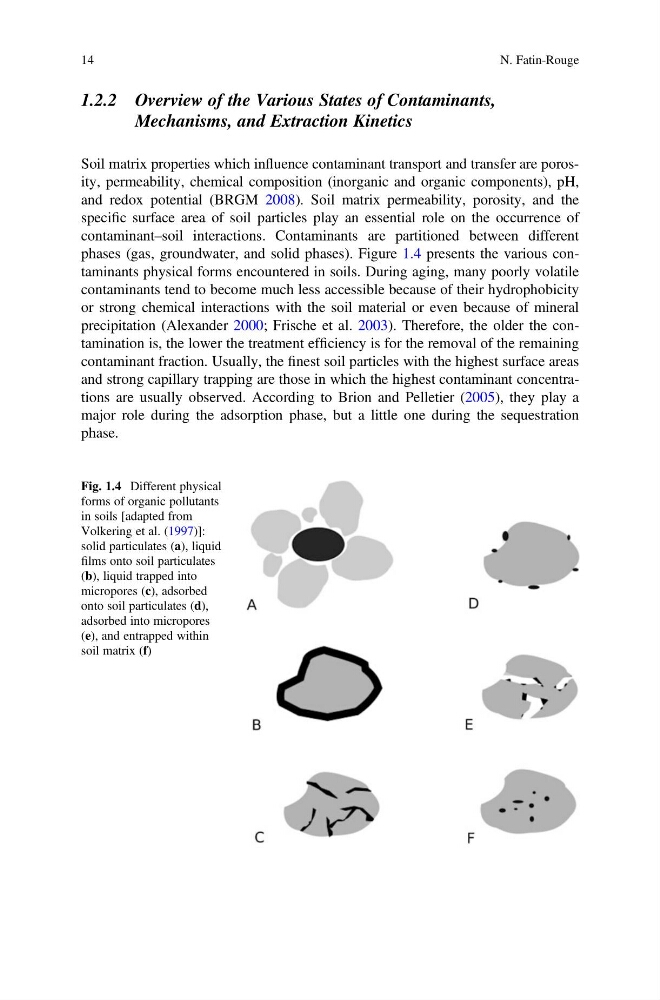
phases (gas, groundwater, and solid phases). Figure 1.4 presents the various contaminants physical forms encountered in soils. During aging, many poorly volatile
contaminants tend to become much less accessible because of their hydrophobicity
or strong chemical interactions with the soil material or even because of mineral
precipitation (Alexander 2000; Frische et al. 2003). Therefore, the older the contamination is, the lower the treatment efficiency is for the removal of the remaining
contaminant fraction. Usually, the finest soil particles with the highest surface areas
and strong capillary trapping are those in which the highest contaminant concentrations are usually observed. According to Brion and Pelletier (2005), they play a
major role during the adsorption phase, but a little one during the sequestration
phase.
Fig. 1.4 Different physical
forms of organic pollutants
in soils [adapted from
Volkering et al. (1997)]:
solid particulates (a), liquid
films onto soil particulates
(b), liquid trapped into
micropores (c), adsorbed
onto soil particulates (d),
adsorbed into micropores
(e), and entrapped within
soil matrix (f)
14
N. Fatin-Rouge
Mechanisms, and Extraction Kinetics
Soil matrix properties which influence contaminant transport and transfer are porosity, permeability, chemical composition (inorganic and organic components), pH,
and redox potential (BRGM 2008). Soil matrix permeability, porosity, and the
specific surface area of soil particles play an essential role on the occurrence of
contaminant–soil interactions. Contaminants are partitioned between different
phases (gas, groundwater, and solid phases). Figure 1.4 presents the various contaminants physical forms encountered in soils. During aging, many poorly volatile
contaminants tend to become much less accessible because of their hydrophobicity
or strong chemical interactions with the soil material or even because of mineral
precipitation (Alexander 2000; Frische et al. 2003). Therefore, the older the contamination is, the lower the treatment efficiency is for the removal of the remaining
contaminant fraction. Usually, the finest soil particles with the highest surface areas
and strong capillary trapping are those in which the highest contaminant concentrations are usually observed. According to Brion and Pelletier (2005), they play a
major role during the adsorption phase, but a little one during the sequestration
phase.
Fig. 1.4 Different physical
forms of organic pollutants
in soils [adapted from
Volkering et al. (1997)]:
solid particulates (a), liquid
films onto soil particulates
(b), liquid trapped into
micropores (c), adsorbed
onto soil particulates (d),
adsorbed into micropores
(e), and entrapped within
soil matrix (f)
14
N. Fatin-Rouge