

to inject oxidant and activating agent in pulses, because these reagents cannot be
mixed aboveground at real sites. These experiments yielded furthermore a better
understanding of the major limiting factor as well as the dissolution of pollutants in
water. As described in the columns’ section, the removals in columns for the highly
soluble and volatile substances were close to 100%. However, only thermal treatment reached 100% removal, sparging with ozone reaching 99%, while the others
ranged between 90 and 95%. At the tank scale, only thermal treatment reached 100%
of removal in zones where the target temperature was reached, the other treatments
only reached 50–78% in the treatment period (Fig. 4.9b). Therefore, if a technique
does not reach 100% in column experiments under the best potential conditions, this
suggests that even in a homogeneous medium there was limited access of the
treatment agent to the contaminant. As in the field, the access to the contaminant
is much more limited due to the heterogeneity, the agent shall only treat a small
portion of the contaminated area.
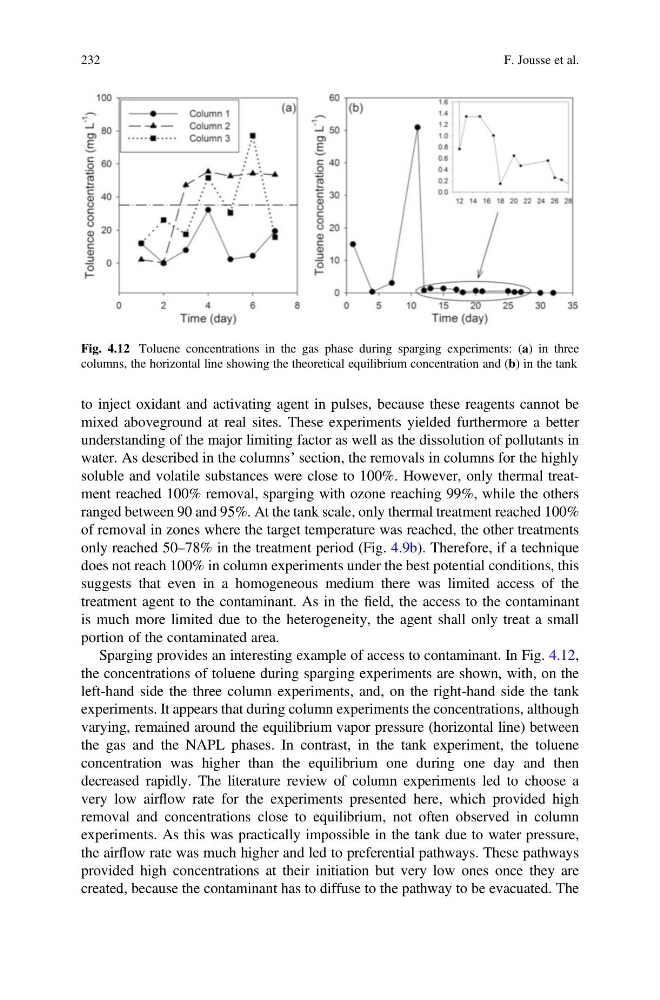
Sparging provides an interesting example of access to contaminant. In Fig. 4.12,
the concentrations of toluene during sparging experiments are shown, with, on the
left-hand side the three column experiments, and, on the right-hand side the tank
experiments. It appears that during column experiments the concentrations, although
varying, remained around the equilibrium vapor pressure (horizontal line) between
the gas and the NAPL phases. In contrast, in the tank experiment, the toluene
concentration was higher than the equilibrium one during one day and then
decreased rapidly. The literature review of column experiments led to choose a
very low airflow rate for the experiments presented here, which provided high
removal and concentrations close to equilibrium, not often observed in column
experiments. As this was practically impossible in the tank due to water pressure,
the airflow rate was much higher and led to preferential pathways. These pathways
provided high concentrations at their initiation but very low ones once they are
created, because the contaminant has to diffuse to the pathway to be evacuated. The
Fig. 4.12 Toluene concentrations in the gas phase during sparging experiments: (a) in three
columns, the horizontal line showing the theoretical equilibrium concentration and (b) in the tank
232
F. Jousse et al.
mixed aboveground at real sites. These experiments yielded furthermore a better
understanding of the major limiting factor as well as the dissolution of pollutants in
water. As described in the columns’ section, the removals in columns for the highly
soluble and volatile substances were close to 100%. However, only thermal treatment reached 100% removal, sparging with ozone reaching 99%, while the others
ranged between 90 and 95%. At the tank scale, only thermal treatment reached 100%
of removal in zones where the target temperature was reached, the other treatments
only reached 50–78% in the treatment period (Fig. 4.9b). Therefore, if a technique
does not reach 100% in column experiments under the best potential conditions, this
suggests that even in a homogeneous medium there was limited access of the
treatment agent to the contaminant. As in the field, the access to the contaminant
is much more limited due to the heterogeneity, the agent shall only treat a small
portion of the contaminated area.
Sparging provides an interesting example of access to contaminant. In Fig. 4.12,
the concentrations of toluene during sparging experiments are shown, with, on the
left-hand side the three column experiments, and, on the right-hand side the tank
experiments. It appears that during column experiments the concentrations, although
varying, remained around the equilibrium vapor pressure (horizontal line) between
the gas and the NAPL phases. In contrast, in the tank experiment, the toluene
concentration was higher than the equilibrium one during one day and then
decreased rapidly. The literature review of column experiments led to choose a
very low airflow rate for the experiments presented here, which provided high
removal and concentrations close to equilibrium, not often observed in column
experiments. As this was practically impossible in the tank due to water pressure,
the airflow rate was much higher and led to preferential pathways. These pathways
provided high concentrations at their initiation but very low ones once they are
created, because the contaminant has to diffuse to the pathway to be evacuated. The
Fig. 4.12 Toluene concentrations in the gas phase during sparging experiments: (a) in three
columns, the horizontal line showing the theoretical equilibrium concentration and (b) in the tank
232
F. Jousse et al.