

remediation projects the mass of product represents only a part of the costs. Water/
surfactant mixture treatment must be added as well as man power costs which are
proportional to treatment time.
The pump and treat option is also shown in Fig. 4.11. 370 pore volumes of water
would have been necessary to reach a full treatment. This outlines the drawback of
the pump and treat approach: its efficiency decreases rapidly because the pollutant’s
concentration decreases. However, our experiments outline that in the first stages of
treatment, water washing is as efficient as other techniques. The outlet flux is quite
high during this period because the pollutant is at equilibrium concentration.
Unfortunately, the same approach cannot be used for sparging because no
contaminant concentrations were measured during treatment phases. However, a
high peak of toluene concentration in the gas phase was observed and later the
toluene concentrations were low but quite stable (about 0.9 mg L
À1 in air samples).
The slow diffusion of contaminants around the air channels shall explain this low
concentration (Chao et al. 2008). If we assume that this value remains stable until
most of the mass will be depleted, in order to reach 75% removal, or remove 54 g
more, this would require approximately 100 more days of sparging treatment.
4.6 Scale Comparison
The batch experimental scale is difficult to compare to the other scales because it
involves no transport. Nevertheless, it is a very important stage in testing any
remediation measures, because it is the only scale that allows testing a large number
of conditions. For example, a large number of different concentrations of oxidants,
and ratios of oxidants to activating agents, can be tested with this kind of experimental approach. Equally, the inhibiting factors such as organic matter and clay can
be varied. It is thus an essential stage in any development. However, the present
discussion on scale effects is focused on the comparison of the results from column
studies versus 3D-pilot tanks where transport is involved.
Experiments at the column scale are necessary to investigate the effects of flow
and mixing on contaminant removal. They are very helpful in designing a good way
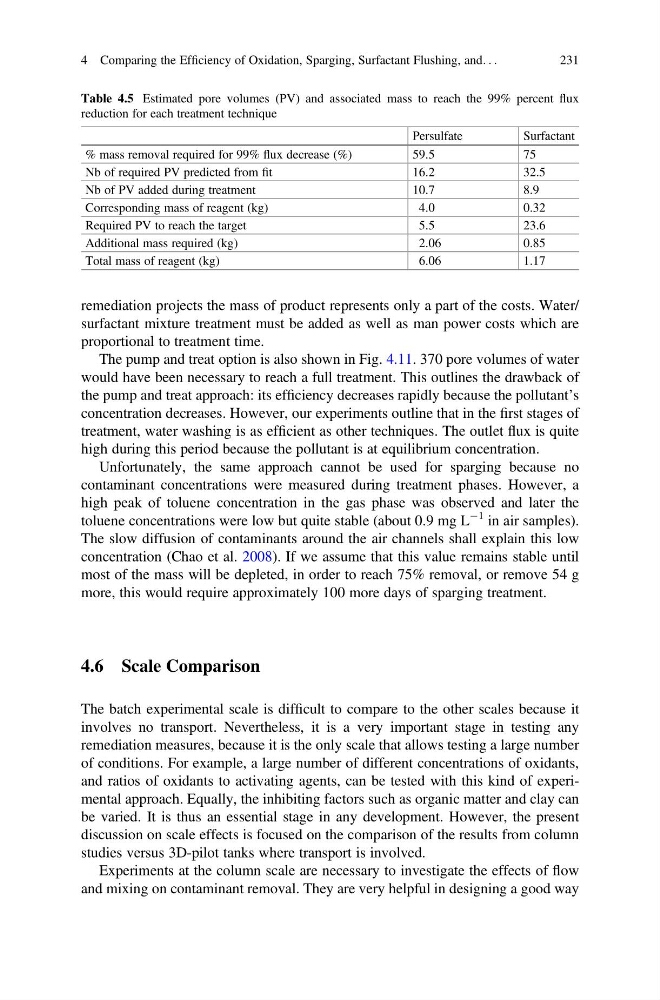
Table 4.5 Estimated pore volumes (PV) and associated mass to reach the 99% percent flux
reduction for each treatment technique
Persulfate
Surfactant
% mass removal required for 99% flux decrease (%)
59.5
75
Nb of required PV predicted from fit
16.2
32.5
Nb of PV added during treatment
10.7
8.9
Corresponding mass of reagent (kg)
4.0
0.32
Required PV to reach the target
5.5
23.6
Additional mass required (kg)
2.06
0.85
Total mass of reagent (kg)
6.06
1.17
4 Comparing the Efficiency of Oxidation, Sparging, Surfactant Flushing, and. . .
231
surfactant mixture treatment must be added as well as man power costs which are
proportional to treatment time.
The pump and treat option is also shown in Fig. 4.11. 370 pore volumes of water
would have been necessary to reach a full treatment. This outlines the drawback of
the pump and treat approach: its efficiency decreases rapidly because the pollutant’s
concentration decreases. However, our experiments outline that in the first stages of
treatment, water washing is as efficient as other techniques. The outlet flux is quite
high during this period because the pollutant is at equilibrium concentration.
Unfortunately, the same approach cannot be used for sparging because no
contaminant concentrations were measured during treatment phases. However, a
high peak of toluene concentration in the gas phase was observed and later the
toluene concentrations were low but quite stable (about 0.9 mg L
À1 in air samples).
The slow diffusion of contaminants around the air channels shall explain this low
concentration (Chao et al. 2008). If we assume that this value remains stable until
most of the mass will be depleted, in order to reach 75% removal, or remove 54 g
more, this would require approximately 100 more days of sparging treatment.
4.6 Scale Comparison
The batch experimental scale is difficult to compare to the other scales because it
involves no transport. Nevertheless, it is a very important stage in testing any
remediation measures, because it is the only scale that allows testing a large number
of conditions. For example, a large number of different concentrations of oxidants,
and ratios of oxidants to activating agents, can be tested with this kind of experimental approach. Equally, the inhibiting factors such as organic matter and clay can
be varied. It is thus an essential stage in any development. However, the present
discussion on scale effects is focused on the comparison of the results from column
studies versus 3D-pilot tanks where transport is involved.
Experiments at the column scale are necessary to investigate the effects of flow
and mixing on contaminant removal. They are very helpful in designing a good way
Table 4.5 Estimated pore volumes (PV) and associated mass to reach the 99% percent flux
reduction for each treatment technique
Persulfate
Surfactant
% mass removal required for 99% flux decrease (%)
59.5
75
Nb of required PV predicted from fit
16.2
32.5
Nb of PV added during treatment
10.7
8.9
Corresponding mass of reagent (kg)
4.0
0.32
Required PV to reach the target
5.5
23.6
Additional mass required (kg)
2.06
0.85
Total mass of reagent (kg)
6.06
1.17
4 Comparing the Efficiency of Oxidation, Sparging, Surfactant Flushing, and. . .
231