

technique, while ISCO shows the highest risk and sparging and surfactant are
intermediate showing reasonable risk levels.
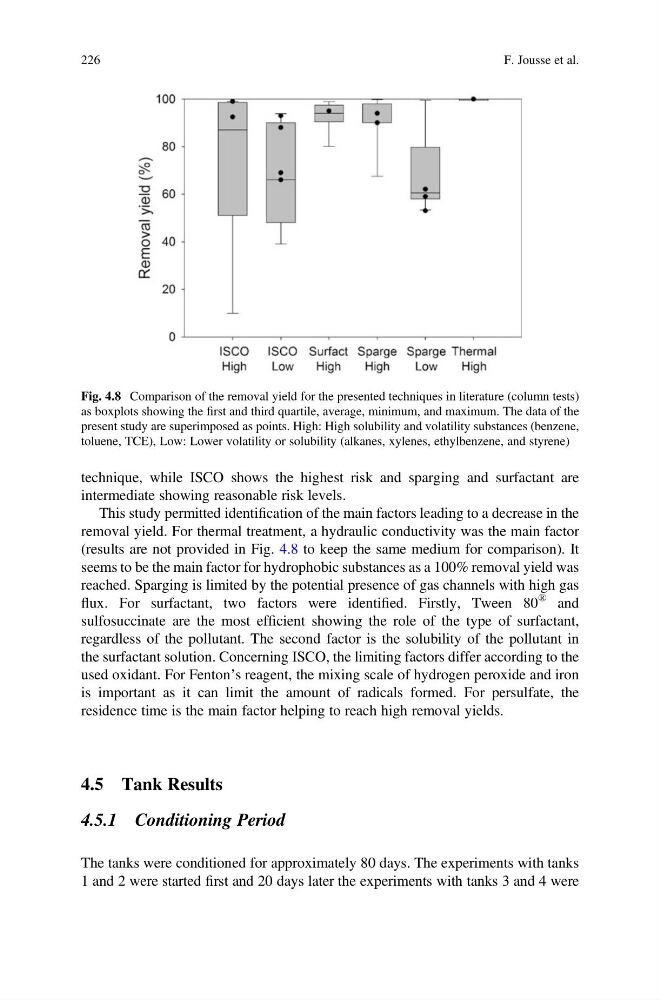
This study permitted identification of the main factors leading to a decrease in the
removal yield. For thermal treatment, a hydraulic conductivity was the main factor
(results are not provided in Fig. 4.8 to keep the same medium for comparison). It
seems to be the main factor for hydrophobic substances as a 100% removal yield was
reached. Sparging is limited by the potential presence of gas channels with high gas
flux. For surfactant, two factors were identified. Firstly, Tween 80
® and
sulfosuccinate are the most efficient showing the role of the type of surfactant,
regardless of the pollutant. The second factor is the solubility of the pollutant in
the surfactant solution. Concerning ISCO, the limiting factors differ according to the
used oxidant. For Fenton’s reagent, the mixing scale of hydrogen peroxide and iron
is important as it can limit the amount of radicals formed. For persulfate, the
residence time is the main factor helping to reach high removal yields.
4.5 Tank Results
4.5.1 Conditioning Period
The tanks were conditioned for approximately 80 days. The experiments with tanks
1 and 2 were started first and 20 days later the experiments with tanks 3 and 4 were
Fig. 4.8 Comparison of the removal yield for the presented techniques in literature (column tests)
as boxplots showing the first and third quartile, average, minimum, and maximum. The data of the
present study are superimposed as points. High: High solubility and volatility substances (benzene,
toluene, TCE), Low: Lower volatility or solubility (alkanes, xylenes, ethylbenzene, and styrene)
226
F. Jousse et al.
intermediate showing reasonable risk levels.
This study permitted identification of the main factors leading to a decrease in the
removal yield. For thermal treatment, a hydraulic conductivity was the main factor
(results are not provided in Fig. 4.8 to keep the same medium for comparison). It
seems to be the main factor for hydrophobic substances as a 100% removal yield was
reached. Sparging is limited by the potential presence of gas channels with high gas
flux. For surfactant, two factors were identified. Firstly, Tween 80
® and
sulfosuccinate are the most efficient showing the role of the type of surfactant,
regardless of the pollutant. The second factor is the solubility of the pollutant in
the surfactant solution. Concerning ISCO, the limiting factors differ according to the
used oxidant. For Fenton’s reagent, the mixing scale of hydrogen peroxide and iron
is important as it can limit the amount of radicals formed. For persulfate, the
residence time is the main factor helping to reach high removal yields.
4.5 Tank Results
4.5.1 Conditioning Period
The tanks were conditioned for approximately 80 days. The experiments with tanks
1 and 2 were started first and 20 days later the experiments with tanks 3 and 4 were
Fig. 4.8 Comparison of the removal yield for the presented techniques in literature (column tests)
as boxplots showing the first and third quartile, average, minimum, and maximum. The data of the
present study are superimposed as points. High: High solubility and volatility substances (benzene,
toluene, TCE), Low: Lower volatility or solubility (alkanes, xylenes, ethylbenzene, and styrene)
226
F. Jousse et al.