

4.4.2 Comparison of the Removal Yields Reached Under
Different Treatment Approaches
The efficiency of the remediation techniques at the column scale is presented in
Fig. 4.8, from this study and literature data, separating two groups of contaminants
depending on their solubility and volatility properties. The results from the
conducted column experiments are in agreement with the literature data for all
techniques. Group a includes the most soluble and volatile substances (benzene,
toluene, TCE), while group b includes substances with lower solubility and volatility
(xylenes, ethylbenzene, alkanes). As field rates are generally much lower than
column ones due to medium heterogeneity, only the techniques reaching high
removal yields in the column may provide efficient results in the field.
This comparison evidences that the highest removal yields are obtained for the
highly soluble and volatile substances present whatever the techniques used. Some
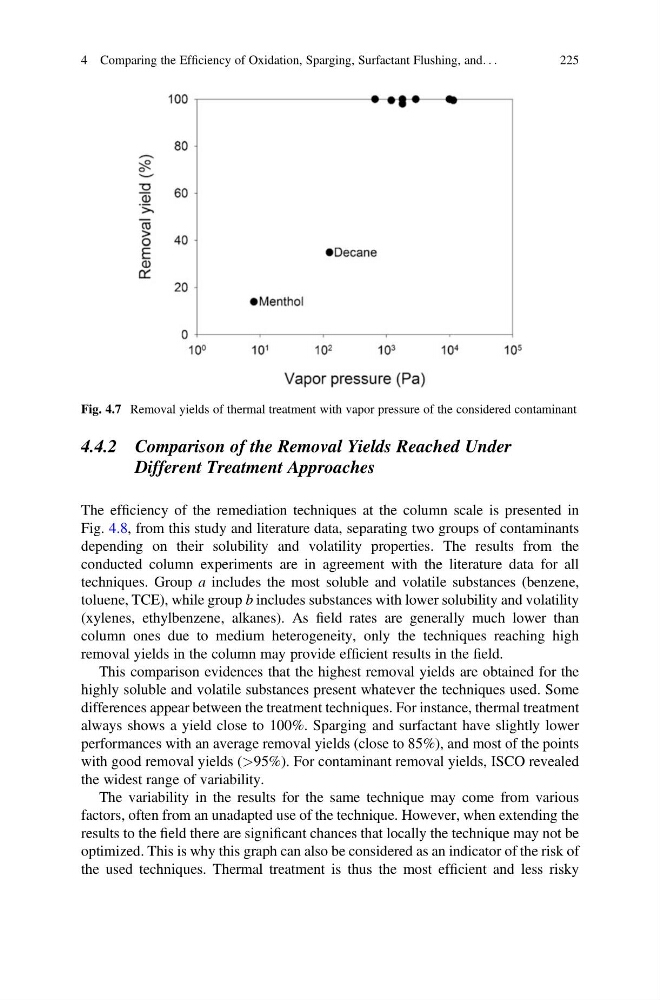
differences appear between the treatment techniques. For instance, thermal treatment
always shows a yield close to 100%. Sparging and surfactant have slightly lower
performances with an average removal yields (close to 85%), and most of the points
with good removal yields (>95%). For contaminant removal yields, ISCO revealed
the widest range of variability.
The variability in the results for the same technique may come from various
factors, often from an unadapted use of the technique. However, when extending the
results to the field there are significant chances that locally the technique may not be
optimized. This is why this graph can also be considered as an indicator of the risk of
the used techniques. Thermal treatment is thus the most efficient and less risky
Fig. 4.7 Removal yields of thermal treatment with vapor pressure of the considered contaminant
4 Comparing the Efficiency of Oxidation, Sparging, Surfactant Flushing, and. . .
225
Different Treatment Approaches
The efficiency of the remediation techniques at the column scale is presented in
Fig. 4.8, from this study and literature data, separating two groups of contaminants
depending on their solubility and volatility properties. The results from the
conducted column experiments are in agreement with the literature data for all
techniques. Group a includes the most soluble and volatile substances (benzene,
toluene, TCE), while group b includes substances with lower solubility and volatility
(xylenes, ethylbenzene, alkanes). As field rates are generally much lower than
column ones due to medium heterogeneity, only the techniques reaching high
removal yields in the column may provide efficient results in the field.
This comparison evidences that the highest removal yields are obtained for the
highly soluble and volatile substances present whatever the techniques used. Some
differences appear between the treatment techniques. For instance, thermal treatment
always shows a yield close to 100%. Sparging and surfactant have slightly lower
performances with an average removal yields (close to 85%), and most of the points
with good removal yields (>95%). For contaminant removal yields, ISCO revealed
the widest range of variability.
The variability in the results for the same technique may come from various
factors, often from an unadapted use of the technique. However, when extending the
results to the field there are significant chances that locally the technique may not be
optimized. This is why this graph can also be considered as an indicator of the risk of
the used techniques. Thermal treatment is thus the most efficient and less risky
Fig. 4.7 Removal yields of thermal treatment with vapor pressure of the considered contaminant
4 Comparing the Efficiency of Oxidation, Sparging, Surfactant Flushing, and. . .
225