

Braida and Ong (2000) using an analytical model representing the media by
tubes, and other authors showed in 2D pilot-scale experiments that the major
limitation of the air sparging technique is the inter-distance of the gas channels in
the medium. This is why Reddy and Adams (2001) suggested that coarse sand may
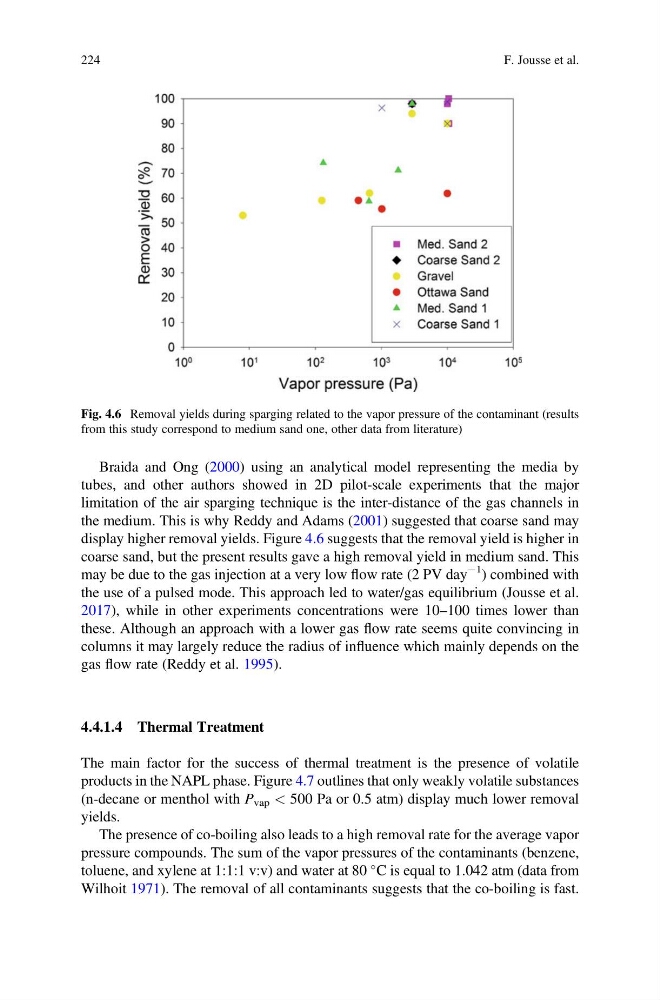
display higher removal yields. Figure 4.6 suggests that the removal yield is higher in
coarse sand, but the present results gave a high removal yield in medium sand. This
may be due to the gas injection at a very low flow rate (2 PV day
À1 ) combined with
the use of a pulsed mode. This approach led to water/gas equilibrium (Jousse et al.
2017), while in other experiments concentrations were 10–100 times lower than
these. Although an approach with a lower gas flow rate seems quite convincing in
columns it may largely reduce the radius of influence which mainly depends on the
gas flow rate (Reddy et al. 1995).
4.4.1.4 Thermal Treatment
The main factor for the success of thermal treatment is the presence of volatile
products in the NAPL phase. Figure 4.7 outlines that only weakly volatile substances
(n-decane or menthol with P vap < 500 Pa or 0.5 atm) display much lower removal
yields.
The presence of co-boiling also leads to a high removal rate for the average vapor
pressure compounds. The sum of the vapor pressures of the contaminants (benzene,
toluene, and xylene at 1:1:1 v:v) and water at 80
C is equal to 1.042 atm (data from
Wilhoit 1971). The removal of all contaminants suggests that the co-boiling is fast.
Fig. 4.6 Removal yields during sparging related to the vapor pressure of the contaminant (results
from this study correspond to medium sand one, other data from literature)
224
F. Jousse et al.
tubes, and other authors showed in 2D pilot-scale experiments that the major
limitation of the air sparging technique is the inter-distance of the gas channels in
the medium. This is why Reddy and Adams (2001) suggested that coarse sand may
display higher removal yields. Figure 4.6 suggests that the removal yield is higher in
coarse sand, but the present results gave a high removal yield in medium sand. This
may be due to the gas injection at a very low flow rate (2 PV day
À1 ) combined with
the use of a pulsed mode. This approach led to water/gas equilibrium (Jousse et al.
2017), while in other experiments concentrations were 10–100 times lower than
these. Although an approach with a lower gas flow rate seems quite convincing in
columns it may largely reduce the radius of influence which mainly depends on the
gas flow rate (Reddy et al. 1995).
4.4.1.4 Thermal Treatment
The main factor for the success of thermal treatment is the presence of volatile
products in the NAPL phase. Figure 4.7 outlines that only weakly volatile substances
(n-decane or menthol with P vap < 500 Pa or 0.5 atm) display much lower removal
yields.
The presence of co-boiling also leads to a high removal rate for the average vapor
pressure compounds. The sum of the vapor pressures of the contaminants (benzene,
toluene, and xylene at 1:1:1 v:v) and water at 80
C is equal to 1.042 atm (data from
Wilhoit 1971). The removal of all contaminants suggests that the co-boiling is fast.
Fig. 4.6 Removal yields during sparging related to the vapor pressure of the contaminant (results
from this study correspond to medium sand one, other data from literature)
224
F. Jousse et al.