

2017). The requirement for short pulses of each substance prevented its use at a
larger scale.
4.4.1.2 Surfactant
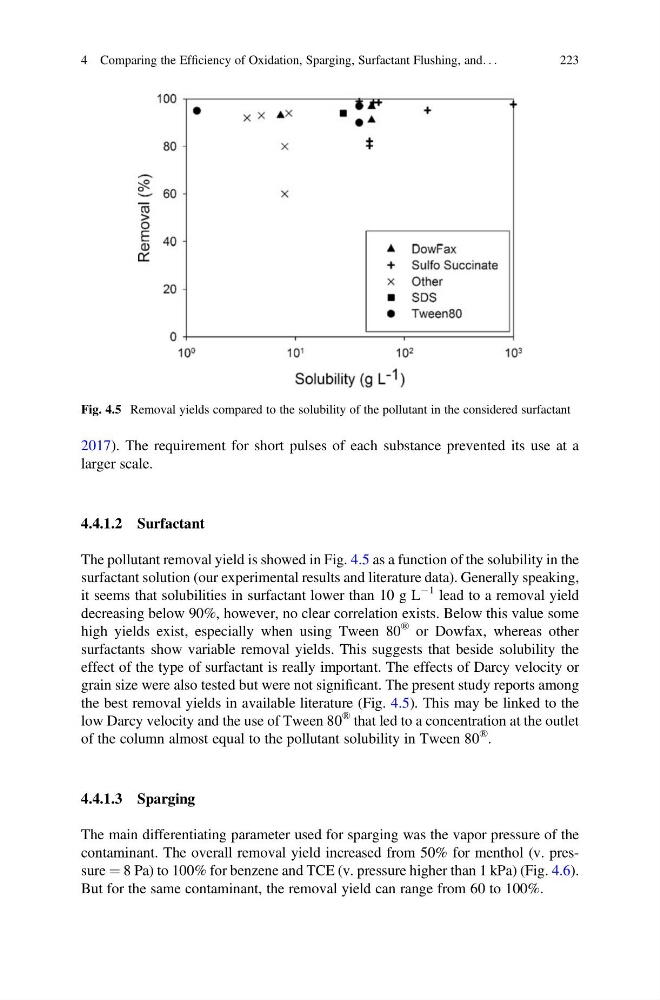
The pollutant removal yield is showed in Fig. 4.5 as a function of the solubility in the
surfactant solution (our experimental results and literature data). Generally speaking,
it seems that solubilities in surfactant lower than 10 g L
À1 lead to a removal yield
decreasing below 90%, however, no clear correlation exists. Below this value some
high yields exist, especially when using Tween 80
® or Dowfax, whereas other
surfactants show variable removal yields. This suggests that beside solubility the
effect of the type of surfactant is really important. The effects of Darcy velocity or
grain size were also tested but were not significant. The present study reports among
the best removal yields in available literature (Fig. 4.5). This may be linked to the
low Darcy velocity and the use of Tween 80
® that led to a concentration at the outlet
of the column almost equal to the pollutant solubility in Tween 80
® .
4.4.1.3 Sparging
The main differentiating parameter used for sparging was the vapor pressure of the
contaminant. The overall removal yield increased from 50% for menthol (v. pressure ¼ 8 Pa) to 100% for benzene and TCE (v. pressure higher than 1 kPa) (Fig. 4.6).
But for the same contaminant, the removal yield can range from 60 to 100%.
Fig. 4.5 Removal yields compared to the solubility of the pollutant in the considered surfactant
4 Comparing the Efficiency of Oxidation, Sparging, Surfactant Flushing, and. . .
223
larger scale.
4.4.1.2 Surfactant
The pollutant removal yield is showed in Fig. 4.5 as a function of the solubility in the
surfactant solution (our experimental results and literature data). Generally speaking,
it seems that solubilities in surfactant lower than 10 g L
À1 lead to a removal yield
decreasing below 90%, however, no clear correlation exists. Below this value some
high yields exist, especially when using Tween 80
® or Dowfax, whereas other
surfactants show variable removal yields. This suggests that beside solubility the
effect of the type of surfactant is really important. The effects of Darcy velocity or
grain size were also tested but were not significant. The present study reports among
the best removal yields in available literature (Fig. 4.5). This may be linked to the
low Darcy velocity and the use of Tween 80
® that led to a concentration at the outlet
of the column almost equal to the pollutant solubility in Tween 80
® .
4.4.1.3 Sparging
The main differentiating parameter used for sparging was the vapor pressure of the
contaminant. The overall removal yield increased from 50% for menthol (v. pressure ¼ 8 Pa) to 100% for benzene and TCE (v. pressure higher than 1 kPa) (Fig. 4.6).
But for the same contaminant, the removal yield can range from 60 to 100%.
Fig. 4.5 Removal yields compared to the solubility of the pollutant in the considered surfactant
4 Comparing the Efficiency of Oxidation, Sparging, Surfactant Flushing, and. . .
223