

4.4 Column Results
4.4.1 Major Influencing Parameters
In order to assess the role of the main influencing parameters on the column results,
both results from this study and from literature are used in the graphs, more details
can be found in Jousse et al. (2017).
4.4.1.1 Oxidation
The first factor influencing the oxidation results was the aqueous solubility of the
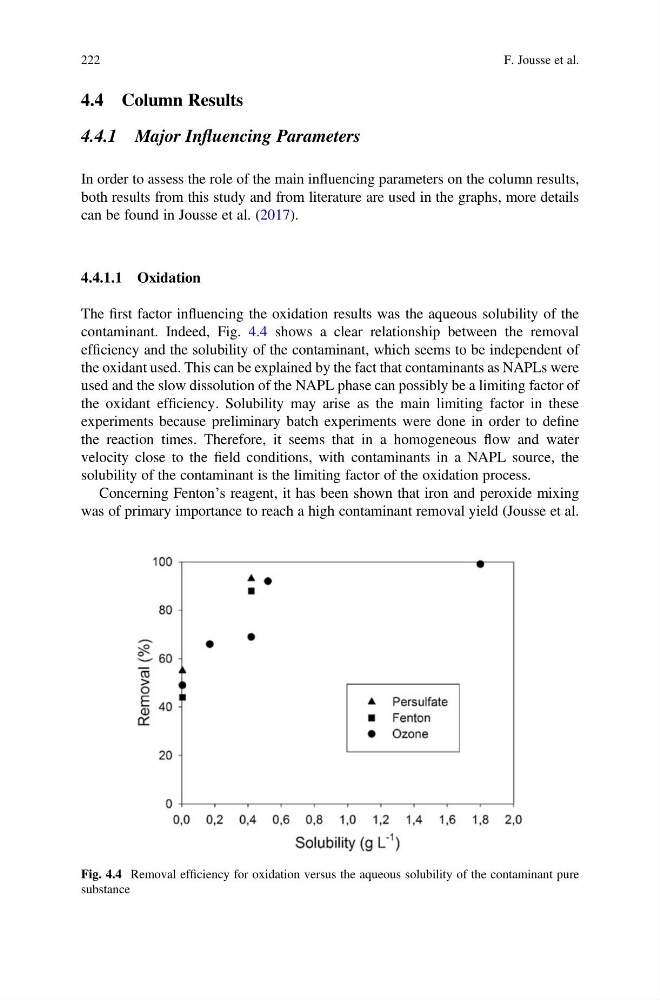
contaminant. Indeed, Fig. 4.4 shows a clear relationship between the removal
efficiency and the solubility of the contaminant, which seems to be independent of
the oxidant used. This can be explained by the fact that contaminants as NAPLs were
used and the slow dissolution of the NAPL phase can possibly be a limiting factor of
the oxidant efficiency. Solubility may arise as the main limiting factor in these
experiments because preliminary batch experiments were done in order to define
the reaction times. Therefore, it seems that in a homogeneous flow and water
velocity close to the field conditions, with contaminants in a NAPL source, the
solubility of the contaminant is the limiting factor of the oxidation process.
Concerning Fenton’s reagent, it has been shown that iron and peroxide mixing
was of primary importance to reach a high contaminant removal yield (Jousse et al.
Fig. 4.4 Removal efficiency for oxidation versus the aqueous solubility of the contaminant pure
substance
222
F. Jousse et al.
4.4.1 Major Influencing Parameters
In order to assess the role of the main influencing parameters on the column results,
both results from this study and from literature are used in the graphs, more details
can be found in Jousse et al. (2017).
4.4.1.1 Oxidation
The first factor influencing the oxidation results was the aqueous solubility of the
contaminant. Indeed, Fig. 4.4 shows a clear relationship between the removal
efficiency and the solubility of the contaminant, which seems to be independent of
the oxidant used. This can be explained by the fact that contaminants as NAPLs were
used and the slow dissolution of the NAPL phase can possibly be a limiting factor of
the oxidant efficiency. Solubility may arise as the main limiting factor in these
experiments because preliminary batch experiments were done in order to define
the reaction times. Therefore, it seems that in a homogeneous flow and water
velocity close to the field conditions, with contaminants in a NAPL source, the
solubility of the contaminant is the limiting factor of the oxidation process.
Concerning Fenton’s reagent, it has been shown that iron and peroxide mixing
was of primary importance to reach a high contaminant removal yield (Jousse et al.
Fig. 4.4 Removal efficiency for oxidation versus the aqueous solubility of the contaminant pure
substance
222
F. Jousse et al.