

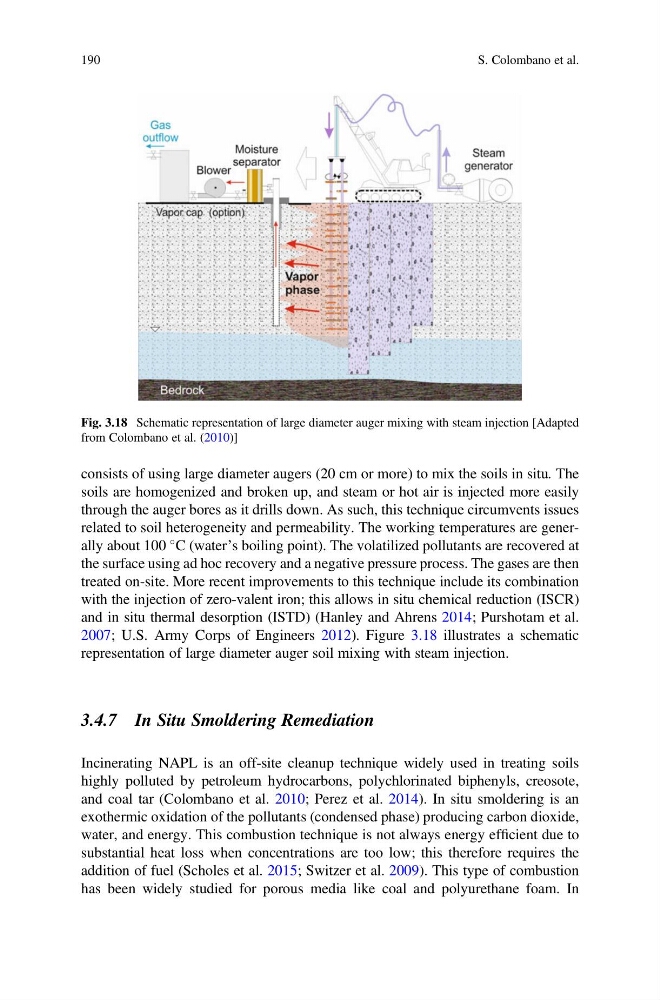
consists of using large diameter augers (20 cm or more) to mix the soils in situ. The
soils are homogenized and broken up, and steam or hot air is injected more easily
through the auger bores as it drills down. As such, this technique circumvents issues
related to soil heterogeneity and permeability. The working temperatures are generally about 100
C (water’s boiling point). The volatilized pollutants are recovered at
the surface using ad hoc recovery and a negative pressure process. The gases are then
treated on-site. More recent improvements to this technique include its combination
with the injection of zero-valent iron; this allows in situ chemical reduction (ISCR)
and in situ thermal desorption (ISTD) (Hanley and Ahrens 2014; Purshotam et al.
2007; U.S. Army Corps of Engineers 2012). Figure 3.18 illustrates a schematic
representation of large diameter auger soil mixing with steam injection.
3.4.7 In Situ Smoldering Remediation
Incinerating NAPL is an off-site cleanup technique widely used in treating soils
highly polluted by petroleum hydrocarbons, polychlorinated biphenyls, creosote,
and coal tar (Colombano et al. 2010; Perez et al. 2014). In situ smoldering is an
exothermic oxidation of the pollutants (condensed phase) producing carbon dioxide,
water, and energy. This combustion technique is not always energy efficient due to
substantial heat loss when concentrations are too low; this therefore requires the
addition of fuel (Scholes et al. 2015; Switzer et al. 2009). This type of combustion
has been widely studied for porous media like coal and polyurethane foam. In
Fig. 3.18 Schematic representation of large diameter auger mixing with steam injection [Adapted
from Colombano et al. (2010)]
190
S. Colombano et al.
soils are homogenized and broken up, and steam or hot air is injected more easily
through the auger bores as it drills down. As such, this technique circumvents issues
related to soil heterogeneity and permeability. The working temperatures are generally about 100
C (water’s boiling point). The volatilized pollutants are recovered at
the surface using ad hoc recovery and a negative pressure process. The gases are then
treated on-site. More recent improvements to this technique include its combination
with the injection of zero-valent iron; this allows in situ chemical reduction (ISCR)
and in situ thermal desorption (ISTD) (Hanley and Ahrens 2014; Purshotam et al.
2007; U.S. Army Corps of Engineers 2012). Figure 3.18 illustrates a schematic
representation of large diameter auger soil mixing with steam injection.
3.4.7 In Situ Smoldering Remediation
Incinerating NAPL is an off-site cleanup technique widely used in treating soils
highly polluted by petroleum hydrocarbons, polychlorinated biphenyls, creosote,
and coal tar (Colombano et al. 2010; Perez et al. 2014). In situ smoldering is an
exothermic oxidation of the pollutants (condensed phase) producing carbon dioxide,
water, and energy. This combustion technique is not always energy efficient due to
substantial heat loss when concentrations are too low; this therefore requires the
addition of fuel (Scholes et al. 2015; Switzer et al. 2009). This type of combustion
has been widely studied for porous media like coal and polyurethane foam. In
Fig. 3.18 Schematic representation of large diameter auger mixing with steam injection [Adapted
from Colombano et al. (2010)]
190
S. Colombano et al.