

are made using pierced vertical tubes; horizontal or oblique tubes may be used for a
more targeted injection of the steam.
In the unsaturated zone, once the desired temperature is reached, SEE is applied
in successive cycles until the desired number of pore volumes is reached. By
contrast, in groundwater, the injection is continuous.
The advantages of SEE are (Davis 1998; Johnson et al. 2009; U.S. Army Corps of
Engineers 2014):
• Temperatures reach a maximum of 170
C which is sufficient for most volatile
compounds and some of the semi-volatile compounds.
• The technique is best suited for permeable to semi-permeable soils.
• Allows for high gradients to be applied which reduces treatment time.
However, one of the limiting factors to the technique is that heat is transferred by
convection. The process is therefore highly dependent on site geology. Moreover,
the temperature reached does not allow all semi-volatile pollutants to be treated
(Johnson et al. 2009).
3.4.3 Radio Frequency Heating
Radio frequency heating (RFH) consists in injecting electromagnetic waves at
microwave frequency range (300 MHz–300 GHz, i.e., 100–0.1 cm of wavelength,
respectively) into the saturated and/or unsaturated zone. These energy ranges correspond to rotational excitation of polar molecules, at their moment of inertia. This
electromagnetic energy is then transformed into heat in the soil, leading to in situ
thermal pollutant desorption (Acierno et al. 2004; Appleton et al. 2005; Chien 2012;
Falciglia et al. 2013; Roudier 2004).
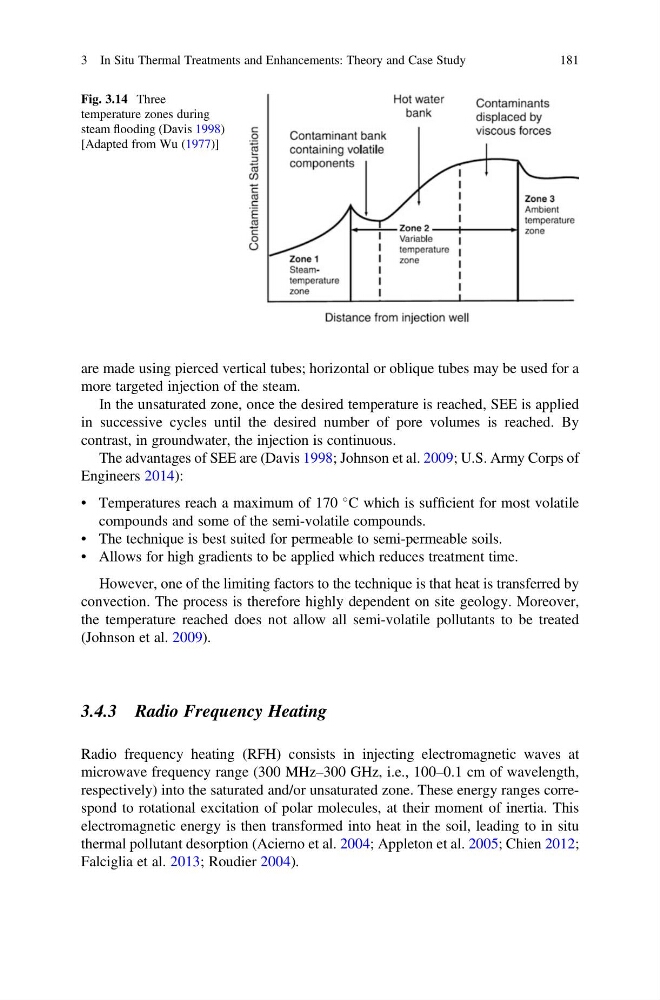
Fig. 3.14 Three
temperature zones during
steam flooding (Davis 1998)
[Adapted from Wu (1977)]
3 In Situ Thermal Treatments and Enhancements: Theory and Case Study
181
more targeted injection of the steam.
In the unsaturated zone, once the desired temperature is reached, SEE is applied
in successive cycles until the desired number of pore volumes is reached. By
contrast, in groundwater, the injection is continuous.
The advantages of SEE are (Davis 1998; Johnson et al. 2009; U.S. Army Corps of
Engineers 2014):
• Temperatures reach a maximum of 170
C which is sufficient for most volatile
compounds and some of the semi-volatile compounds.
• The technique is best suited for permeable to semi-permeable soils.
• Allows for high gradients to be applied which reduces treatment time.
However, one of the limiting factors to the technique is that heat is transferred by
convection. The process is therefore highly dependent on site geology. Moreover,
the temperature reached does not allow all semi-volatile pollutants to be treated
(Johnson et al. 2009).
3.4.3 Radio Frequency Heating
Radio frequency heating (RFH) consists in injecting electromagnetic waves at
microwave frequency range (300 MHz–300 GHz, i.e., 100–0.1 cm of wavelength,
respectively) into the saturated and/or unsaturated zone. These energy ranges correspond to rotational excitation of polar molecules, at their moment of inertia. This
electromagnetic energy is then transformed into heat in the soil, leading to in situ
thermal pollutant desorption (Acierno et al. 2004; Appleton et al. 2005; Chien 2012;
Falciglia et al. 2013; Roudier 2004).
Fig. 3.14 Three
temperature zones during
steam flooding (Davis 1998)
[Adapted from Wu (1977)]
3 In Situ Thermal Treatments and Enhancements: Theory and Case Study
181