

The first applications for soil treatment took place in the 1970s for the recovery of
bitumen from tar sand deposits (two techniques were implemented at the same time:
electrical heating and radio frequency radiation) (Chute and Vermeulen 1988; Sresty
et al. 1986). In situ application of RFH is still at the Research and Development
stage; only a few pilot treatments have been performed with promising results (Chien
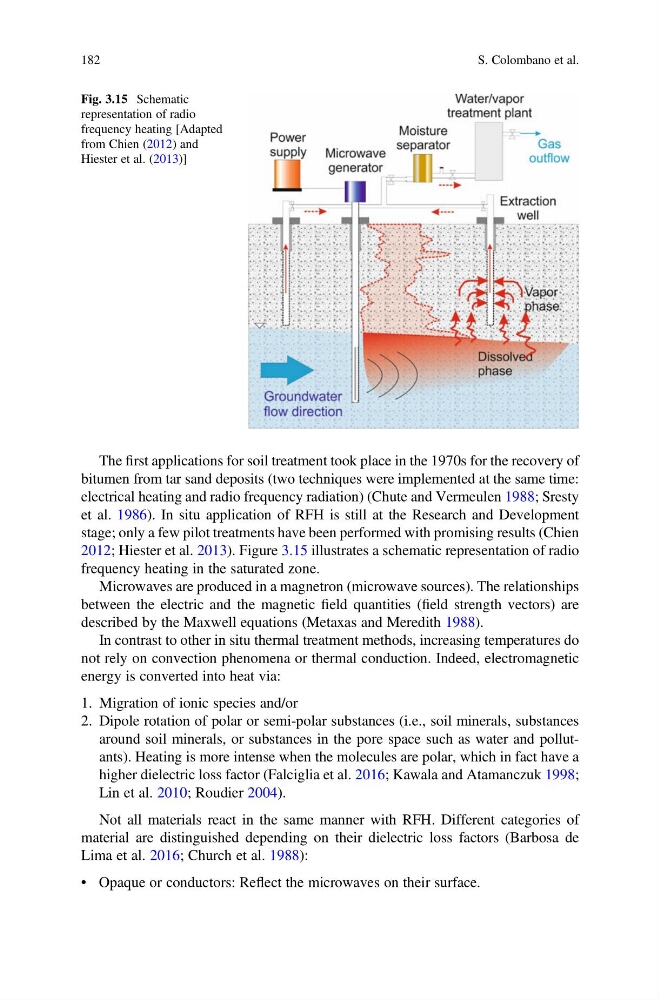
2012; Hiester et al. 2013). Figure 3.15 illustrates a schematic representation of radio
frequency heating in the saturated zone.
Microwaves are produced in a magnetron (microwave sources). The relationships
between the electric and the magnetic field quantities (field strength vectors) are
described by the Maxwell equations (Metaxas and Meredith 1988).
In contrast to other in situ thermal treatment methods, increasing temperatures do
not rely on convection phenomena or thermal conduction. Indeed, electromagnetic
energy is converted into heat via:
1. Migration of ionic species and/or
2. Dipole rotation of polar or semi-polar substances (i.e., soil minerals, substances
around soil minerals, or substances in the pore space such as water and pollutants). Heating is more intense when the molecules are polar, which in fact have a
higher dielectric loss factor (Falciglia et al. 2016; Kawala and Atamanczuk 1998;
Lin et al. 2010; Roudier 2004).
Not all materials react in the same manner with RFH. Different categories of
material are distinguished depending on their dielectric loss factors (Barbosa de
Lima et al. 2016; Church et al. 1988):
• Opaque or conductors: Reflect the microwaves on their surface.
Fig. 3.15 Schematic
representation of radio
frequency heating [Adapted
from Chien (2012) and
Hiester et al. (2013)]
182
S. Colombano et al.
bitumen from tar sand deposits (two techniques were implemented at the same time:
electrical heating and radio frequency radiation) (Chute and Vermeulen 1988; Sresty
et al. 1986). In situ application of RFH is still at the Research and Development
stage; only a few pilot treatments have been performed with promising results (Chien
2012; Hiester et al. 2013). Figure 3.15 illustrates a schematic representation of radio
frequency heating in the saturated zone.
Microwaves are produced in a magnetron (microwave sources). The relationships
between the electric and the magnetic field quantities (field strength vectors) are
described by the Maxwell equations (Metaxas and Meredith 1988).
In contrast to other in situ thermal treatment methods, increasing temperatures do
not rely on convection phenomena or thermal conduction. Indeed, electromagnetic
energy is converted into heat via:
1. Migration of ionic species and/or
2. Dipole rotation of polar or semi-polar substances (i.e., soil minerals, substances
around soil minerals, or substances in the pore space such as water and pollutants). Heating is more intense when the molecules are polar, which in fact have a
higher dielectric loss factor (Falciglia et al. 2016; Kawala and Atamanczuk 1998;
Lin et al. 2010; Roudier 2004).
Not all materials react in the same manner with RFH. Different categories of
material are distinguished depending on their dielectric loss factors (Barbosa de
Lima et al. 2016; Church et al. 1988):
• Opaque or conductors: Reflect the microwaves on their surface.
Fig. 3.15 Schematic
representation of radio
frequency heating [Adapted
from Chien (2012) and
Hiester et al. (2013)]
182
S. Colombano et al.