

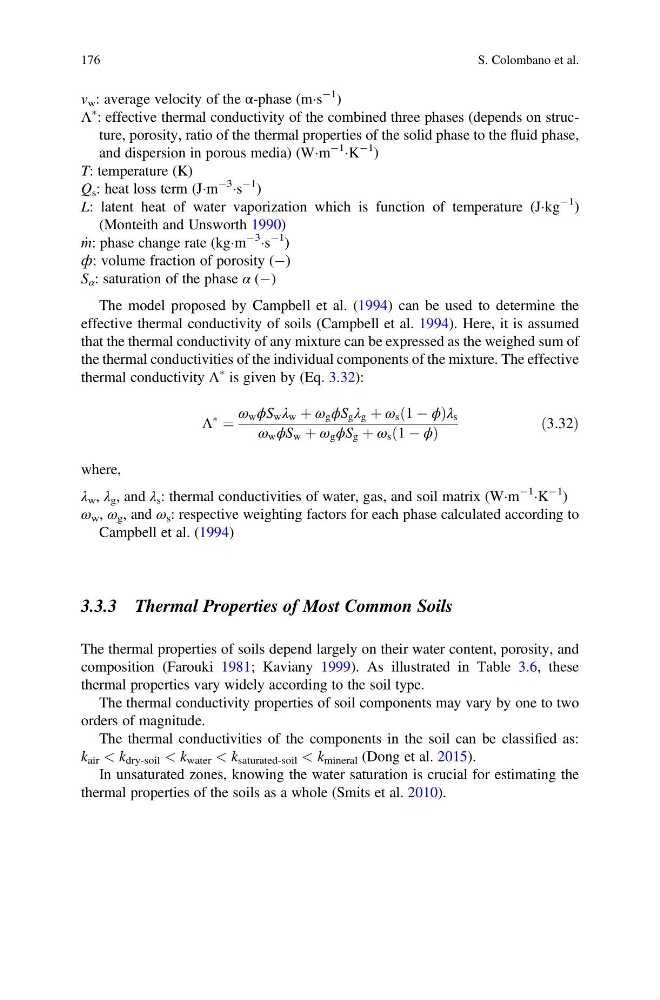
v w : average velocity of the α-phase (mÁs
À1 )
Λ
à : effective thermal conductivity of the combined three phases (depends on structure, porosity, ratio of the thermal properties of the solid phase to the fluid phase,
and dispersion in porous media) (WÁm
À1
ÁK
À1 )
T: temperature (K)
Q s : heat loss term (JÁm
À3
Ás
À1 )
L: latent heat of water vaporization which is function of temperature (JÁkg
À1 )
(Monteith and Unsworth 1990)
_
m: phase change rate (kgÁm
À3
Ás
À1 )
ф: volume fraction of porosity (À)
S α : saturation of the phase α (À)
The model proposed by Campbell et al. (1994) can be used to determine the
effective thermal conductivity of soils (Campbell et al. 1994). Here, it is assumed
that the thermal conductivity of any mixture can be expressed as the weighed sum of
the thermal conductivities of the individual components of the mixture. The effective
thermal conductivity Λ
à is given by (Eq. 3.32):
Λ
Ã
¼
ω w ϕS w λ w þ ω g ϕS g λ g þ ω s 1 À ϕ
ð
Þλ s
ω w ϕS w þ ω g ϕS g þ ω s 1 À ϕ
ð
Þ
ð3:32Þ
where,
λ w , λ g , and λ s : thermal conductivities of water, gas, and soil matrix (WÁm
À1
ÁK
À1 )
ω w , ω g , and ω s : respective weighting factors for each phase calculated according to
Campbell et al. (1994)
3.3.3 Thermal Properties of Most Common Soils
The thermal properties of soils depend largely on their water content, porosity, and
composition (Farouki 1981; Kaviany 1999). As illustrated in Table 3.6, these
thermal properties vary widely according to the soil type.
The thermal conductivity properties of soil components may vary by one to two
orders of magnitude.
The thermal conductivities of the components in the soil can be classified as:
k air < k dry-soil < k water < k saturated-soil < k mineral (Dong et al. 2015).
In unsaturated zones, knowing the water saturation is crucial for estimating the
thermal properties of the soils as a whole (Smits et al. 2010).
176
S. Colombano et al.
À1 )
Λ
à : effective thermal conductivity of the combined three phases (depends on structure, porosity, ratio of the thermal properties of the solid phase to the fluid phase,
and dispersion in porous media) (WÁm
À1
ÁK
À1 )
T: temperature (K)
Q s : heat loss term (JÁm
À3
Ás
À1 )
L: latent heat of water vaporization which is function of temperature (JÁkg
À1 )
(Monteith and Unsworth 1990)
_
m: phase change rate (kgÁm
À3
Ás
À1 )
ф: volume fraction of porosity (À)
S α : saturation of the phase α (À)
The model proposed by Campbell et al. (1994) can be used to determine the
effective thermal conductivity of soils (Campbell et al. 1994). Here, it is assumed
that the thermal conductivity of any mixture can be expressed as the weighed sum of
the thermal conductivities of the individual components of the mixture. The effective
thermal conductivity Λ
à is given by (Eq. 3.32):
Λ
Ã
¼
ω w ϕS w λ w þ ω g ϕS g λ g þ ω s 1 À ϕ
ð
Þλ s
ω w ϕS w þ ω g ϕS g þ ω s 1 À ϕ
ð
Þ
ð3:32Þ
where,
λ w , λ g , and λ s : thermal conductivities of water, gas, and soil matrix (WÁm
À1
ÁK
À1 )
ω w , ω g , and ω s : respective weighting factors for each phase calculated according to
Campbell et al. (1994)
3.3.3 Thermal Properties of Most Common Soils
The thermal properties of soils depend largely on their water content, porosity, and
composition (Farouki 1981; Kaviany 1999). As illustrated in Table 3.6, these
thermal properties vary widely according to the soil type.
The thermal conductivity properties of soil components may vary by one to two
orders of magnitude.
The thermal conductivities of the components in the soil can be classified as:
k air < k dry-soil < k water < k saturated-soil < k mineral (Dong et al. 2015).
In unsaturated zones, knowing the water saturation is crucial for estimating the
thermal properties of the soils as a whole (Smits et al. 2010).
176
S. Colombano et al.