

3.3.1.1 Heat Convection
Heat convection relies on a heat carrying mass (e.g., liquid, vapor, or gas) moving
through a porous medium. There is a distinction between free and forced convection:
in free (or natural) convection, the motion of the fluid is influenced by natural factors
whereas, in forced convection, the motion of fluids is influenced by external factors.
The convection of the heat flux is defined as:
J u ¼ ρC p
À
Á
vT
ð3:22Þ
where,
ρ: fluid density (kgÁm
À3 )
C p : specific heat at constant pressure (JÁkg
À1
ÁK
À1 )
v: Darcy’s fluid velocity (mÁs
À1 )
T: temperature (K)
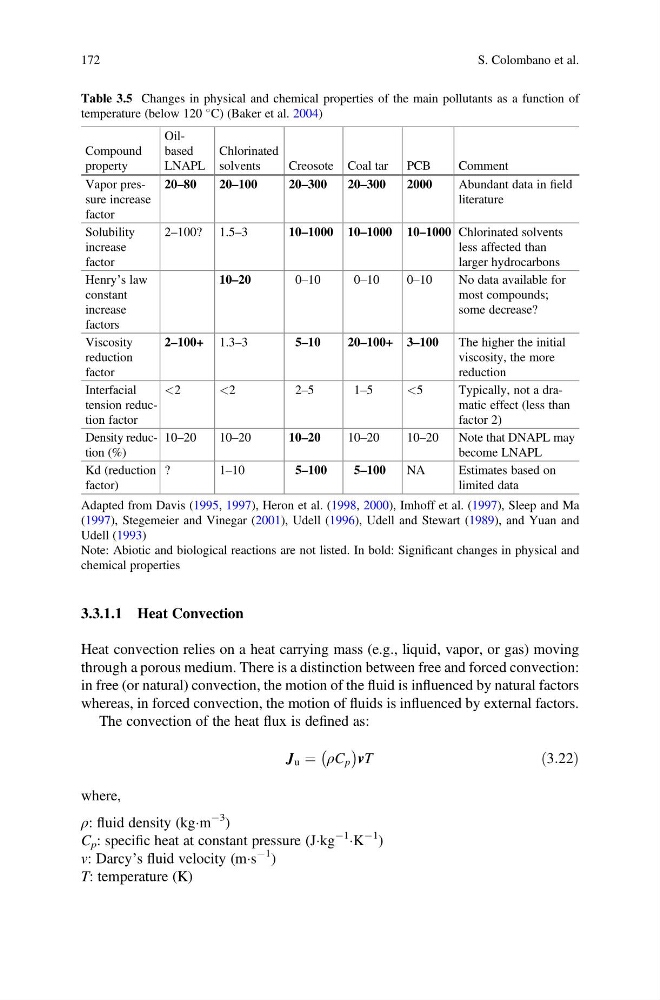
Table 3.5 Changes in physical and chemical properties of the main pollutants as a function of
temperature (below 120
C) (Baker et al. 2004)
Compound
property
Oilbased
LNAPL
Chlorinated
solvents
Creosote Coal tar PCB
Comment
Vapor pressure increase
factor
20–80
20–100
20–300
20–300
2000
Abundant data in field
literature
Solubility
increase
factor
2–100? 1.5–3
10–1000 10–1000 10–1000 Chlorinated solvents
less affected than
larger hydrocarbons
Henry’s law
constant
increase
factors
10–20
0–10
0–10
0–10
No data available for
most compounds;
some decrease?
Viscosity
reduction
factor
2–100+ 1.3–3
5–10
20–100+ 3–100
The higher the initial
viscosity, the more
reduction
Interfacial
tension reduction factor
<2
<2
2 –5
1 –5
<5
Typically, not a dramatic effect (less than
factor 2)
Density reduction (%)
10–20
10–20
10–20
10–20
10–20
Note that DNAPL may
become LNAPL
Kd (reduction
factor)
?
1 –10
5–100
5–100
NA
Estimates based on
limited data
Adapted from Davis (1995, 1997), Heron et al. (1998, 2000), Imhoff et al. (1997), Sleep and Ma
(1997), Stegemeier and Vinegar (2001), Udell (1996), Udell and Stewart (1989), and Yuan and
Udell (1993)
Note: Abiotic and biological reactions are not listed. In bold: Significant changes in physical and
chemical properties
172
S. Colombano et al.
Heat convection relies on a heat carrying mass (e.g., liquid, vapor, or gas) moving
through a porous medium. There is a distinction between free and forced convection:
in free (or natural) convection, the motion of the fluid is influenced by natural factors
whereas, in forced convection, the motion of fluids is influenced by external factors.
The convection of the heat flux is defined as:
J u ¼ ρC p
À
Á
vT
ð3:22Þ
where,
ρ: fluid density (kgÁm
À3 )
C p : specific heat at constant pressure (JÁkg
À1
ÁK
À1 )
v: Darcy’s fluid velocity (mÁs
À1 )
T: temperature (K)
Table 3.5 Changes in physical and chemical properties of the main pollutants as a function of
temperature (below 120
C) (Baker et al. 2004)
Compound
property
Oilbased
LNAPL
Chlorinated
solvents
Creosote Coal tar PCB
Comment
Vapor pressure increase
factor
20–80
20–100
20–300
20–300
2000
Abundant data in field
literature
Solubility
increase
factor
2–100? 1.5–3
10–1000 10–1000 10–1000 Chlorinated solvents
less affected than
larger hydrocarbons
Henry’s law
constant
increase
factors
10–20
0–10
0–10
0–10
No data available for
most compounds;
some decrease?
Viscosity
reduction
factor
2–100+ 1.3–3
5–10
20–100+ 3–100
The higher the initial
viscosity, the more
reduction
Interfacial
tension reduction factor
<2
<2
2 –5
1 –5
<5
Typically, not a dramatic effect (less than
factor 2)
Density reduction (%)
10–20
10–20
10–20
10–20
10–20
Note that DNAPL may
become LNAPL
Kd (reduction
factor)
?
1 –10
5–100
5–100
NA
Estimates based on
limited data
Adapted from Davis (1995, 1997), Heron et al. (1998, 2000), Imhoff et al. (1997), Sleep and Ma
(1997), Stegemeier and Vinegar (2001), Udell (1996), Udell and Stewart (1989), and Yuan and
Udell (1993)
Note: Abiotic and biological reactions are not listed. In bold: Significant changes in physical and
chemical properties
172
S. Colombano et al.