

Free convection is a natural mass transport that occurs through the effect of
thermal gradients. As discussed in Sect. 3.2.3.3, temperature variations influence
fluid density. These densities are generally lower when the temperature increases.
The flows generated by the free convection are proportional to the average soil
particle parameter, fluid velocity, and its volumetric-specific heat (Farouki 1981).
In soils, free convection of air or water is mostly low; therefore, the effects of free
convection are minimal in heat transfers except in the case of high porosity. Free
convection mostly contributes to heat transfer when the particle size D 50 is above
6 mm (Yun 2005).
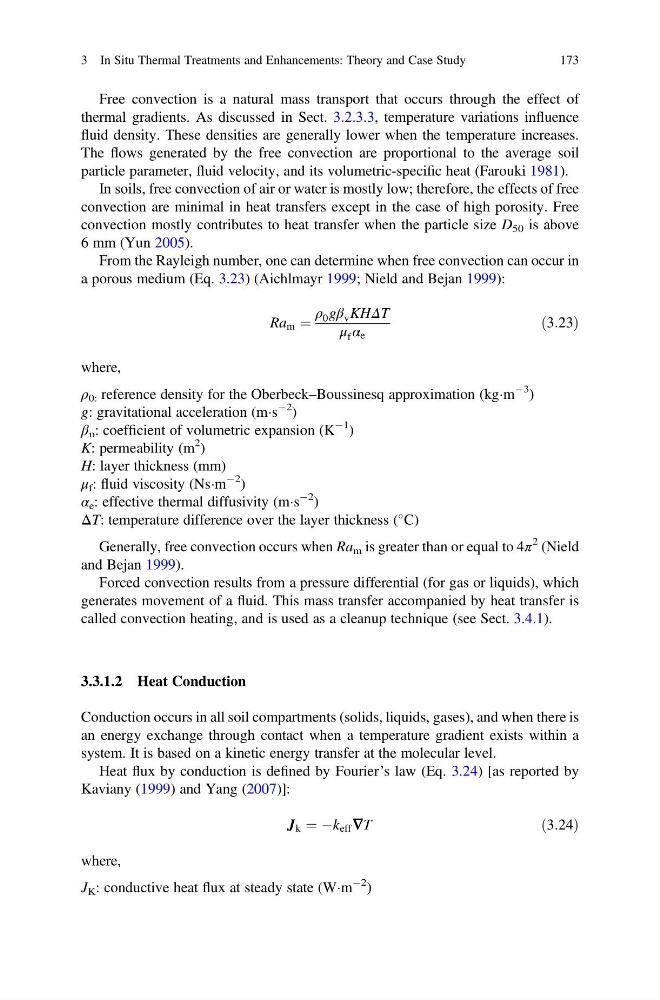
From the Rayleigh number, one can determine when free convection can occur in
a porous medium (Eq. 3.23) (Aichlmayr 1999; Nield and Bejan 1999):
Ra m ¼
ρ 0 gβ v KHΔT
μ f α e
ð3:23Þ
where,
ρ 0: reference density for the Oberbeck–Boussinesq approximation (kgÁm
À3 )
g: gravitational acceleration (mÁs
À2 )
β υ : coefficient of volumetric expansion (K
À1 )
K: permeability (m
2 )
H: layer thickness (mm)
μ f : fluid viscosity (NsÁm
À2 )
α e : effective thermal diffusivity (mÁs
À2 )
ΔT: temperature difference over the layer thickness (
C)
Generally, free convection occurs when Ra m is greater than or equal to 4π
2 (Nield
and Bejan 1999).
Forced convection results from a pressure differential (for gas or liquids), which
generates movement of a fluid. This mass transfer accompanied by heat transfer is
called convection heating, and is used as a cleanup technique (see Sect. 3.4.1).
3.3.1.2 Heat Conduction
Conduction occurs in all soil compartments (solids, liquids, gases), and when there is
an energy exchange through contact when a temperature gradient exists within a
system. It is based on a kinetic energy transfer at the molecular level.
Heat flux by conduction is defined by Fourier’s law (Eq. 3.24) [as reported by
Kaviany (1999) and Yang (2007)]:
J k ¼ Àk eff —T
ð3:24Þ
where,
J K : conductive heat flux at steady state (WÁm
À2 )
3 In Situ Thermal Treatments and Enhancements: Theory and Case Study
173
thermal gradients. As discussed in Sect. 3.2.3.3, temperature variations influence
fluid density. These densities are generally lower when the temperature increases.
The flows generated by the free convection are proportional to the average soil
particle parameter, fluid velocity, and its volumetric-specific heat (Farouki 1981).
In soils, free convection of air or water is mostly low; therefore, the effects of free
convection are minimal in heat transfers except in the case of high porosity. Free
convection mostly contributes to heat transfer when the particle size D 50 is above
6 mm (Yun 2005).
From the Rayleigh number, one can determine when free convection can occur in
a porous medium (Eq. 3.23) (Aichlmayr 1999; Nield and Bejan 1999):
Ra m ¼
ρ 0 gβ v KHΔT
μ f α e
ð3:23Þ
where,
ρ 0: reference density for the Oberbeck–Boussinesq approximation (kgÁm
À3 )
g: gravitational acceleration (mÁs
À2 )
β υ : coefficient of volumetric expansion (K
À1 )
K: permeability (m
2 )
H: layer thickness (mm)
μ f : fluid viscosity (NsÁm
À2 )
α e : effective thermal diffusivity (mÁs
À2 )
ΔT: temperature difference over the layer thickness (
C)
Generally, free convection occurs when Ra m is greater than or equal to 4π
2 (Nield
and Bejan 1999).
Forced convection results from a pressure differential (for gas or liquids), which
generates movement of a fluid. This mass transfer accompanied by heat transfer is
called convection heating, and is used as a cleanup technique (see Sect. 3.4.1).
3.3.1.2 Heat Conduction
Conduction occurs in all soil compartments (solids, liquids, gases), and when there is
an energy exchange through contact when a temperature gradient exists within a
system. It is based on a kinetic energy transfer at the molecular level.
Heat flux by conduction is defined by Fourier’s law (Eq. 3.24) [as reported by
Kaviany (1999) and Yang (2007)]:
J k ¼ Àk eff —T
ð3:24Þ
where,
J K : conductive heat flux at steady state (WÁm
À2 )
3 In Situ Thermal Treatments and Enhancements: Theory and Case Study
173