

P nw : pressure of the non-wetting fluid (Pa)
P w : pressure of the wetting fluid (Pa)
r: radius of the capillary tube (m)
θ: contact angle between fluids and solid surface (
)
σ: interfacial tension (mNÁm
À1 )
Many studies have shown that the volume of trapped non-wetting phase
decreases with increasing temperatures, as do interfacial tension and contact angle
temperature-dependent variables (Adamson and Gast 1997; Grant and Salehzadeh
1996; Hopmans and Dane 1986; Poston et al. 1970; Sinnokrot et al. 1971). Hopmans
and Dane (1986) found that entrapped air volume decreases with increasing temperatures (Hopmans and Dane 1986).
The impact of temperature variations on capillary pressure–saturation relationships was widely studied from both the experimental and the theoretical point of
view (Davis 1994; Grant 2003; Grant and Salehzadeh 1996; O’Carroll and Sleep
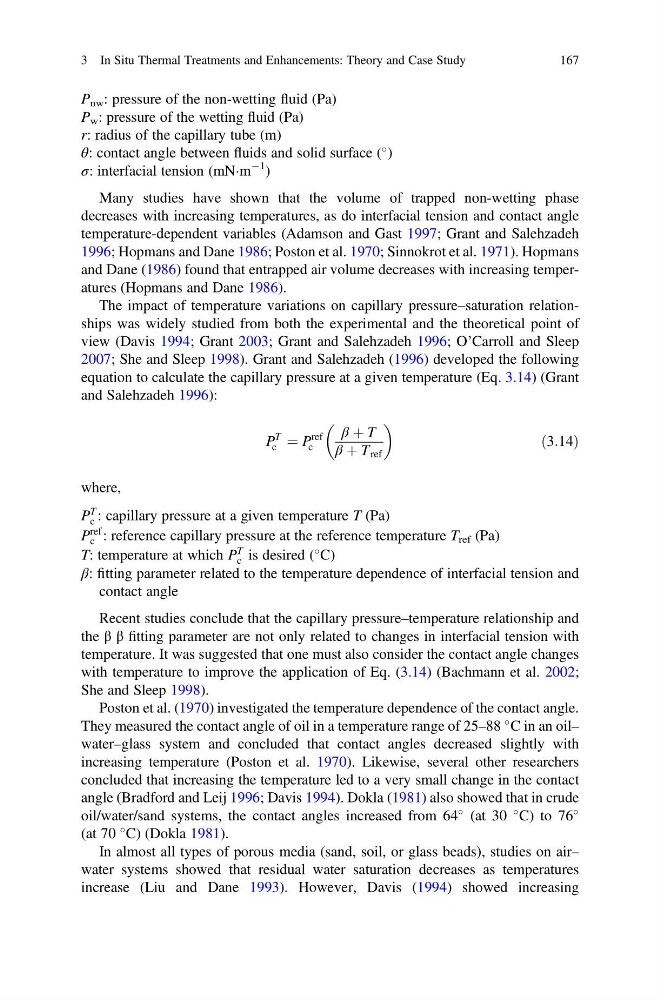
2007; She and Sleep 1998). Grant and Salehzadeh (1996) developed the following
equation to calculate the capillary pressure at a given temperature (Eq. 3.14) (Grant
and Salehzadeh 1996):
P
T
c ¼ P
ref
c
β þ T
β þ T ref
ð3:14Þ
where,
P
T
c : capillary pressure at a given temperature T (Pa)
P
ref
c : reference capillary pressure at the reference temperature T ref (Pa)
T: temperature at which P
T
c is desired (
C)
β: fitting parameter related to the temperature dependence of interfacial tension and
contact angle
Recent studies conclude that the capillary pressure–temperature relationship and
the β β fitting parameter are not only related to changes in interfacial tension with
temperature. It was suggested that one must also consider the contact angle changes
with temperature to improve the application of Eq. (3.14) (Bachmann et al. 2002;
She and Sleep 1998).
Poston et al. (1970) investigated the temperature dependence of the contact angle.
They measured the contact angle of oil in a temperature range of 25–88
C in an oil–
water–glass system and concluded that contact angles decreased slightly with
increasing temperature (Poston et al. 1970). Likewise, several other researchers
concluded that increasing the temperature led to a very small change in the contact
angle (Bradford and Leij 1996; Davis 1994). Dokla (1981) also showed that in crude
oil/water/sand systems, the contact angles increased from 64
(at 30
C) to 76
(at 70
C) (Dokla 1981).
In almost all types of porous media (sand, soil, or glass beads), studies on air–
water systems showed that residual water saturation decreases as temperatures
increase (Liu and Dane 1993). However, Davis (1994) showed increasing
3 In Situ Thermal Treatments and Enhancements: Theory and Case Study
167
P w : pressure of the wetting fluid (Pa)
r: radius of the capillary tube (m)
θ: contact angle between fluids and solid surface (
)
σ: interfacial tension (mNÁm
À1 )
Many studies have shown that the volume of trapped non-wetting phase
decreases with increasing temperatures, as do interfacial tension and contact angle
temperature-dependent variables (Adamson and Gast 1997; Grant and Salehzadeh
1996; Hopmans and Dane 1986; Poston et al. 1970; Sinnokrot et al. 1971). Hopmans
and Dane (1986) found that entrapped air volume decreases with increasing temperatures (Hopmans and Dane 1986).
The impact of temperature variations on capillary pressure–saturation relationships was widely studied from both the experimental and the theoretical point of
view (Davis 1994; Grant 2003; Grant and Salehzadeh 1996; O’Carroll and Sleep
2007; She and Sleep 1998). Grant and Salehzadeh (1996) developed the following
equation to calculate the capillary pressure at a given temperature (Eq. 3.14) (Grant
and Salehzadeh 1996):
P
T
c ¼ P
ref
c
β þ T
β þ T ref
ð3:14Þ
where,
P
T
c : capillary pressure at a given temperature T (Pa)
P
ref
c : reference capillary pressure at the reference temperature T ref (Pa)
T: temperature at which P
T
c is desired (
C)
β: fitting parameter related to the temperature dependence of interfacial tension and
contact angle
Recent studies conclude that the capillary pressure–temperature relationship and
the β β fitting parameter are not only related to changes in interfacial tension with
temperature. It was suggested that one must also consider the contact angle changes
with temperature to improve the application of Eq. (3.14) (Bachmann et al. 2002;
She and Sleep 1998).
Poston et al. (1970) investigated the temperature dependence of the contact angle.
They measured the contact angle of oil in a temperature range of 25–88
C in an oil–
water–glass system and concluded that contact angles decreased slightly with
increasing temperature (Poston et al. 1970). Likewise, several other researchers
concluded that increasing the temperature led to a very small change in the contact
angle (Bradford and Leij 1996; Davis 1994). Dokla (1981) also showed that in crude
oil/water/sand systems, the contact angles increased from 64
(at 30
C) to 76
(at 70
C) (Dokla 1981).
In almost all types of porous media (sand, soil, or glass beads), studies on air–
water systems showed that residual water saturation decreases as temperatures
increase (Liu and Dane 1993). However, Davis (1994) showed increasing
3 In Situ Thermal Treatments and Enhancements: Theory and Case Study
167