

irreducible water saturations in air–water and hydrocarbon–water systems in the
range of 10–30
C (Davis 1994). Other researchers showed that in organic–water
systems the residual water saturation increases and the residual organic saturation
decreases with increasing temperatures (Davis 1994; Poston et al. 1970; She and
Sleep 1998; Sinnokrot et al. 1971). In a porous medium consisting of 3 mm of glass
beads, the water residual saturation (Swr) varied by over 8–8.5% when interfacial
tension ranged between 22 and 71.2 mNÁm
À1 (Morrow 1970).
She and Sleep (1998) found that increasing the temperature decreased residual
PCE, but increased the irreducible water value (She and Sleep 1998). They concluded that the capillary pressure–saturation curve is not only influenced by the
interfacial tension and the contact angle, but that viscosity may change the displacement process, which also affects the capillary pressure.
One can estimate these residual saturations using the concept of total trapping
number (N T ) developed by Pennell et al. (1996) by combining the capillary number
(N Ca ) and the Bond number (N B ) (Pennell et al. 1996). N B compares the magnitude
of gravity and capillary forces whereas the N Ca takes into account viscous and
capillary forces (Kingston et al. 2014). As a first approach, N T can be used to
estimate the impact of variations in these forces as a function of temperature
(Kingston et al. 2014). According to the experiments by Sleep and Ma (1997) on
heating PCE in a saturated porous medium (90
C), the mobilization of trapped pure
PCE did not increase. Indeed, increasing the temperature reduced interfacial tension
but also, and more significantly, it reduced water viscosity (Sleep and Ma 1997).
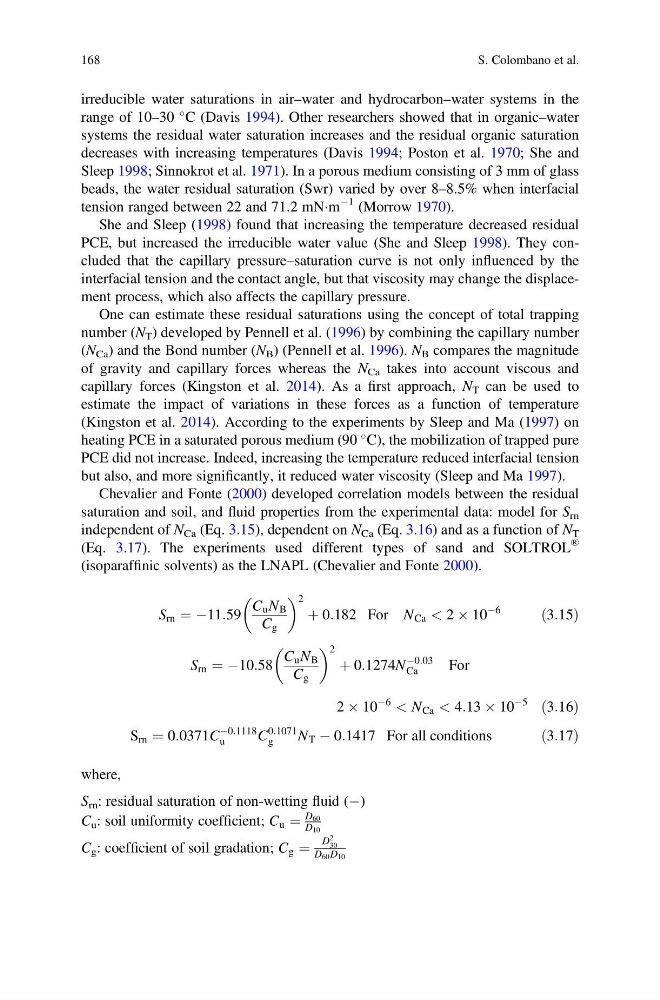
Chevalier and Fonte (2000) developed correlation models between the residual
saturation and soil, and fluid properties from the experimental data: model for S rn
independent of N Ca (Eq. 3.15), dependent on N Ca (Eq. 3.16) and as a function of N T
(Eq. 3.17). The experiments used different types of sand and SOLTROL
®
(isoparaffinic solvents) as the LNAPL (Chevalier and Fonte 2000).
S rn ¼ À11:59
C u N B
C g
2
þ 0:182 For N Ca < 2 Â 10
À6
ð3:15Þ
S rn ¼ À10:58
C u N B
C g
2
þ 0:1274N
À0:03
Ca
For
2 Â 10
À6
< N Ca < 4:13 Â 10
À5
ð3:16Þ
S rn ¼ 0:0371C
À0:1118
u
C
0:1071
g
N T À 0:1417 For all conditions
ð3:17Þ
where,
S rn : residual saturation of non-wetting fluid (À)
C u : soil uniformity coefficient; C u ¼
D 60
D 10
C g : coefficient of soil gradation; C g ¼
D
2
30
D 60 D 10
168
S. Colombano et al.
range of 10–30
C (Davis 1994). Other researchers showed that in organic–water
systems the residual water saturation increases and the residual organic saturation
decreases with increasing temperatures (Davis 1994; Poston et al. 1970; She and
Sleep 1998; Sinnokrot et al. 1971). In a porous medium consisting of 3 mm of glass
beads, the water residual saturation (Swr) varied by over 8–8.5% when interfacial
tension ranged between 22 and 71.2 mNÁm
À1 (Morrow 1970).
She and Sleep (1998) found that increasing the temperature decreased residual
PCE, but increased the irreducible water value (She and Sleep 1998). They concluded that the capillary pressure–saturation curve is not only influenced by the
interfacial tension and the contact angle, but that viscosity may change the displacement process, which also affects the capillary pressure.
One can estimate these residual saturations using the concept of total trapping
number (N T ) developed by Pennell et al. (1996) by combining the capillary number
(N Ca ) and the Bond number (N B ) (Pennell et al. 1996). N B compares the magnitude
of gravity and capillary forces whereas the N Ca takes into account viscous and
capillary forces (Kingston et al. 2014). As a first approach, N T can be used to
estimate the impact of variations in these forces as a function of temperature
(Kingston et al. 2014). According to the experiments by Sleep and Ma (1997) on
heating PCE in a saturated porous medium (90
C), the mobilization of trapped pure
PCE did not increase. Indeed, increasing the temperature reduced interfacial tension
but also, and more significantly, it reduced water viscosity (Sleep and Ma 1997).
Chevalier and Fonte (2000) developed correlation models between the residual
saturation and soil, and fluid properties from the experimental data: model for S rn
independent of N Ca (Eq. 3.15), dependent on N Ca (Eq. 3.16) and as a function of N T
(Eq. 3.17). The experiments used different types of sand and SOLTROL
®
(isoparaffinic solvents) as the LNAPL (Chevalier and Fonte 2000).
S rn ¼ À11:59
C u N B
C g
2
þ 0:182 For N Ca < 2 Â 10
À6
ð3:15Þ
S rn ¼ À10:58
C u N B
C g
2
þ 0:1274N
À0:03
Ca
For
2 Â 10
À6
< N Ca < 4:13 Â 10
À5
ð3:16Þ
S rn ¼ 0:0371C
À0:1118
u
C
0:1071
g
N T À 0:1417 For all conditions
ð3:17Þ
where,
S rn : residual saturation of non-wetting fluid (À)
C u : soil uniformity coefficient; C u ¼
D 60
D 10
C g : coefficient of soil gradation; C g ¼
D
2
30
D 60 D 10
168
S. Colombano et al.