

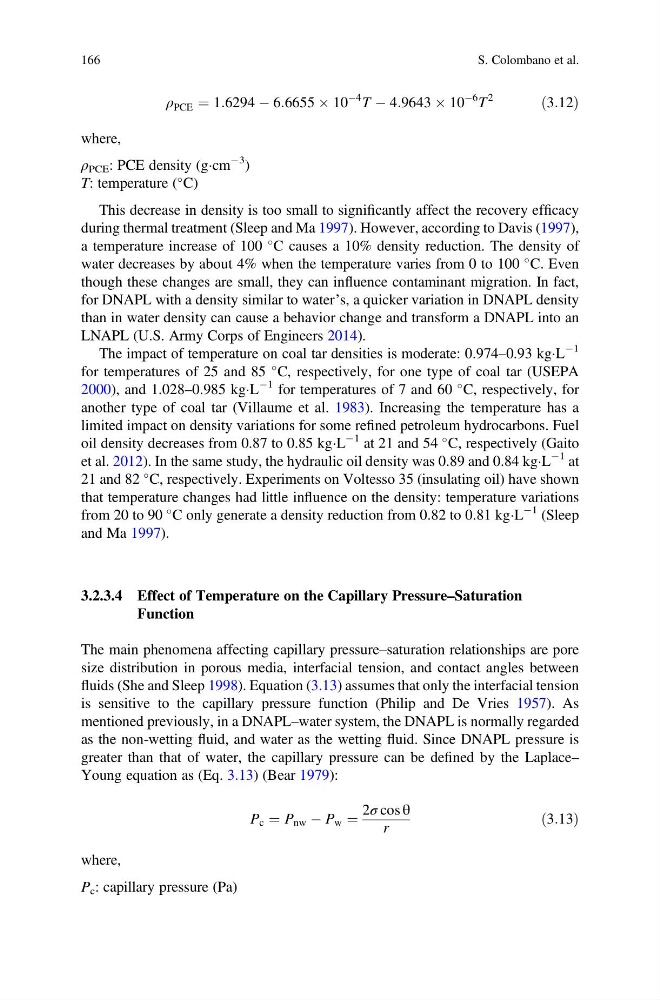
ρ PCE ¼ 1:6294 À 6:6655 Â 10
À4 T À 4:9643 Â 10
À6 T
2
ð3:12Þ
where,
ρ PCE : PCE density (gÁcm
À3 )
T: temperature (
C)
This decrease in density is too small to significantly affect the recovery efficacy
during thermal treatment (Sleep and Ma 1997). However, according to Davis (1997),
a temperature increase of 100
C causes a 10% density reduction. The density of
water decreases by about 4% when the temperature varies from 0 to 100
C. Even
though these changes are small, they can influence contaminant migration. In fact,
for DNAPL with a density similar to water’s, a quicker variation in DNAPL density
than in water density can cause a behavior change and transform a DNAPL into an
LNAPL (U.S. Army Corps of Engineers 2014).
The impact of temperature on coal tar densities is moderate: 0.974–0.93 kgÁL
À1
for temperatures of 25 and 85
C, respectively, for one type of coal tar (USEPA
2000), and 1.028–0.985 kgÁL
À1 for temperatures of 7 and 60
C, respectively, for
another type of coal tar (Villaume et al. 1983). Increasing the temperature has a
limited impact on density variations for some refined petroleum hydrocarbons. Fuel
oil density decreases from 0.87 to 0.85 kgÁL
À1 at 21 and 54
C, respectively (Gaito
et al. 2012). In the same study, the hydraulic oil density was 0.89 and 0.84 kgÁL
À1 at
21 and 82
C, respectively. Experiments on Voltesso 35 (insulating oil) have shown
that temperature changes had little influence on the density: temperature variations
from 20 to 90
C only generate a density reduction from 0.82 to 0.81 kgÁL
À1 (Sleep
and Ma 1997).
3.2.3.4 Effect of Temperature on the Capillary Pressure–Saturation
Function
The main phenomena affecting capillary pressure–saturation relationships are pore
size distribution in porous media, interfacial tension, and contact angles between
fluids (She and Sleep 1998). Equation (3.13) assumes that only the interfacial tension
is sensitive to the capillary pressure function (Philip and De Vries 1957). As
mentioned previously, in a DNAPL–water system, the DNAPL is normally regarded
as the non-wetting fluid, and water as the wetting fluid. Since DNAPL pressure is
greater than that of water, the capillary pressure can be defined by the Laplace–
Young equation as (Eq. 3.13) (Bear 1979):
P c ¼ P nw À P w ¼
2σ cos θ
r
ð3:13Þ
where,
P c : capillary pressure (Pa)
166
S. Colombano et al.
À4 T À 4:9643 Â 10
À6 T
2
ð3:12Þ
where,
ρ PCE : PCE density (gÁcm
À3 )
T: temperature (
C)
This decrease in density is too small to significantly affect the recovery efficacy
during thermal treatment (Sleep and Ma 1997). However, according to Davis (1997),
a temperature increase of 100
C causes a 10% density reduction. The density of
water decreases by about 4% when the temperature varies from 0 to 100
C. Even
though these changes are small, they can influence contaminant migration. In fact,
for DNAPL with a density similar to water’s, a quicker variation in DNAPL density
than in water density can cause a behavior change and transform a DNAPL into an
LNAPL (U.S. Army Corps of Engineers 2014).
The impact of temperature on coal tar densities is moderate: 0.974–0.93 kgÁL
À1
for temperatures of 25 and 85
C, respectively, for one type of coal tar (USEPA
2000), and 1.028–0.985 kgÁL
À1 for temperatures of 7 and 60
C, respectively, for
another type of coal tar (Villaume et al. 1983). Increasing the temperature has a
limited impact on density variations for some refined petroleum hydrocarbons. Fuel
oil density decreases from 0.87 to 0.85 kgÁL
À1 at 21 and 54
C, respectively (Gaito
et al. 2012). In the same study, the hydraulic oil density was 0.89 and 0.84 kgÁL
À1 at
21 and 82
C, respectively. Experiments on Voltesso 35 (insulating oil) have shown
that temperature changes had little influence on the density: temperature variations
from 20 to 90
C only generate a density reduction from 0.82 to 0.81 kgÁL
À1 (Sleep
and Ma 1997).
3.2.3.4 Effect of Temperature on the Capillary Pressure–Saturation
Function
The main phenomena affecting capillary pressure–saturation relationships are pore
size distribution in porous media, interfacial tension, and contact angles between
fluids (She and Sleep 1998). Equation (3.13) assumes that only the interfacial tension
is sensitive to the capillary pressure function (Philip and De Vries 1957). As
mentioned previously, in a DNAPL–water system, the DNAPL is normally regarded
as the non-wetting fluid, and water as the wetting fluid. Since DNAPL pressure is
greater than that of water, the capillary pressure can be defined by the Laplace–
Young equation as (Eq. 3.13) (Bear 1979):
P c ¼ P nw À P w ¼
2σ cos θ
r
ð3:13Þ
where,
P c : capillary pressure (Pa)
166
S. Colombano et al.