

Based on these results, they proposed the following linear relationship (Eq. 3.11)
in order to predict the PCE surface tension behavior for temperature ranging between
20 and 90
C (Sleep and Ma 1997):
γ PCE ¼ 45:808 À 0:042T
ð3:11Þ
where,
γ: interfacial tension (mJÁm
À2 )
T: temperature (
C)
These results confirm Imhoff et al.’s (1997) study showing a slight reduction
(7%) of the surface tension between the PCE and water with temperatures ranging
from 5 to 40
C. Experiments conducted with Voltesso 35 (insulating oil) have
shown that temperature changes had a moderate influence on the interfacial tensions:
32 mJÁm
À2 at 23.4
C and 43 mJÁm
À2 at 61.4
C (Sleep and Ma 1997).
As for coal tar, the interfacial tensions are not greatly influenced by increasing
temperatures. So the IFT for coal tars from Charleston remains stable around 20–22
dynesÁcm
À1 for temperatures ranging from 22 to 50
C (Kong 2004).
As for fuel oil, the interfacial tensions do not vary much with increasing temperatures either: 7.6–5.2 dynesÁcm
À1 at temperatures of 21
C and 82
C, respectively
(Gaito et al. 2012). In this study, the measured interfacial tension of hydraulic oil led
to the same conclusions (14.7–12.3 dynesÁcm
À1 at temperatures of 21
C and 82
C,
respectively).
3.2.3.3 Influence of Temperature on Density
The density of CVOCs is a function of molar mass (Lemière et al. 2008). Sleep and
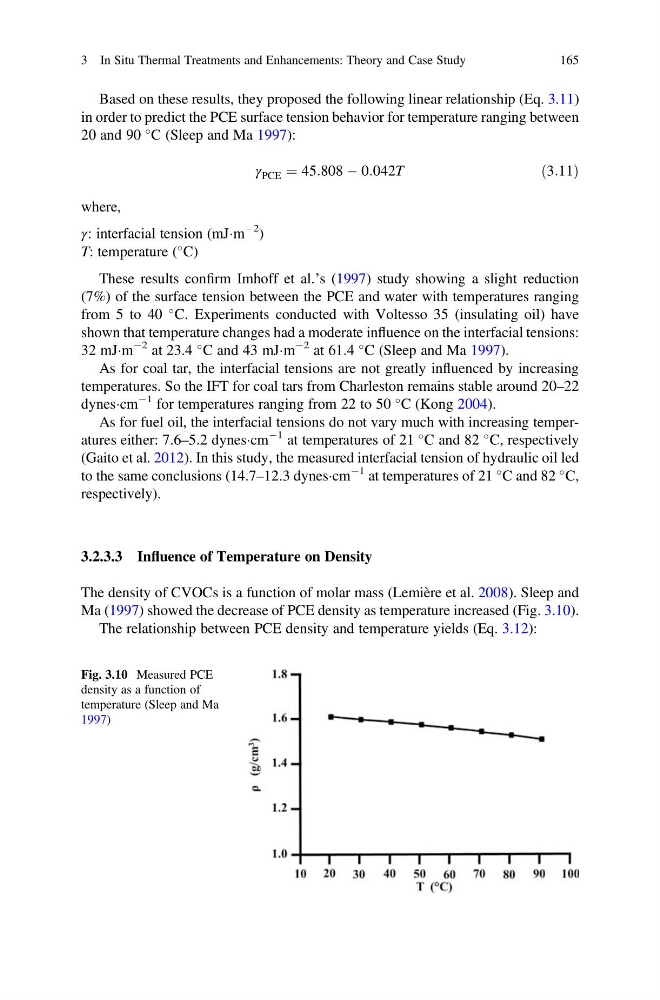
Ma (1997) showed the decrease of PCE density as temperature increased (Fig. 3.10).
The relationship between PCE density and temperature yields (Eq. 3.12):
Fig. 3.10 Measured PCE
density as a function of
temperature (Sleep and Ma
1997)
3 In Situ Thermal Treatments and Enhancements: Theory and Case Study
165
in order to predict the PCE surface tension behavior for temperature ranging between
20 and 90
C (Sleep and Ma 1997):
γ PCE ¼ 45:808 À 0:042T
ð3:11Þ
where,
γ: interfacial tension (mJÁm
À2 )
T: temperature (
C)
These results confirm Imhoff et al.’s (1997) study showing a slight reduction
(7%) of the surface tension between the PCE and water with temperatures ranging
from 5 to 40
C. Experiments conducted with Voltesso 35 (insulating oil) have
shown that temperature changes had a moderate influence on the interfacial tensions:
32 mJÁm
À2 at 23.4
C and 43 mJÁm
À2 at 61.4
C (Sleep and Ma 1997).
As for coal tar, the interfacial tensions are not greatly influenced by increasing
temperatures. So the IFT for coal tars from Charleston remains stable around 20–22
dynesÁcm
À1 for temperatures ranging from 22 to 50
C (Kong 2004).
As for fuel oil, the interfacial tensions do not vary much with increasing temperatures either: 7.6–5.2 dynesÁcm
À1 at temperatures of 21
C and 82
C, respectively
(Gaito et al. 2012). In this study, the measured interfacial tension of hydraulic oil led
to the same conclusions (14.7–12.3 dynesÁcm
À1 at temperatures of 21
C and 82
C,
respectively).
3.2.3.3 Influence of Temperature on Density
The density of CVOCs is a function of molar mass (Lemière et al. 2008). Sleep and
Ma (1997) showed the decrease of PCE density as temperature increased (Fig. 3.10).
The relationship between PCE density and temperature yields (Eq. 3.12):
Fig. 3.10 Measured PCE
density as a function of
temperature (Sleep and Ma
1997)
3 In Situ Thermal Treatments and Enhancements: Theory and Case Study
165