

that coal tar viscosity could decrease from 41.4 to 1.16 cP when temperatures are
increased from 25 to 85
C (USEPA 2000). Another study conducted on a different
coal tar, showed a decrease in viscosity from 18.98 to 3.89 cP, when the temperature
rose from 7 to 60
C (Villaume et al. 1983). Kong (2004) showed that temperature
elevation has a greater effect on the viscosity of coal tars when the initial viscosity is
high; e.g., the viscosity of coal tar from Charleston (USA) decreased from 425 cP at
22
C to 120 cP at 40
C (Kong 2004).
Temperature greatly affects the viscosity of fuel oil. A reduction by a factor of
two for a moderate temperature increase was observed: from 1.19 to 0.56 cP (at 21
and 82
C, respectively), for AOI 40 fuel oil; and from 5.15 to 2.33 cP (at 21 and
54
C, respectively) for AOI 16 fuel oil (Gaito et al. 2012). The same authors
demonstrated that the viscosity of hydraulic oils is generally more sensitive to
temperature increases. They observed a reduction by a factor of ten for similar
temperature variations: 47.7–5.08 cP (at 21 and 82
C, respectively) for AOI
12 hydraulic oil; and 362–46.6 cP (at 21 and 54
C, respectively) for AOI 02 hydraulic oil. In the case of Voltesso 35, an insulating oil, its viscosity at 90
C was 11% of
its value at 20
C (22.47 cP) (Sleep and Ma 1997).
The viscosity of gases tends to be 10–100 times lower than that of liquids.
However, conversely to liquids, the viscosity of a gas increases greatly with temperature. Davis (1997) showed that the viscosity of gas increases by 30% when the
temperature increases by 100
C. Thermal treatment is therefore less favorable to gas
mobility.
3.2.3.2 Influence of Temperature on Interfacial Tension
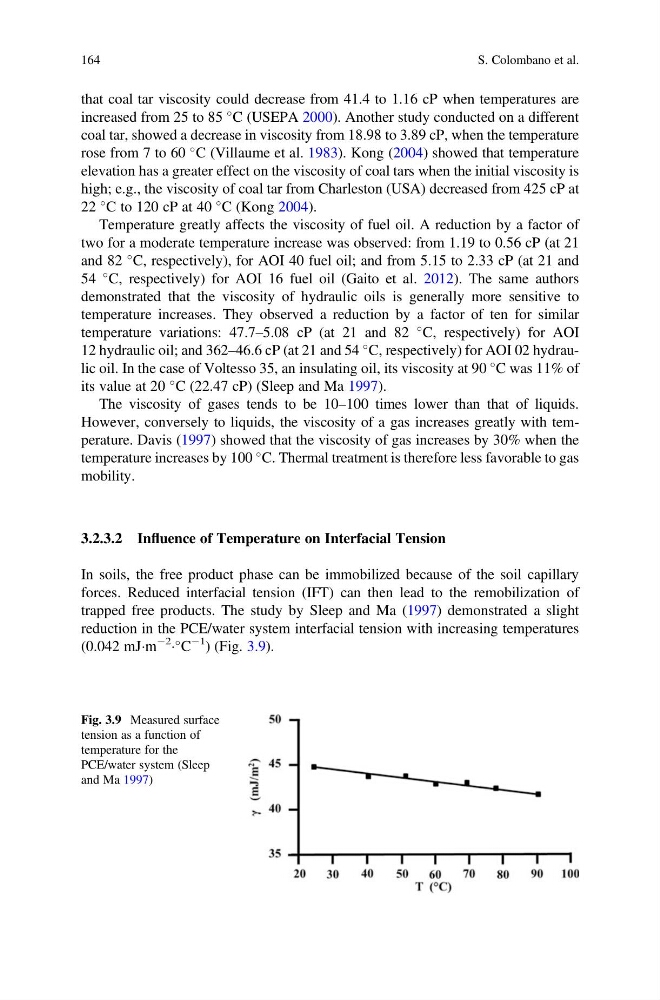
In soils, the free product phase can be immobilized because of the soil capillary
forces. Reduced interfacial tension (IFT) can then lead to the remobilization of
trapped free products. The study by Sleep and Ma (1997) demonstrated a slight
reduction in the PCE/water system interfacial tension with increasing temperatures
(0.042 mJÁm
À2 Á
C
À1 ) (Fig. 3.9).
Fig. 3.9 Measured surface
tension as a function of
temperature for the
PCE/water system (Sleep
and Ma 1997)
164
S. Colombano et al.
increased from 25 to 85
C (USEPA 2000). Another study conducted on a different
coal tar, showed a decrease in viscosity from 18.98 to 3.89 cP, when the temperature
rose from 7 to 60
C (Villaume et al. 1983). Kong (2004) showed that temperature
elevation has a greater effect on the viscosity of coal tars when the initial viscosity is
high; e.g., the viscosity of coal tar from Charleston (USA) decreased from 425 cP at
22
C to 120 cP at 40
C (Kong 2004).
Temperature greatly affects the viscosity of fuel oil. A reduction by a factor of
two for a moderate temperature increase was observed: from 1.19 to 0.56 cP (at 21
and 82
C, respectively), for AOI 40 fuel oil; and from 5.15 to 2.33 cP (at 21 and
54
C, respectively) for AOI 16 fuel oil (Gaito et al. 2012). The same authors
demonstrated that the viscosity of hydraulic oils is generally more sensitive to
temperature increases. They observed a reduction by a factor of ten for similar
temperature variations: 47.7–5.08 cP (at 21 and 82
C, respectively) for AOI
12 hydraulic oil; and 362–46.6 cP (at 21 and 54
C, respectively) for AOI 02 hydraulic oil. In the case of Voltesso 35, an insulating oil, its viscosity at 90
C was 11% of
its value at 20
C (22.47 cP) (Sleep and Ma 1997).
The viscosity of gases tends to be 10–100 times lower than that of liquids.
However, conversely to liquids, the viscosity of a gas increases greatly with temperature. Davis (1997) showed that the viscosity of gas increases by 30% when the
temperature increases by 100
C. Thermal treatment is therefore less favorable to gas
mobility.
3.2.3.2 Influence of Temperature on Interfacial Tension
In soils, the free product phase can be immobilized because of the soil capillary
forces. Reduced interfacial tension (IFT) can then lead to the remobilization of
trapped free products. The study by Sleep and Ma (1997) demonstrated a slight
reduction in the PCE/water system interfacial tension with increasing temperatures
(0.042 mJÁm
À2 Á
C
À1 ) (Fig. 3.9).
Fig. 3.9 Measured surface
tension as a function of
temperature for the
PCE/water system (Sleep
and Ma 1997)
164
S. Colombano et al.