

3.2.3 Influence of Temperature on Multiphase Flow
The migration of multiphase fluids in porous media is affected by several factors. For
NAPL–water–air systems, the main properties governing NAPL migration are
interfacial tension (for saturated zone), surface tension (for unsaturated zone),
wettability, viscosity, density, solubility, and volatility (Lyman et al. 1982).
3.2.3.1 Influence of Temperature on Dynamic Viscosity
Numerous studies reported a significant decrease in aqueous phase gradients due to a
reduction in fluid viscosities with increasing temperatures, in a series of horizontal
column experiments with hot water flooding. Significant reductions in water and
NAPL viscosities have been reported when temperatures increased (e.g.,
Edmondson 1965; Sleep and Ma 1997; Villaume et al. 1983).
Typically, chlorinated solvents are less viscous than water (viscosity less than
10
À3 PaÁs
À1 ). Additionally, with the effect of raised temperatures, liquids expand
and interactions between the molecules are reduced, consequently decreasing the
viscosity. The viscosity of a chlorinated solvent generally reduces by 1% per degree
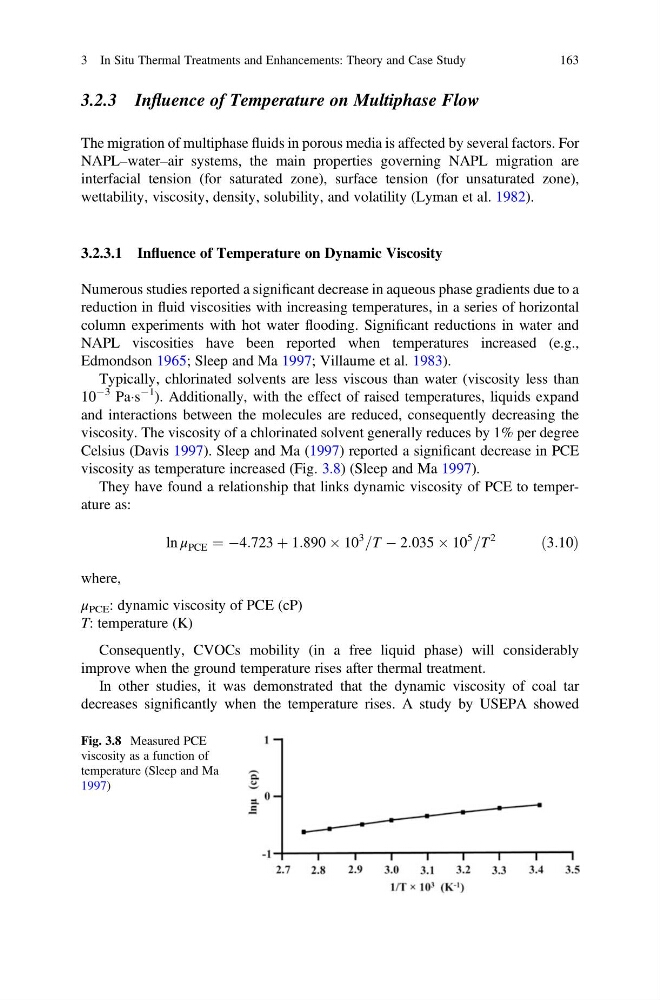
Celsius (Davis 1997). Sleep and Ma (1997) reported a significant decrease in PCE
viscosity as temperature increased (Fig. 3.8) (Sleep and Ma 1997).
They have found a relationship that links dynamic viscosity of PCE to temperature as:
ln μ PCE ¼ À4:723 þ 1:890 Â 10
3
=T À 2:035 Â 10
5
=T
2
ð3:10Þ
where,
μ PCE : dynamic viscosity of PCE (cP)
T: temperature (K)
Consequently, CVOCs mobility (in a free liquid phase) will considerably
improve when the ground temperature rises after thermal treatment.
In other studies, it was demonstrated that the dynamic viscosity of coal tar
decreases significantly when the temperature rises. A study by USEPA showed
Fig. 3.8 Measured PCE
viscosity as a function of
temperature (Sleep and Ma
1997)
3 In Situ Thermal Treatments and Enhancements: Theory and Case Study
163
The migration of multiphase fluids in porous media is affected by several factors. For
NAPL–water–air systems, the main properties governing NAPL migration are
interfacial tension (for saturated zone), surface tension (for unsaturated zone),
wettability, viscosity, density, solubility, and volatility (Lyman et al. 1982).
3.2.3.1 Influence of Temperature on Dynamic Viscosity
Numerous studies reported a significant decrease in aqueous phase gradients due to a
reduction in fluid viscosities with increasing temperatures, in a series of horizontal
column experiments with hot water flooding. Significant reductions in water and
NAPL viscosities have been reported when temperatures increased (e.g.,
Edmondson 1965; Sleep and Ma 1997; Villaume et al. 1983).
Typically, chlorinated solvents are less viscous than water (viscosity less than
10
À3 PaÁs
À1 ). Additionally, with the effect of raised temperatures, liquids expand
and interactions between the molecules are reduced, consequently decreasing the
viscosity. The viscosity of a chlorinated solvent generally reduces by 1% per degree
Celsius (Davis 1997). Sleep and Ma (1997) reported a significant decrease in PCE
viscosity as temperature increased (Fig. 3.8) (Sleep and Ma 1997).
They have found a relationship that links dynamic viscosity of PCE to temperature as:
ln μ PCE ¼ À4:723 þ 1:890 Â 10
3
=T À 2:035 Â 10
5
=T
2
ð3:10Þ
where,
μ PCE : dynamic viscosity of PCE (cP)
T: temperature (K)
Consequently, CVOCs mobility (in a free liquid phase) will considerably
improve when the ground temperature rises after thermal treatment.
In other studies, it was demonstrated that the dynamic viscosity of coal tar
decreases significantly when the temperature rises. A study by USEPA showed
Fig. 3.8 Measured PCE
viscosity as a function of
temperature (Sleep and Ma
1997)
3 In Situ Thermal Treatments and Enhancements: Theory and Case Study
163