

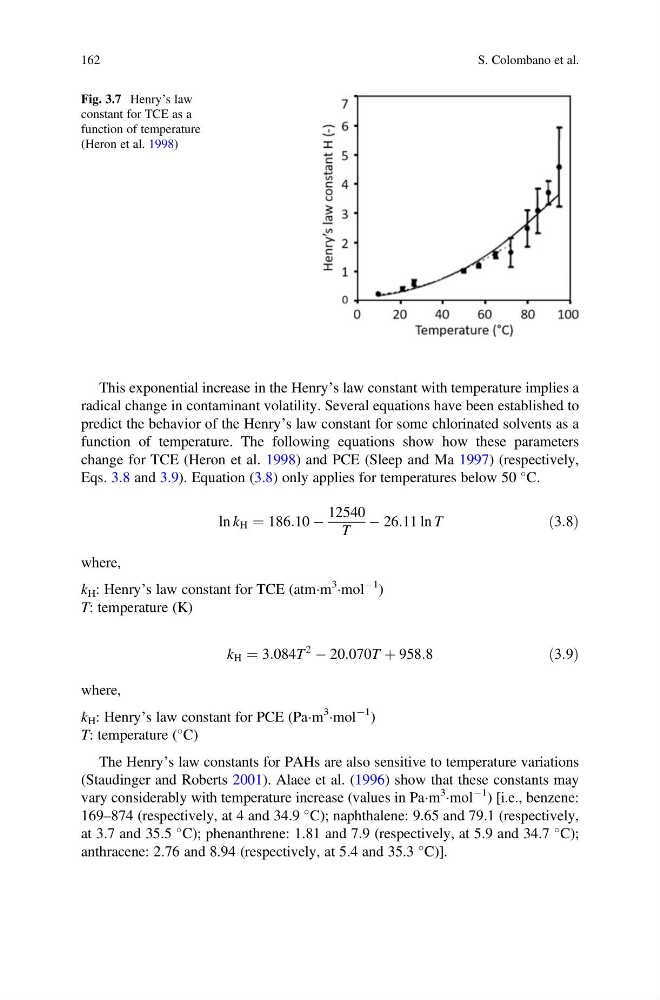
This exponential increase in the Henry’s law constant with temperature implies a
radical change in contaminant volatility. Several equations have been established to
predict the behavior of the Henry’s law constant for some chlorinated solvents as a
function of temperature. The following equations show how these parameters
change for TCE (Heron et al. 1998) and PCE (Sleep and Ma 1997) (respectively,
Eqs. 3.8 and 3.9). Equation (3.8) only applies for temperatures below 50
C.
ln k H ¼ 186:10 À
12540
T
À 26:11 ln T
ð3:8Þ
where,
k H : Henry’s law constant for TCE (atmÁm
3
Ámol
À1 )
T: temperature (K)
k H ¼ 3:084T
2
À 20:070T þ 958:8
ð3:9Þ
where,
k H : Henry’s law constant for PCE (PaÁm
3
Ámol
À1 )
T: temperature (
C)
The Henry’s law constants for PAHs are also sensitive to temperature variations
(Staudinger and Roberts 2001). Alaee et al. (1996) show that these constants may
vary considerably with temperature increase (values in PaÁm
3
Ámol
À1 ) [i.e., benzene:
169–874 (respectively, at 4 and 34.9
C); naphthalene: 9.65 and 79.1 (respectively,
at 3.7 and 35.5
C); phenanthrene: 1.81 and 7.9 (respectively, at 5.9 and 34.7
C);
anthracene: 2.76 and 8.94 (respectively, at 5.4 and 35.3
C)].
Fig. 3.7 Henry’s law
constant for TCE as a
function of temperature
(Heron et al. 1998)
162
S. Colombano et al.
radical change in contaminant volatility. Several equations have been established to
predict the behavior of the Henry’s law constant for some chlorinated solvents as a
function of temperature. The following equations show how these parameters
change for TCE (Heron et al. 1998) and PCE (Sleep and Ma 1997) (respectively,
Eqs. 3.8 and 3.9). Equation (3.8) only applies for temperatures below 50
C.
ln k H ¼ 186:10 À
12540
T
À 26:11 ln T
ð3:8Þ
where,
k H : Henry’s law constant for TCE (atmÁm
3
Ámol
À1 )
T: temperature (K)
k H ¼ 3:084T
2
À 20:070T þ 958:8
ð3:9Þ
where,
k H : Henry’s law constant for PCE (PaÁm
3
Ámol
À1 )
T: temperature (
C)
The Henry’s law constants for PAHs are also sensitive to temperature variations
(Staudinger and Roberts 2001). Alaee et al. (1996) show that these constants may
vary considerably with temperature increase (values in PaÁm
3
Ámol
À1 ) [i.e., benzene:
169–874 (respectively, at 4 and 34.9
C); naphthalene: 9.65 and 79.1 (respectively,
at 3.7 and 35.5
C); phenanthrene: 1.81 and 7.9 (respectively, at 5.9 and 34.7
C);
anthracene: 2.76 and 8.94 (respectively, at 5.4 and 35.3
C)].
Fig. 3.7 Henry’s law
constant for TCE as a
function of temperature
(Heron et al. 1998)
162
S. Colombano et al.