

3.2.2 Effect of Temperature on Volatilization
Volatilization is the mechanism used to observe the transfer of organic compounds:
• From the NAPL phase to the vapor phase; distribution between each phase is
defined by the vapor pressure and Raoult’s law for an ideal mixture.
• From the aqueous phase to the vapor phase; distribution between each phase is
defined by Henry’s law constant.
• From the solid phase to the vapor phase; distribution between each phase is also
defined by the vapor pressure.
CVOCs exhibit high volatility, which depends on their molar mass (Lemière et al.
2008), though they are all very volatile by definition. Chlorinated solvents are
commonly present in the liquid phase at ambient temperatures and volatilize at
temperatures ranging from 40 to 180
C (USEPA 2004). However, the boiling
point of a given CVOCs in an aqueous phase is lower than the boiling point of
pure product (Davis 1997). For example, the volatilization of PCE dissolved in water
occurs at 88
C, which is 33
C lower than the 121
C required to vaporize pure PCE
(USEPA 2004).
3.2.2.1 Influence of Temperature on Vapor Pressure
Vapor pressure is a parameter that always increases with temperature (Davis 1997).
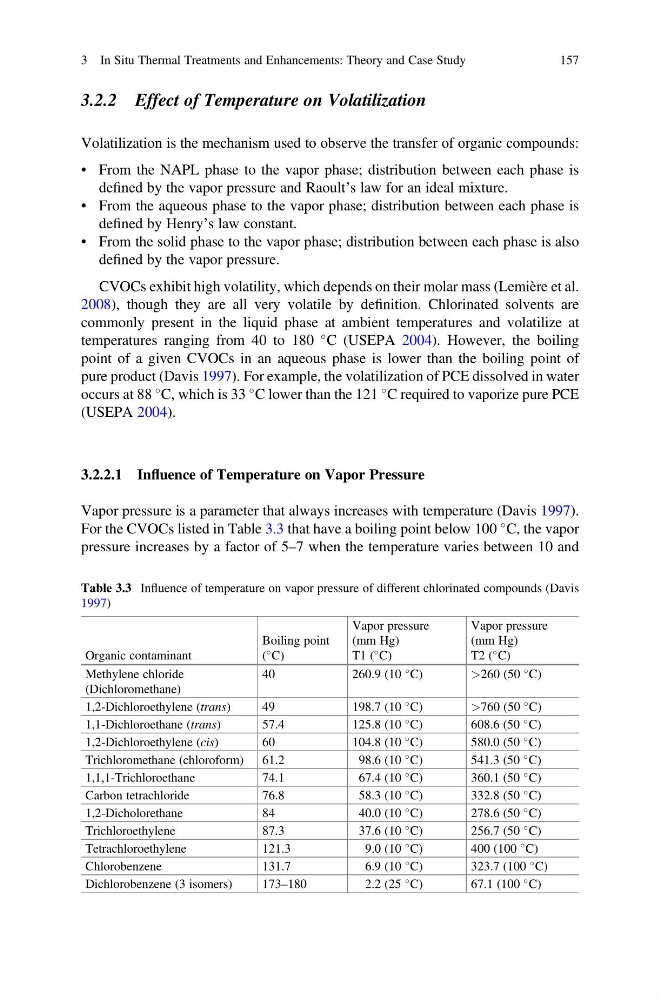
For the CVOCs listed in Table 3.3 that have a boiling point below 100
C, the vapor
pressure increases by a factor of 5–7 when the temperature varies between 10 and
Table 3.3 Influence of temperature on vapor pressure of different chlorinated compounds (Davis
1997)
Organic contaminant
Boiling point
(
C)
Vapor pressure
(mm Hg)
T1 (
C)
Vapor pressure
(mm Hg)
T2 (
C)
Methylene chloride
(Dichloromethane)
40
260.9 (10
C)
>260 (50
C)
1,2-Dichloroethylene (trans)
49
198.7 (10
C)
>760 (50
C)
1,1-Dichloroethane (trans)
57.4
125.8 (10
C)
608.6 (50
C)
1,2-Dichloroethylene (cis)
60
104.8 (10
C)
580.0 (50
C)
Trichloromethane (chloroform) 61.2
98.6 (10
C)
541.3 (50
C)
1,1,1-Trichloroethane
74.1
67.4 (10
C)
360.1 (50
C)
Carbon tetrachloride
76.8
58.3 (10
C)
332.8 (50
C)
1,2-Dicholorethane
84
40.0 (10
C)
278.6 (50
C)
Trichloroethylene
87.3
37.6 (10
C)
256.7 (50
C)
Tetrachloroethylene
121.3
9.0 (10
C)
400 (100
C)
Chlorobenzene
131.7
6.9 (10
C)
323.7 (100
C)
Dichlorobenzene (3 isomers)
173–180
2.2 (25
C)
67.1 (100
C)
3 In Situ Thermal Treatments and Enhancements: Theory and Case Study
157
Volatilization is the mechanism used to observe the transfer of organic compounds:
• From the NAPL phase to the vapor phase; distribution between each phase is
defined by the vapor pressure and Raoult’s law for an ideal mixture.
• From the aqueous phase to the vapor phase; distribution between each phase is
defined by Henry’s law constant.
• From the solid phase to the vapor phase; distribution between each phase is also
defined by the vapor pressure.
CVOCs exhibit high volatility, which depends on their molar mass (Lemière et al.
2008), though they are all very volatile by definition. Chlorinated solvents are
commonly present in the liquid phase at ambient temperatures and volatilize at
temperatures ranging from 40 to 180
C (USEPA 2004). However, the boiling
point of a given CVOCs in an aqueous phase is lower than the boiling point of
pure product (Davis 1997). For example, the volatilization of PCE dissolved in water
occurs at 88
C, which is 33
C lower than the 121
C required to vaporize pure PCE
(USEPA 2004).
3.2.2.1 Influence of Temperature on Vapor Pressure
Vapor pressure is a parameter that always increases with temperature (Davis 1997).
For the CVOCs listed in Table 3.3 that have a boiling point below 100
C, the vapor
pressure increases by a factor of 5–7 when the temperature varies between 10 and
Table 3.3 Influence of temperature on vapor pressure of different chlorinated compounds (Davis
1997)
Organic contaminant
Boiling point
(
C)
Vapor pressure
(mm Hg)
T1 (
C)
Vapor pressure
(mm Hg)
T2 (
C)
Methylene chloride
(Dichloromethane)
40
260.9 (10
C)
>260 (50
C)
1,2-Dichloroethylene (trans)
49
198.7 (10
C)
>760 (50
C)
1,1-Dichloroethane (trans)
57.4
125.8 (10
C)
608.6 (50
C)
1,2-Dichloroethylene (cis)
60
104.8 (10
C)
580.0 (50
C)
Trichloromethane (chloroform) 61.2
98.6 (10
C)
541.3 (50
C)
1,1,1-Trichloroethane
74.1
67.4 (10
C)
360.1 (50
C)
Carbon tetrachloride
76.8
58.3 (10
C)
332.8 (50
C)
1,2-Dicholorethane
84
40.0 (10
C)
278.6 (50
C)
Trichloroethylene
87.3
37.6 (10
C)
256.7 (50
C)
Tetrachloroethylene
121.3
9.0 (10
C)
400 (100
C)
Chlorobenzene
131.7
6.9 (10
C)
323.7 (100
C)
Dichlorobenzene (3 isomers)
173–180
2.2 (25
C)
67.1 (100
C)
3 In Situ Thermal Treatments and Enhancements: Theory and Case Study
157