

S ¼ 0:02098T
2
À 0:788T þ 168:0
ð3:3Þ
where,
S: water solubility of PCE in water (mgÁL
À1 )
T: temperature (
C)
With regard to Polycyclic Aromatic Hydrocarbons (PAHs), several studies
showed that solubility also increases with temperature (Dohányosová et al. 2003;
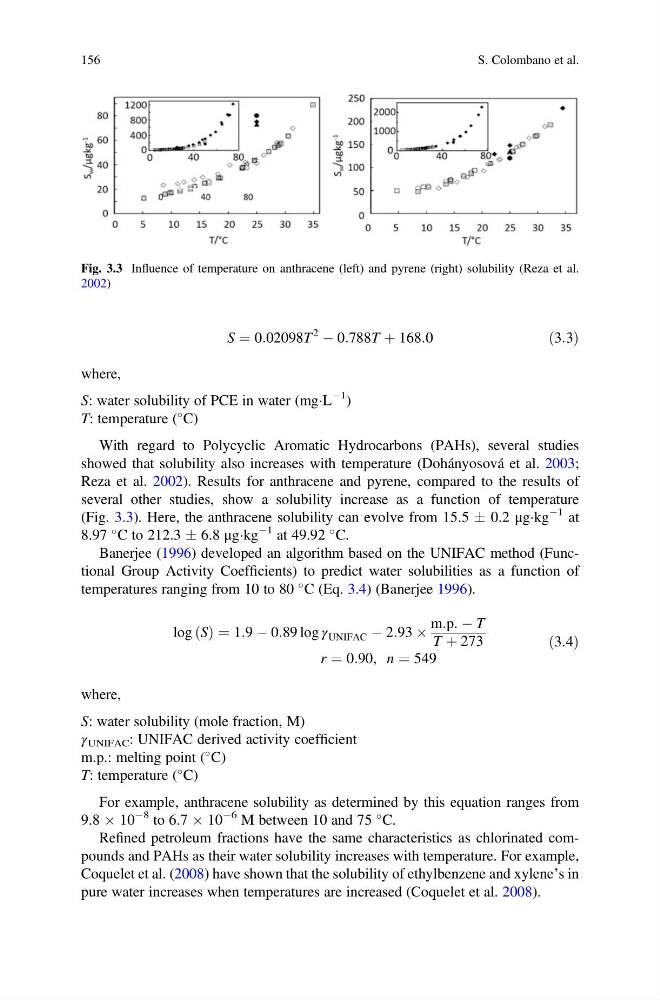
Reza et al. 2002). Results for anthracene and pyrene, compared to the results of
several other studies, show a solubility increase as a function of temperature
(Fig. 3.3). Here, the anthracene solubility can evolve from 15.5 Æ 0.2 μgÁkg
À1 at
8.97
C to 212.3 Æ 6.8 μgÁkg
À1 at 49.92
C.
Banerjee (1996) developed an algorithm based on the UNIFAC method (Functional Group Activity Coefficients) to predict water solubilities as a function of
temperatures ranging from 10 to 80
C (Eq. 3.4) (Banerjee 1996).
log S
ð Þ ¼ 1:9 À 0:89 log γ UNIFAC À 2:93 Â
m:p: À T
T þ 273
r ¼ 0:90, n ¼ 549
ð3:4Þ
where,
S: water solubility (mole fraction, M)
γ UNIFAC : UNIFAC derived activity coefficient
m.p.: melting point (
C)
T: temperature (
C)
For example, anthracene solubility as determined by this equation ranges from
9.8 Â 10
À8 to 6.7 Â 10
À6 M between 10 and 75
C.
Refined petroleum fractions have the same characteristics as chlorinated compounds and PAHs as their water solubility increases with temperature. For example,
Coquelet et al. (2008) have shown that the solubility of ethylbenzene and xylene’s in
pure water increases when temperatures are increased (Coquelet et al. 2008).
Fig. 3.3 Influence of temperature on anthracene (left) and pyrene (right) solubility (Reza et al.
2002)
156
S. Colombano et al.
2
À 0:788T þ 168:0
ð3:3Þ
where,
S: water solubility of PCE in water (mgÁL
À1 )
T: temperature (
C)
With regard to Polycyclic Aromatic Hydrocarbons (PAHs), several studies
showed that solubility also increases with temperature (Dohányosová et al. 2003;
Reza et al. 2002). Results for anthracene and pyrene, compared to the results of
several other studies, show a solubility increase as a function of temperature
(Fig. 3.3). Here, the anthracene solubility can evolve from 15.5 Æ 0.2 μgÁkg
À1 at
8.97
C to 212.3 Æ 6.8 μgÁkg
À1 at 49.92
C.
Banerjee (1996) developed an algorithm based on the UNIFAC method (Functional Group Activity Coefficients) to predict water solubilities as a function of
temperatures ranging from 10 to 80
C (Eq. 3.4) (Banerjee 1996).
log S
ð Þ ¼ 1:9 À 0:89 log γ UNIFAC À 2:93 Â
m:p: À T
T þ 273
r ¼ 0:90, n ¼ 549
ð3:4Þ
where,
S: water solubility (mole fraction, M)
γ UNIFAC : UNIFAC derived activity coefficient
m.p.: melting point (
C)
T: temperature (
C)
For example, anthracene solubility as determined by this equation ranges from
9.8 Â 10
À8 to 6.7 Â 10
À6 M between 10 and 75
C.
Refined petroleum fractions have the same characteristics as chlorinated compounds and PAHs as their water solubility increases with temperature. For example,
Coquelet et al. (2008) have shown that the solubility of ethylbenzene and xylene’s in
pure water increases when temperatures are increased (Coquelet et al. 2008).
Fig. 3.3 Influence of temperature on anthracene (left) and pyrene (right) solubility (Reza et al.
2002)
156
S. Colombano et al.