

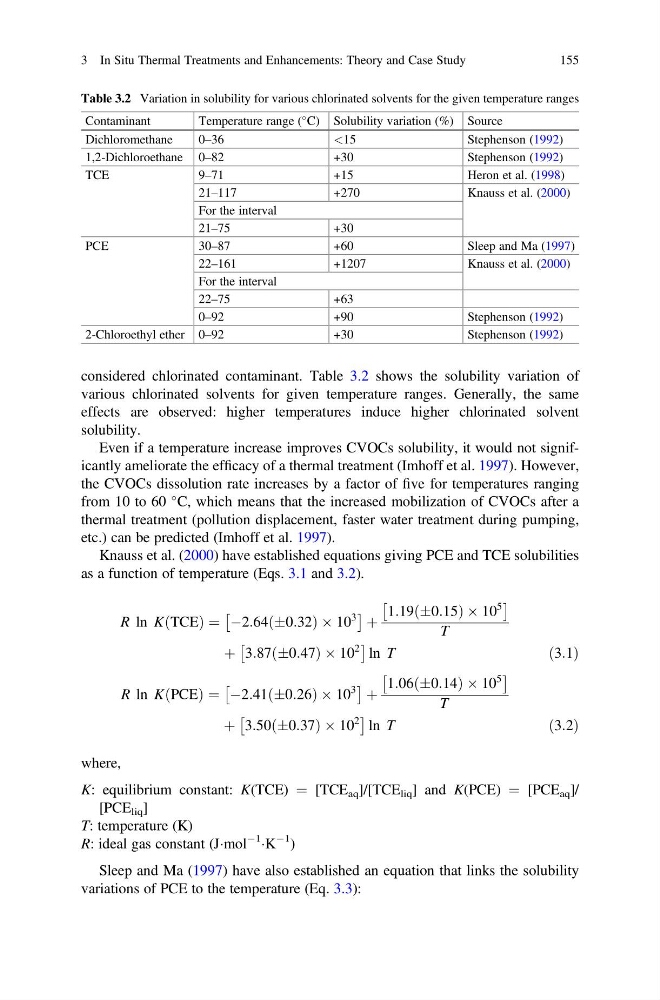
considered chlorinated contaminant. Table 3.2 shows the solubility variation of
various chlorinated solvents for given temperature ranges. Generally, the same
effects are observed: higher temperatures induce higher chlorinated solvent
solubility.
Even if a temperature increase improves CVOCs solubility, it would not significantly ameliorate the efficacy of a thermal treatment (Imhoff et al. 1997). However,
the CVOCs dissolution rate increases by a factor of five for temperatures ranging
from 10 to 60
C, which means that the increased mobilization of CVOCs after a
thermal treatment (pollution displacement, faster water treatment during pumping,
etc.) can be predicted (Imhoff et al. 1997).
Knauss et al. (2000) have established equations giving PCE and TCE solubilities
as a function of temperature (Eqs. 3.1 and 3.2).
R ln K TCE
ð
Þ¼ À2:64 Æ0:32
ð
ÞÂ10
3
Â
à þ
1:19 Æ0:15
ð
ÞÂ10
5
Â
Ã
T
þ 3:87 Æ0:47
ð
ÞÂ10
2
Â
Ã
ln T
ð3:1Þ
R ln K PCE
ð
Þ¼ À2:41 Æ0:26
ð
ÞÂ10
3
Â
à þ
1:06 Æ0:14
ð
ÞÂ10
5
Â
Ã
T
þ 3:50 Æ0:37
ð
ÞÂ10
2
Â
Ã
ln T
ð3:2Þ
where,
K: equilibrium constant: K(TCE) ¼ [TCE aq ]/[TCE liq ] and K(PCE) ¼ [PCE aq ]/
[PCE liq ]
T: temperature (K)
R: ideal gas constant (JÁmol
À1
ÁK
À1 )
Sleep and Ma (1997) have also established an equation that links the solubility
variations of PCE to the temperature (Eq. 3.3):
Table 3.2 Variation in solubility for various chlorinated solvents for the given temperature ranges
Contaminant
Temperature range (
C) Solubility variation (%) Source
Dichloromethane
0–36
<15
Stephenson (1992)
1,2-Dichloroethane 0–82
+30
Stephenson (1992)
TCE
9–71
+15
Heron et al. (1998)
21–117
+270
Knauss et al. (2000)
For the interval
21–75
+30
PCE
30–87
+60
Sleep and Ma (1997)
22–161
+1207
Knauss et al. (2000)
For the interval
22–75
+63
0–92
+90
Stephenson (1992)
2-Chloroethyl ether 0–92
+30
Stephenson (1992)
3 In Situ Thermal Treatments and Enhancements: Theory and Case Study
155
various chlorinated solvents for given temperature ranges. Generally, the same
effects are observed: higher temperatures induce higher chlorinated solvent
solubility.
Even if a temperature increase improves CVOCs solubility, it would not significantly ameliorate the efficacy of a thermal treatment (Imhoff et al. 1997). However,
the CVOCs dissolution rate increases by a factor of five for temperatures ranging
from 10 to 60
C, which means that the increased mobilization of CVOCs after a
thermal treatment (pollution displacement, faster water treatment during pumping,
etc.) can be predicted (Imhoff et al. 1997).
Knauss et al. (2000) have established equations giving PCE and TCE solubilities
as a function of temperature (Eqs. 3.1 and 3.2).
R ln K TCE
ð
Þ¼ À2:64 Æ0:32
ð
ÞÂ10
3
Â
à þ
1:19 Æ0:15
ð
ÞÂ10
5
Â
Ã
T
þ 3:87 Æ0:47
ð
ÞÂ10
2
Â
Ã
ln T
ð3:1Þ
R ln K PCE
ð
Þ¼ À2:41 Æ0:26
ð
ÞÂ10
3
Â
à þ
1:06 Æ0:14
ð
ÞÂ10
5
Â
Ã
T
þ 3:50 Æ0:37
ð
ÞÂ10
2
Â
Ã
ln T
ð3:2Þ
where,
K: equilibrium constant: K(TCE) ¼ [TCE aq ]/[TCE liq ] and K(PCE) ¼ [PCE aq ]/
[PCE liq ]
T: temperature (K)
R: ideal gas constant (JÁmol
À1
ÁK
À1 )
Sleep and Ma (1997) have also established an equation that links the solubility
variations of PCE to the temperature (Eq. 3.3):
Table 3.2 Variation in solubility for various chlorinated solvents for the given temperature ranges
Contaminant
Temperature range (
C) Solubility variation (%) Source
Dichloromethane
0–36
<15
Stephenson (1992)
1,2-Dichloroethane 0–82
+30
Stephenson (1992)
TCE
9–71
+15
Heron et al. (1998)
21–117
+270
Knauss et al. (2000)
For the interval
21–75
+30
PCE
30–87
+60
Sleep and Ma (1997)
22–161
+1207
Knauss et al. (2000)
For the interval
22–75
+63
0–92
+90
Stephenson (1992)
2-Chloroethyl ether 0–92
+30
Stephenson (1992)
3 In Situ Thermal Treatments and Enhancements: Theory and Case Study
155