

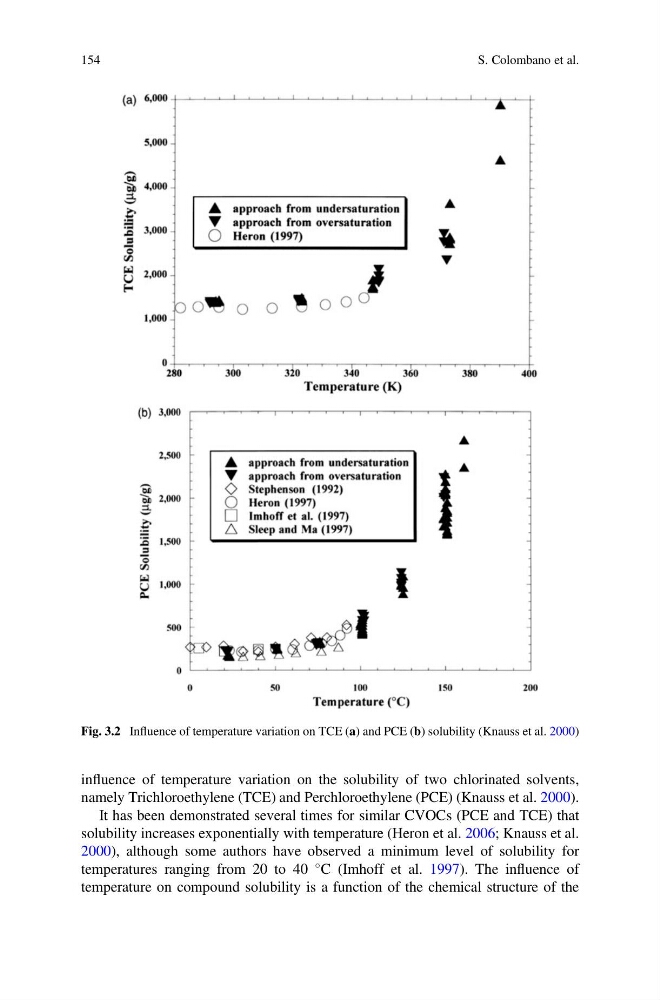
influence of temperature variation on the solubility of two chlorinated solvents,
namely Trichloroethylene (TCE) and Perchloroethylene (PCE) (Knauss et al. 2000).
It has been demonstrated several times for similar CVOCs (PCE and TCE) that
solubility increases exponentially with temperature (Heron et al. 2006; Knauss et al.
2000), although some authors have observed a minimum level of solubility for
temperatures ranging from 20 to 40
C (Imhoff et al. 1997). The influence of
temperature on compound solubility is a function of the chemical structure of the
Fig. 3.2 Influence of temperature variation on TCE (a) and PCE (b) solubility (Knauss et al. 2000)
154
S. Colombano et al.
namely Trichloroethylene (TCE) and Perchloroethylene (PCE) (Knauss et al. 2000).
It has been demonstrated several times for similar CVOCs (PCE and TCE) that
solubility increases exponentially with temperature (Heron et al. 2006; Knauss et al.
2000), although some authors have observed a minimum level of solubility for
temperatures ranging from 20 to 40
C (Imhoff et al. 1997). The influence of
temperature on compound solubility is a function of the chemical structure of the
Fig. 3.2 Influence of temperature variation on TCE (a) and PCE (b) solubility (Knauss et al. 2000)
154
S. Colombano et al.