

50
C (Davis 1997). For CVOCs with a boiling point above 100
C, the vapor
pressure increases by a factor of 40 to 50 when the temperature varies between
10 and 100
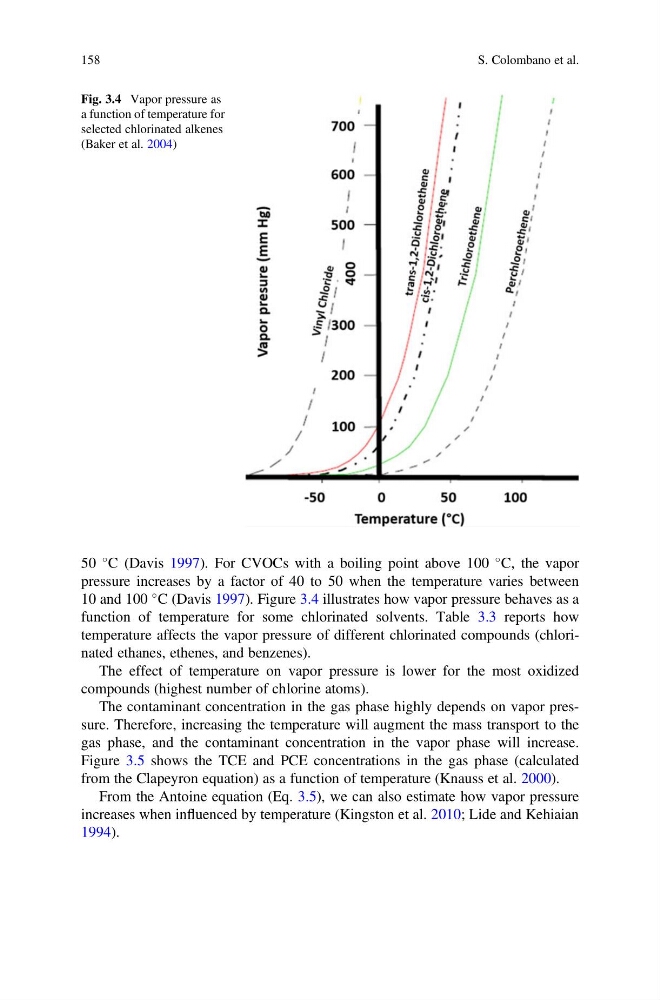
C (Davis 1997). Figure 3.4 illustrates how vapor pressure behaves as a
function of temperature for some chlorinated solvents. Table 3.3 reports how
temperature affects the vapor pressure of different chlorinated compounds (chlorinated ethanes, ethenes, and benzenes).
The effect of temperature on vapor pressure is lower for the most oxidized
compounds (highest number of chlorine atoms).
The contaminant concentration in the gas phase highly depends on vapor pressure. Therefore, increasing the temperature will augment the mass transport to the
gas phase, and the contaminant concentration in the vapor phase will increase.
Figure 3.5 shows the TCE and PCE concentrations in the gas phase (calculated
from the Clapeyron equation) as a function of temperature (Knauss et al. 2000).
From the Antoine equation (Eq. 3.5), we can also estimate how vapor pressure
increases when influenced by temperature (Kingston et al. 2010; Lide and Kehiaian
1994).
Fig. 3.4 Vapor pressure as
a function of temperature for
selected chlorinated alkenes
(Baker et al. 2004)
158
S. Colombano et al.
C (Davis 1997). For CVOCs with a boiling point above 100
C, the vapor
pressure increases by a factor of 40 to 50 when the temperature varies between
10 and 100
C (Davis 1997). Figure 3.4 illustrates how vapor pressure behaves as a
function of temperature for some chlorinated solvents. Table 3.3 reports how
temperature affects the vapor pressure of different chlorinated compounds (chlorinated ethanes, ethenes, and benzenes).
The effect of temperature on vapor pressure is lower for the most oxidized
compounds (highest number of chlorine atoms).
The contaminant concentration in the gas phase highly depends on vapor pressure. Therefore, increasing the temperature will augment the mass transport to the
gas phase, and the contaminant concentration in the vapor phase will increase.
Figure 3.5 shows the TCE and PCE concentrations in the gas phase (calculated
from the Clapeyron equation) as a function of temperature (Knauss et al. 2000).
From the Antoine equation (Eq. 3.5), we can also estimate how vapor pressure
increases when influenced by temperature (Kingston et al. 2010; Lide and Kehiaian
1994).
Fig. 3.4 Vapor pressure as
a function of temperature for
selected chlorinated alkenes
(Baker et al. 2004)
158
S. Colombano et al.