

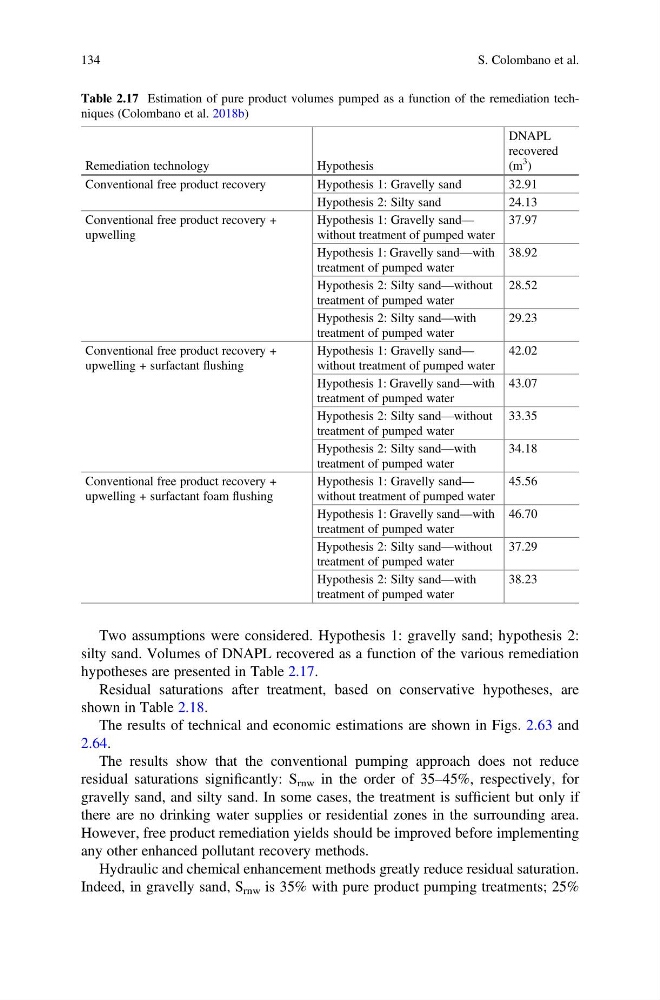
Two assumptions were considered. Hypothesis 1: gravelly sand; hypothesis 2:
silty sand. Volumes of DNAPL recovered as a function of the various remediation
hypotheses are presented in Table 2.17.
Residual saturations after treatment, based on conservative hypotheses, are
shown in Table 2.18.
The results of technical and economic estimations are shown in Figs. 2.63 and
2.64.
The results show that the conventional pumping approach does not reduce
residual saturations significantly: S rnw in the order of 35–45%, respectively, for
gravelly sand, and silty sand. In some cases, the treatment is sufficient but only if
there are no drinking water supplies or residential zones in the surrounding area.
However, free product remediation yields should be improved before implementing
any other enhanced pollutant recovery methods.
Hydraulic and chemical enhancement methods greatly reduce residual saturation.
Indeed, in gravelly sand, S rnw is 35% with pure product pumping treatments; 25%
Table 2.17 Estimation of pure product volumes pumped as a function of the remediation techniques (Colombano et al. 2018b)
Remediation technology
Hypothesis
DNAPL
recovered
(m
3
)
Conventional free product recovery
Hypothesis 1: Gravelly sand
32.91
Hypothesis 2: Silty sand
24.13
Conventional free product recovery +
upwelling
Hypothesis 1: Gravelly sand—
without treatment of pumped water
37.97
Hypothesis 1: Gravelly sand—with
treatment of pumped water
38.92
Hypothesis 2: Silty sand—without
treatment of pumped water
28.52
Hypothesis 2: Silty sand—with
treatment of pumped water
29.23
Conventional free product recovery +
upwelling + surfactant flushing
Hypothesis 1: Gravelly sand—
without treatment of pumped water
42.02
Hypothesis 1: Gravelly sand—with
treatment of pumped water
43.07
Hypothesis 2: Silty sand—without
treatment of pumped water
33.35
Hypothesis 2: Silty sand—with
treatment of pumped water
34.18
Conventional free product recovery +
upwelling + surfactant foam flushing
Hypothesis 1: Gravelly sand—
without treatment of pumped water
45.56
Hypothesis 1: Gravelly sand—with
treatment of pumped water
46.70
Hypothesis 2: Silty sand—without
treatment of pumped water
37.29
Hypothesis 2: Silty sand—with
treatment of pumped water
38.23
134
S. Colombano et al.
silty sand. Volumes of DNAPL recovered as a function of the various remediation
hypotheses are presented in Table 2.17.
Residual saturations after treatment, based on conservative hypotheses, are
shown in Table 2.18.
The results of technical and economic estimations are shown in Figs. 2.63 and
2.64.
The results show that the conventional pumping approach does not reduce
residual saturations significantly: S rnw in the order of 35–45%, respectively, for
gravelly sand, and silty sand. In some cases, the treatment is sufficient but only if
there are no drinking water supplies or residential zones in the surrounding area.
However, free product remediation yields should be improved before implementing
any other enhanced pollutant recovery methods.
Hydraulic and chemical enhancement methods greatly reduce residual saturation.
Indeed, in gravelly sand, S rnw is 35% with pure product pumping treatments; 25%
Table 2.17 Estimation of pure product volumes pumped as a function of the remediation techniques (Colombano et al. 2018b)
Remediation technology
Hypothesis
DNAPL
recovered
(m
3
)
Conventional free product recovery
Hypothesis 1: Gravelly sand
32.91
Hypothesis 2: Silty sand
24.13
Conventional free product recovery +
upwelling
Hypothesis 1: Gravelly sand—
without treatment of pumped water
37.97
Hypothesis 1: Gravelly sand—with
treatment of pumped water
38.92
Hypothesis 2: Silty sand—without
treatment of pumped water
28.52
Hypothesis 2: Silty sand—with
treatment of pumped water
29.23
Conventional free product recovery +
upwelling + surfactant flushing
Hypothesis 1: Gravelly sand—
without treatment of pumped water
42.02
Hypothesis 1: Gravelly sand—with
treatment of pumped water
43.07
Hypothesis 2: Silty sand—without
treatment of pumped water
33.35
Hypothesis 2: Silty sand—with
treatment of pumped water
34.18
Conventional free product recovery +
upwelling + surfactant foam flushing
Hypothesis 1: Gravelly sand—
without treatment of pumped water
45.56
Hypothesis 1: Gravelly sand—with
treatment of pumped water
46.70
Hypothesis 2: Silty sand—without
treatment of pumped water
37.29
Hypothesis 2: Silty sand—with
treatment of pumped water
38.23
134
S. Colombano et al.