

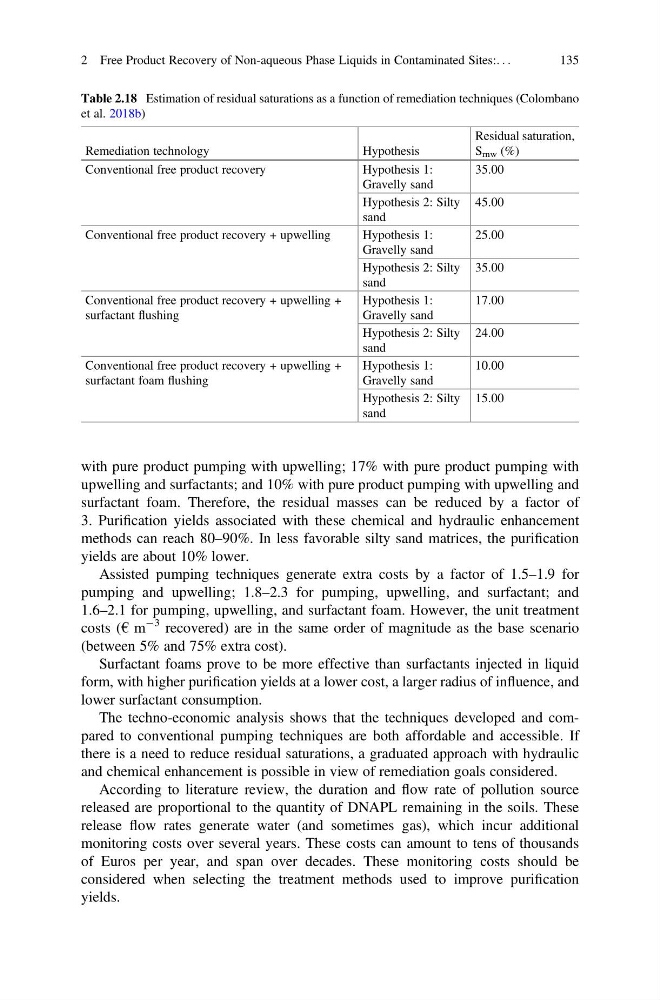
with pure product pumping with upwelling; 17% with pure product pumping with
upwelling and surfactants; and 10% with pure product pumping with upwelling and
surfactant foam. Therefore, the residual masses can be reduced by a factor of
3. Purification yields associated with these chemical and hydraulic enhancement
methods can reach 80–90%. In less favorable silty sand matrices, the purification
yields are about 10% lower.
Assisted pumping techniques generate extra costs by a factor of 1.5–1.9 for
pumping and upwelling; 1.8–2.3 for pumping, upwelling, and surfactant; and
1.6–2.1 for pumping, upwelling, and surfactant foam. However, the unit treatment
costs (€ m
À3 recovered) are in the same order of magnitude as the base scenario
(between 5% and 75% extra cost).
Surfactant foams prove to be more effective than surfactants injected in liquid
form, with higher purification yields at a lower cost, a larger radius of influence, and
lower surfactant consumption.
The techno-economic analysis shows that the techniques developed and compared to conventional pumping techniques are both affordable and accessible. If
there is a need to reduce residual saturations, a graduated approach with hydraulic
and chemical enhancement is possible in view of remediation goals considered.
According to literature review, the duration and flow rate of pollution source
released are proportional to the quantity of DNAPL remaining in the soils. These
release flow rates generate water (and sometimes gas), which incur additional
monitoring costs over several years. These costs can amount to tens of thousands
of Euros per year, and span over decades. These monitoring costs should be
considered when selecting the treatment methods used to improve purification
yields.
Table 2.18 Estimation of residual saturations as a function of remediation techniques (Colombano
et al. 2018b)
Remediation technology
Hypothesis
Residual saturation,
S rnw (%)
Conventional free product recovery
Hypothesis 1:
Gravelly sand
35.00
Hypothesis 2: Silty
sand
45.00
Conventional free product recovery + upwelling
Hypothesis 1:
Gravelly sand
25.00
Hypothesis 2: Silty
sand
35.00
Conventional free product recovery + upwelling +
surfactant flushing
Hypothesis 1:
Gravelly sand
17.00
Hypothesis 2: Silty
sand
24.00
Conventional free product recovery + upwelling +
surfactant foam flushing
Hypothesis 1:
Gravelly sand
10.00
Hypothesis 2: Silty
sand
15.00
2 Free Product Recovery of Non-aqueous Phase Liquids in Contaminated Sites:. . .
135
upwelling and surfactants; and 10% with pure product pumping with upwelling and
surfactant foam. Therefore, the residual masses can be reduced by a factor of
3. Purification yields associated with these chemical and hydraulic enhancement
methods can reach 80–90%. In less favorable silty sand matrices, the purification
yields are about 10% lower.
Assisted pumping techniques generate extra costs by a factor of 1.5–1.9 for
pumping and upwelling; 1.8–2.3 for pumping, upwelling, and surfactant; and
1.6–2.1 for pumping, upwelling, and surfactant foam. However, the unit treatment
costs (€ m
À3 recovered) are in the same order of magnitude as the base scenario
(between 5% and 75% extra cost).
Surfactant foams prove to be more effective than surfactants injected in liquid
form, with higher purification yields at a lower cost, a larger radius of influence, and
lower surfactant consumption.
The techno-economic analysis shows that the techniques developed and compared to conventional pumping techniques are both affordable and accessible. If
there is a need to reduce residual saturations, a graduated approach with hydraulic
and chemical enhancement is possible in view of remediation goals considered.
According to literature review, the duration and flow rate of pollution source
released are proportional to the quantity of DNAPL remaining in the soils. These
release flow rates generate water (and sometimes gas), which incur additional
monitoring costs over several years. These costs can amount to tens of thousands
of Euros per year, and span over decades. These monitoring costs should be
considered when selecting the treatment methods used to improve purification
yields.
Table 2.18 Estimation of residual saturations as a function of remediation techniques (Colombano
et al. 2018b)
Remediation technology
Hypothesis
Residual saturation,
S rnw (%)
Conventional free product recovery
Hypothesis 1:
Gravelly sand
35.00
Hypothesis 2: Silty
sand
45.00
Conventional free product recovery + upwelling
Hypothesis 1:
Gravelly sand
25.00
Hypothesis 2: Silty
sand
35.00
Conventional free product recovery + upwelling +
surfactant flushing
Hypothesis 1:
Gravelly sand
17.00
Hypothesis 2: Silty
sand
24.00
Conventional free product recovery + upwelling +
surfactant foam flushing
Hypothesis 1:
Gravelly sand
10.00
Hypothesis 2: Silty
sand
15.00
2 Free Product Recovery of Non-aqueous Phase Liquids in Contaminated Sites:. . .
135