

2.7.1.6 Next Steps
Once the cleanup goals were achieved, monitored measurements suggested that the
absence of unacceptable residual impact could be guaranteed (with a review after
4 years). We also implemented usage and conservation restrictions for industrial uses
at the site, usage restrictions for groundwater at the site, and groundwater
monitoring.
2.7.2 Case Study 2: DNAPL Recovery
This study is part of the SILPHES project, financially supported by the ADEME as
part of “Investissements d’Avenir” (Investments for the Future).
The Tavaux site is a large chloroalkali chemical plant located near Dole in eastern
France. From the early 1980s until 2007, an historical DNAPL pool of several
hectares was physically confined, and migration was monitored (Fig. 2.41). Following DNAPL migration from a landfill, a steady-state plume has formed within a
shallow water-table sandy aquifer located above a clayey unit 10 m deep. A DNAPL
thickness of 0.20–1.50 m due to the morphology of the substratum has been
observed (Figs. 2.42 and 2.43) (Cazaux et al. 2014). The hydraulic conductivity of
the site ranges from 10
À2 to 10
À4 m s
À1 depending on the proportion of clay in the
sand. DNAPL migration has been controlled by two water-pumping wells for the
past 30 years. This has caused a water depression and inverse gradient in the area.
The average flow rate of the hydraulic confinement is 40 m
3 h
À1 . The DNAPL is
composed of a mixture of heavy chlorinated compounds: hexachlorobutadiene
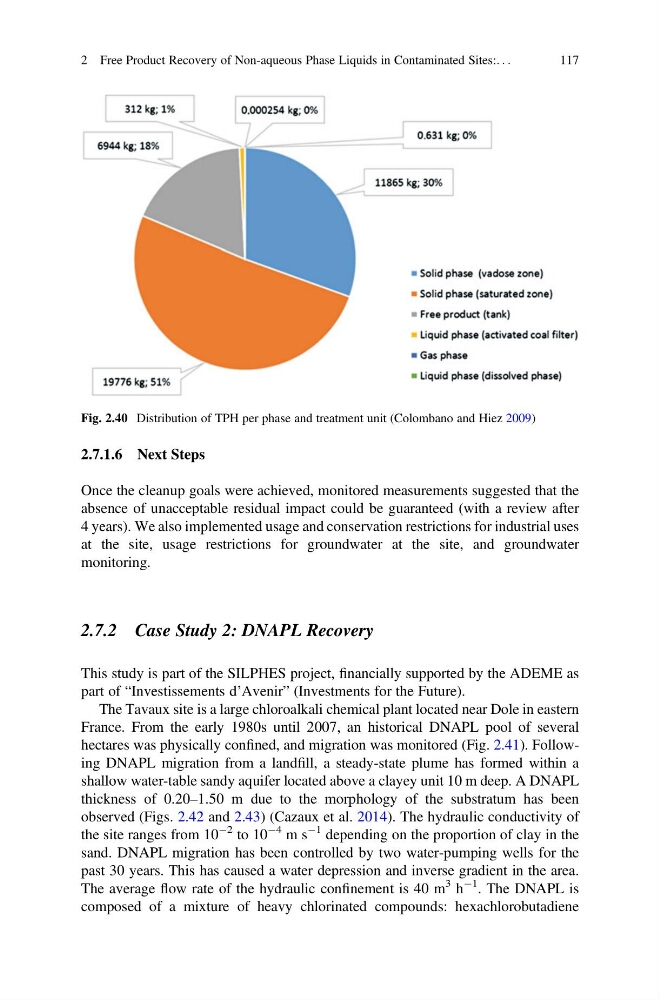
Fig. 2.40 Distribution of TPH per phase and treatment unit (Colombano and Hiez 2009)
2 Free Product Recovery of Non-aqueous Phase Liquids in Contaminated Sites:. . .
117
Once the cleanup goals were achieved, monitored measurements suggested that the
absence of unacceptable residual impact could be guaranteed (with a review after
4 years). We also implemented usage and conservation restrictions for industrial uses
at the site, usage restrictions for groundwater at the site, and groundwater
monitoring.
2.7.2 Case Study 2: DNAPL Recovery
This study is part of the SILPHES project, financially supported by the ADEME as
part of “Investissements d’Avenir” (Investments for the Future).
The Tavaux site is a large chloroalkali chemical plant located near Dole in eastern
France. From the early 1980s until 2007, an historical DNAPL pool of several
hectares was physically confined, and migration was monitored (Fig. 2.41). Following DNAPL migration from a landfill, a steady-state plume has formed within a
shallow water-table sandy aquifer located above a clayey unit 10 m deep. A DNAPL
thickness of 0.20–1.50 m due to the morphology of the substratum has been
observed (Figs. 2.42 and 2.43) (Cazaux et al. 2014). The hydraulic conductivity of
the site ranges from 10
À2 to 10
À4 m s
À1 depending on the proportion of clay in the
sand. DNAPL migration has been controlled by two water-pumping wells for the
past 30 years. This has caused a water depression and inverse gradient in the area.
The average flow rate of the hydraulic confinement is 40 m
3 h
À1 . The DNAPL is
composed of a mixture of heavy chlorinated compounds: hexachlorobutadiene
Fig. 2.40 Distribution of TPH per phase and treatment unit (Colombano and Hiez 2009)
2 Free Product Recovery of Non-aqueous Phase Liquids in Contaminated Sites:. . .
117