

(55%), hexachloroethane (14%), perchloroethylene (8%), carbon tetrachloride (4%),
trichloroethylene (2%), hexachlorobenzene (1%), and others (16%).
2.7.2.1 Installation of Concrete Cubic Compartments
Four concrete cubic compartments were built, confining a DNAPL pool at the
bottom of the alluvial aquifer of the polluted zone (Figs. 2.43 and 2.44). The purpose
of these cubic compartments was to be able to perform DNAPL recovery tests with
hydraulic and chemical enhancements in completely controlled conditions. The goal
of this research project was to improve the recovery rate and yield of free product
and consequently, to reduce residual saturation as much as possible.
Figures 2.45 and 2.46 show the construction of the concrete cubic compartments
and free product recovery tests.
2.7.2.2 Conventional Free Product Recovery and Modeling
Each compartment is equipped with a central recovery well and four monitoring
wells/recovery wells, located at each corner (Fig. 2.47). DNAPL is pumped from the
central recovery well via a regulation controller. The control is achieved by two
pressure probes (DNAPL level sensors), one placed in the DNAPL free phase within
the collector, and the other in the aqueous phase (Fig. 2.48).
To optimize the DNAPL extraction, the aim was to set a pumping cycle that
would allow most of the free DNAPL mobile phase to be recovered as fast as
possible, without having to purge the collector. The idea was to maintain the
continuum of the free DNAPL phase. Indeed, the continuum can be broken if
pumping is done too quickly, potentially hindering the DNAPL from reaching the
central station, and stifling the capacity to extract a maximum of DNAPL due to the
Monitoring wells
DNAPL pumping
wells
Water pumping
wells
Modern alluvium
Old alluvium
Bedrock
Alveoli « watertight »
(empty today)
Dams
Free product
Dissolved phase
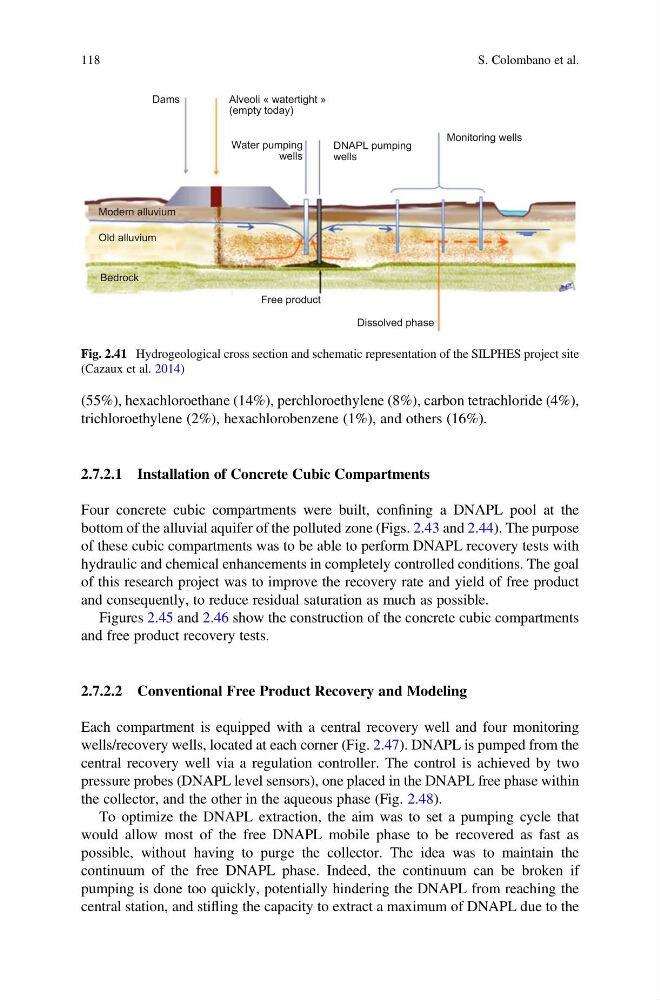
Fig. 2.41 Hydrogeological cross section and schematic representation of the SILPHES project site
(Cazaux et al. 2014)
118
S. Colombano et al.
trichloroethylene (2%), hexachlorobenzene (1%), and others (16%).
2.7.2.1 Installation of Concrete Cubic Compartments
Four concrete cubic compartments were built, confining a DNAPL pool at the
bottom of the alluvial aquifer of the polluted zone (Figs. 2.43 and 2.44). The purpose
of these cubic compartments was to be able to perform DNAPL recovery tests with
hydraulic and chemical enhancements in completely controlled conditions. The goal
of this research project was to improve the recovery rate and yield of free product
and consequently, to reduce residual saturation as much as possible.
Figures 2.45 and 2.46 show the construction of the concrete cubic compartments
and free product recovery tests.
2.7.2.2 Conventional Free Product Recovery and Modeling
Each compartment is equipped with a central recovery well and four monitoring
wells/recovery wells, located at each corner (Fig. 2.47). DNAPL is pumped from the
central recovery well via a regulation controller. The control is achieved by two
pressure probes (DNAPL level sensors), one placed in the DNAPL free phase within
the collector, and the other in the aqueous phase (Fig. 2.48).
To optimize the DNAPL extraction, the aim was to set a pumping cycle that
would allow most of the free DNAPL mobile phase to be recovered as fast as
possible, without having to purge the collector. The idea was to maintain the
continuum of the free DNAPL phase. Indeed, the continuum can be broken if
pumping is done too quickly, potentially hindering the DNAPL from reaching the
central station, and stifling the capacity to extract a maximum of DNAPL due to the
Monitoring wells
DNAPL pumping
wells
Water pumping
wells
Modern alluvium
Old alluvium
Bedrock
Alveoli « watertight »
(empty today)
Dams
Free product
Dissolved phase
Fig. 2.41 Hydrogeological cross section and schematic representation of the SILPHES project site
(Cazaux et al. 2014)
118
S. Colombano et al.