

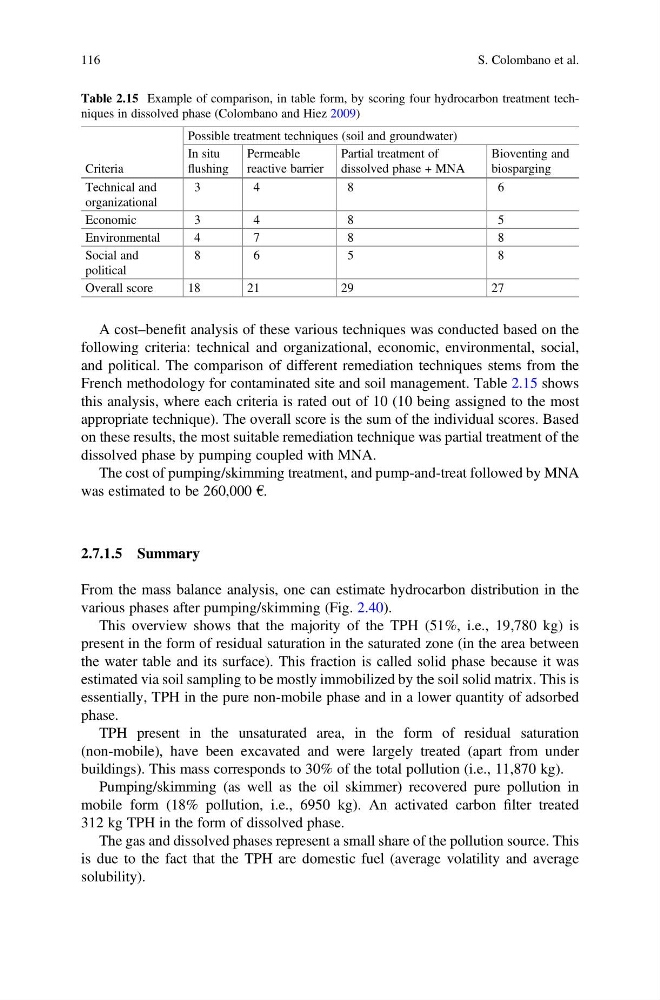
A cost–benefit analysis of these various techniques was conducted based on the
following criteria: technical and organizational, economic, environmental, social,
and political. The comparison of different remediation techniques stems from the
French methodology for contaminated site and soil management. Table 2.15 shows
this analysis, where each criteria is rated out of 10 (10 being assigned to the most
appropriate technique). The overall score is the sum of the individual scores. Based
on these results, the most suitable remediation technique was partial treatment of the
dissolved phase by pumping coupled with MNA.
The cost of pumping/skimming treatment, and pump-and-treat followed by MNA
was estimated to be 260,000 €.
2.7.1.5 Summary
From the mass balance analysis, one can estimate hydrocarbon distribution in the
various phases after pumping/skimming (Fig. 2.40).
This overview shows that the majority of the TPH (51%, i.e., 19,780 kg) is
present in the form of residual saturation in the saturated zone (in the area between
the water table and its surface). This fraction is called solid phase because it was
estimated via soil sampling to be mostly immobilized by the soil solid matrix. This is
essentially, TPH in the pure non-mobile phase and in a lower quantity of adsorbed
phase.
TPH present in the unsaturated area, in the form of residual saturation
(non-mobile), have been excavated and were largely treated (apart from under
buildings). This mass corresponds to 30% of the total pollution (i.e., 11,870 kg).
Pumping/skimming (as well as the oil skimmer) recovered pure pollution in
mobile form (18% pollution, i.e., 6950 kg). An activated carbon filter treated
312 kg TPH in the form of dissolved phase.
The gas and dissolved phases represent a small share of the pollution source. This
is due to the fact that the TPH are domestic fuel (average volatility and average
solubility).
Table 2.15 Example of comparison, in table form, by scoring four hydrocarbon treatment techniques in dissolved phase (Colombano and Hiez 2009)
Criteria
Possible treatment techniques (soil and groundwater)
In situ
flushing
Permeable
reactive barrier
Partial treatment of
dissolved phase + MNA
Bioventing and
biosparging
Technical and
organizational
3
4
8
6
Economic
3
4
8
5
Environmental
4
7
8
8
Social and
political
8
6
5
8
Overall score
18
21
29
27
116
S. Colombano et al.
following criteria: technical and organizational, economic, environmental, social,
and political. The comparison of different remediation techniques stems from the
French methodology for contaminated site and soil management. Table 2.15 shows
this analysis, where each criteria is rated out of 10 (10 being assigned to the most
appropriate technique). The overall score is the sum of the individual scores. Based
on these results, the most suitable remediation technique was partial treatment of the
dissolved phase by pumping coupled with MNA.
The cost of pumping/skimming treatment, and pump-and-treat followed by MNA
was estimated to be 260,000 €.
2.7.1.5 Summary
From the mass balance analysis, one can estimate hydrocarbon distribution in the
various phases after pumping/skimming (Fig. 2.40).
This overview shows that the majority of the TPH (51%, i.e., 19,780 kg) is
present in the form of residual saturation in the saturated zone (in the area between
the water table and its surface). This fraction is called solid phase because it was
estimated via soil sampling to be mostly immobilized by the soil solid matrix. This is
essentially, TPH in the pure non-mobile phase and in a lower quantity of adsorbed
phase.
TPH present in the unsaturated area, in the form of residual saturation
(non-mobile), have been excavated and were largely treated (apart from under
buildings). This mass corresponds to 30% of the total pollution (i.e., 11,870 kg).
Pumping/skimming (as well as the oil skimmer) recovered pure pollution in
mobile form (18% pollution, i.e., 6950 kg). An activated carbon filter treated
312 kg TPH in the form of dissolved phase.
The gas and dissolved phases represent a small share of the pollution source. This
is due to the fact that the TPH are domestic fuel (average volatility and average
solubility).
Table 2.15 Example of comparison, in table form, by scoring four hydrocarbon treatment techniques in dissolved phase (Colombano and Hiez 2009)
Criteria
Possible treatment techniques (soil and groundwater)
In situ
flushing
Permeable
reactive barrier
Partial treatment of
dissolved phase + MNA
Bioventing and
biosparging
Technical and
organizational
3
4
8
6
Economic
3
4
8
5
Environmental
4
7
8
8
Social and
political
8
6
5
8
Overall score
18
21
29
27
116
S. Colombano et al.