

Some of the key challenges perpetuating the high incidence of poverty include,
among others, the rapid population growth, environmental change, income inequalities, fragility to shocks, inadequate economic diversification from primary economic sectors and lack of (and ineffective use) of resources (AfDB 2018;
Sembene 2015; UNECA 2017; Hakura et al. 2016; Alobo Loison 2015)
(Table 1.1). Many national, regional and international actors have sought for decades
to reduce poverty with large-scale policies, programs and plans or small tailored
interventions (World Bank 2019a; Sembene 2015). However such efforts often
underperform or even fail due to the lack of evidence, capacity, political commitment and/or funding (World Bank 2017). Furthermore, there is a critical lack of
updated, reliable and comparable data across geographic scales to understand better
the current poverty patterns and its determinants (SDG Centre for Africa 2019).
The above are compounded by the fact that SSA still has a predominately rural
population (Amoah and Phillips 2018). Rural settlements are scattered and lack
proper infrastructure, hence it is not easy to deliver basic services vital for poverty
reduction such as education, health and access to clean drinking water and energy,
or to generate jobs and income opportunities, creating thus a vicious cycle (see Sects.
1.2.6, 1.2.7, 1.2.9 and 1.2.11). Furthermore, as rain-fed subsistence agriculture and
pastoralism are the primary livelihoods across much of the continent, their increasing
vulnerability to climate change, land degradation and social conflicts poses further
barriers to rural poverty alleviation (IPBES 2018) (Sects. 1.2.2, 1.2.8, 1.2.13 and
1.2.15). For example, poverty for as many as 52% of the pastoralist and 42% of the
agro-pastoralist communities in the region might be due to drought-related crop
failures and massive death of livestock (Middleton and Sternberg 2013). Indeed,
communities in semi-arid areas lag for most of the development indicators and hence
are highly vulnerable to extreme poverty (Middleton and Sternberg 2013).
Despite the growing urban population (Sect. 1.1), the dynamics and extent of
urban poverty have not received due attention in research and policy (Lucci et al.
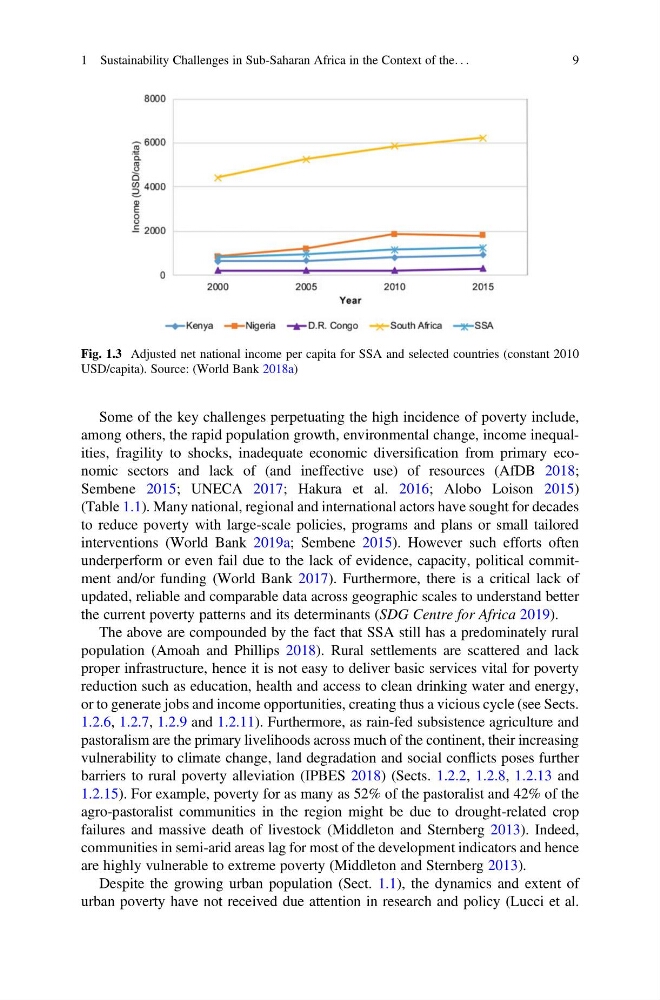
Fig. 1.3 Adjusted net national income per capita for SSA and selected countries (constant 2010
USD/capita). Source: (World Bank 2018a)
1 Sustainability Challenges in Sub-Saharan Africa in the Context of the. . .
9
among others, the rapid population growth, environmental change, income inequalities, fragility to shocks, inadequate economic diversification from primary economic sectors and lack of (and ineffective use) of resources (AfDB 2018;
Sembene 2015; UNECA 2017; Hakura et al. 2016; Alobo Loison 2015)
(Table 1.1). Many national, regional and international actors have sought for decades
to reduce poverty with large-scale policies, programs and plans or small tailored
interventions (World Bank 2019a; Sembene 2015). However such efforts often
underperform or even fail due to the lack of evidence, capacity, political commitment and/or funding (World Bank 2017). Furthermore, there is a critical lack of
updated, reliable and comparable data across geographic scales to understand better
the current poverty patterns and its determinants (SDG Centre for Africa 2019).
The above are compounded by the fact that SSA still has a predominately rural
population (Amoah and Phillips 2018). Rural settlements are scattered and lack
proper infrastructure, hence it is not easy to deliver basic services vital for poverty
reduction such as education, health and access to clean drinking water and energy,
or to generate jobs and income opportunities, creating thus a vicious cycle (see Sects.
1.2.6, 1.2.7, 1.2.9 and 1.2.11). Furthermore, as rain-fed subsistence agriculture and
pastoralism are the primary livelihoods across much of the continent, their increasing
vulnerability to climate change, land degradation and social conflicts poses further
barriers to rural poverty alleviation (IPBES 2018) (Sects. 1.2.2, 1.2.8, 1.2.13 and
1.2.15). For example, poverty for as many as 52% of the pastoralist and 42% of the
agro-pastoralist communities in the region might be due to drought-related crop
failures and massive death of livestock (Middleton and Sternberg 2013). Indeed,
communities in semi-arid areas lag for most of the development indicators and hence
are highly vulnerable to extreme poverty (Middleton and Sternberg 2013).
Despite the growing urban population (Sect. 1.1), the dynamics and extent of
urban poverty have not received due attention in research and policy (Lucci et al.
Fig. 1.3 Adjusted net national income per capita for SSA and selected countries (constant 2010
USD/capita). Source: (World Bank 2018a)
1 Sustainability Challenges in Sub-Saharan Africa in the Context of the. . .
9