

different countries, local contexts and sustainability challenges in the region, this
introduction chapter does not seek to be comprehensive but to highlight some of the
most important trends and prevailing circumstances. Section 1.2 introduces the main
patterns and challenges for each SDG. Section 1.3 introduces briefly the different
chapters and the overall aims, themes and structure of the two edited volumes.
1.2 SDG Progress and Underlying Sustainability
Challenges in Sub-Saharan Africa
1.2.1 SDG 1: No Poverty
SSA is characterized by deep and endemic poverty in many areas. Even though the
overall poverty rate has dropped from 57% in 1990 to 43% in 2012 (Hakura et al.
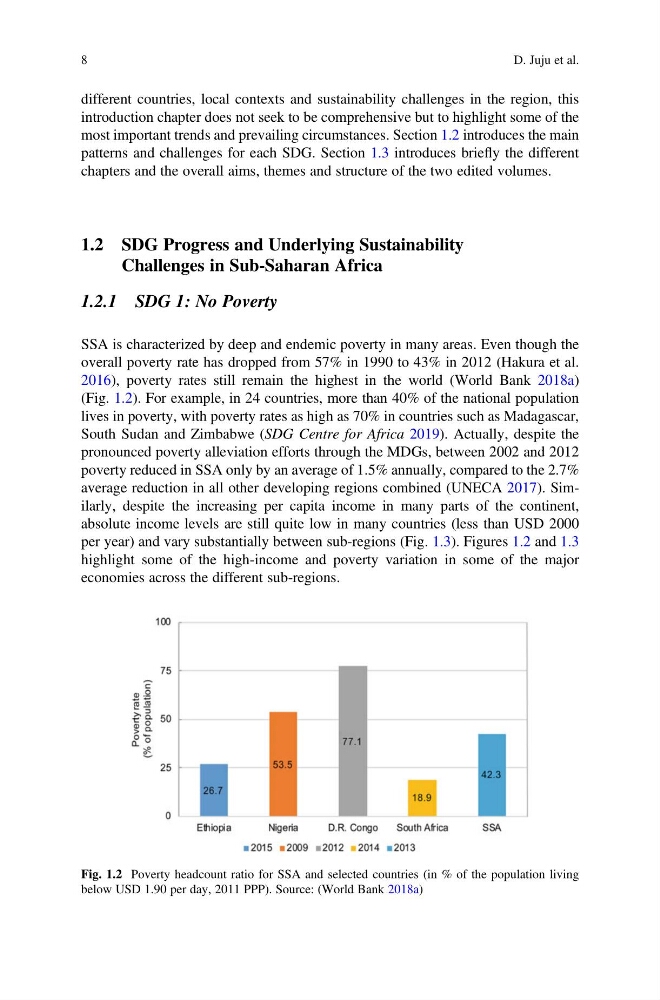
2016), poverty rates still remain the highest in the world (World Bank 2018a)
(Fig. 1.2). For example, in 24 countries, more than 40% of the national population
lives in poverty, with poverty rates as high as 70% in countries such as Madagascar,
South Sudan and Zimbabwe (SDG Centre for Africa 2019). Actually, despite the
pronounced poverty alleviation efforts through the MDGs, between 2002 and 2012
poverty reduced in SSA only by an average of 1.5% annually, compared to the 2.7%
average reduction in all other developing regions combined (UNECA 2017). Similarly, despite the increasing per capita income in many parts of the continent,
absolute income levels are still quite low in many countries (less than USD 2000
per year) and vary substantially between sub-regions (Fig. 1.3). Figures 1.2 and 1.3
highlight some of the high-income and poverty variation in some of the major
economies across the different sub-regions.
Fig. 1.2 Poverty headcount ratio for SSA and selected countries (in % of the population living
below USD 1.90 per day, 2011 PPP). Source: (World Bank 2018a)
8
D. Juju et al.
introduction chapter does not seek to be comprehensive but to highlight some of the
most important trends and prevailing circumstances. Section 1.2 introduces the main
patterns and challenges for each SDG. Section 1.3 introduces briefly the different
chapters and the overall aims, themes and structure of the two edited volumes.
1.2 SDG Progress and Underlying Sustainability
Challenges in Sub-Saharan Africa
1.2.1 SDG 1: No Poverty
SSA is characterized by deep and endemic poverty in many areas. Even though the
overall poverty rate has dropped from 57% in 1990 to 43% in 2012 (Hakura et al.
2016), poverty rates still remain the highest in the world (World Bank 2018a)
(Fig. 1.2). For example, in 24 countries, more than 40% of the national population
lives in poverty, with poverty rates as high as 70% in countries such as Madagascar,
South Sudan and Zimbabwe (SDG Centre for Africa 2019). Actually, despite the
pronounced poverty alleviation efforts through the MDGs, between 2002 and 2012
poverty reduced in SSA only by an average of 1.5% annually, compared to the 2.7%
average reduction in all other developing regions combined (UNECA 2017). Similarly, despite the increasing per capita income in many parts of the continent,
absolute income levels are still quite low in many countries (less than USD 2000
per year) and vary substantially between sub-regions (Fig. 1.3). Figures 1.2 and 1.3
highlight some of the high-income and poverty variation in some of the major
economies across the different sub-regions.
Fig. 1.2 Poverty headcount ratio for SSA and selected countries (in % of the population living
below USD 1.90 per day, 2011 PPP). Source: (World Bank 2018a)
8
D. Juju et al.