

Second-Generation Bioethanol: Advancement of Ethanologenic …
77
act as a physical support (Pandey 2001). However, SSF poses some problem which
is poor heat removal, hardly to agitate the substrate, aeration problem, moisture distribution problem, rapid microorganism determination and limited type of organism
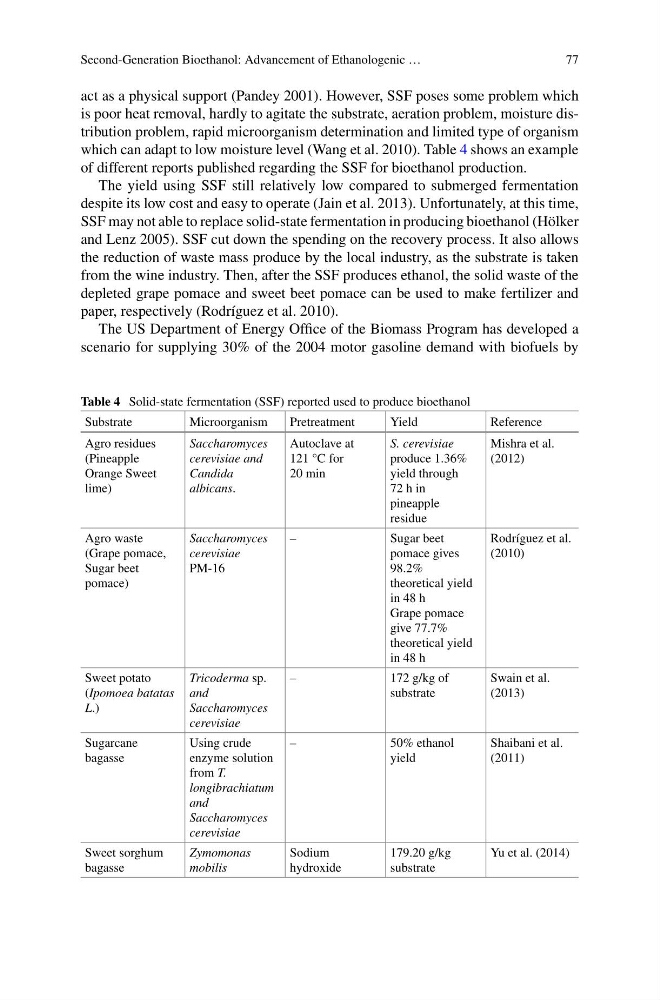
which can adapt to low moisture level (Wang et al. 2010). Table 4 shows an example
of different reports published regarding the SSF for bioethanol production.
The yield using SSF still relatively low compared to submerged fermentation
despite its low cost and easy to operate (Jain et al. 2013). Unfortunately, at this time,
SSF may not able to replace solid-state fermentation in producing bioethanol (Hölker
and Lenz 2005). SSF cut down the spending on the recovery process. It also allows
the reduction of waste mass produce by the local industry, as the substrate is taken
from the wine industry. Then, after the SSF produces ethanol, the solid waste of the
depleted grape pomace and sweet beet pomace can be used to make fertilizer and
paper, respectively (Rodríguez et al. 2010).
The US Department of Energy Office of the Biomass Program has developed a
scenario for supplying 30% of the 2004 motor gasoline demand with biofuels by
Table 4 Solid-state fermentation (SSF) reported used to produce bioethanol
Substrate
Microorganism
Pretreatment
Yield
Reference
Agro residues
(Pineapple
Orange Sweet
lime)
Saccharomyces
cerevisiae and
Candida
albicans.
Autoclave at
121 °C for
20 min
S. cerevisiae
produce 1.36%
yield through
72 h in
pineapple
residue
Mishra et al.
(2012)
Agro waste
(Grape pomace,
Sugar beet
pomace)
Saccharomyces
cerevisiae
PM-16
–
Sugar beet
pomace gives
98.2%
theoretical yield
in 48 h
Grape pomace
give 77.7%
theoretical yield
in 48 h
Rodríguez et al.
(2010)
Sweet potato
(Ipomoea batatas
L.)
Tricoderma sp.
and
Saccharomyces
cerevisiae
–
172 g/kg of
substrate
Swain et al.
(2013)
Sugarcane
bagasse
Using crude
enzyme solution
from T.
longibrachiatum
and
Saccharomyces
cerevisiae
–
50% ethanol
yield
Shaibani et al.
(2011)
Sweet sorghum
bagasse
Zymomonas
mobilis
Sodium
hydroxide
179.20 g/kg
substrate
Yu et al. (2014)
77
act as a physical support (Pandey 2001). However, SSF poses some problem which
is poor heat removal, hardly to agitate the substrate, aeration problem, moisture distribution problem, rapid microorganism determination and limited type of organism
which can adapt to low moisture level (Wang et al. 2010). Table 4 shows an example
of different reports published regarding the SSF for bioethanol production.
The yield using SSF still relatively low compared to submerged fermentation
despite its low cost and easy to operate (Jain et al. 2013). Unfortunately, at this time,
SSF may not able to replace solid-state fermentation in producing bioethanol (Hölker
and Lenz 2005). SSF cut down the spending on the recovery process. It also allows
the reduction of waste mass produce by the local industry, as the substrate is taken
from the wine industry. Then, after the SSF produces ethanol, the solid waste of the
depleted grape pomace and sweet beet pomace can be used to make fertilizer and
paper, respectively (Rodríguez et al. 2010).
The US Department of Energy Office of the Biomass Program has developed a
scenario for supplying 30% of the 2004 motor gasoline demand with biofuels by
Table 4 Solid-state fermentation (SSF) reported used to produce bioethanol
Substrate
Microorganism
Pretreatment
Yield
Reference
Agro residues
(Pineapple
Orange Sweet
lime)
Saccharomyces
cerevisiae and
Candida
albicans.
Autoclave at
121 °C for
20 min
S. cerevisiae
produce 1.36%
yield through
72 h in
pineapple
residue
Mishra et al.
(2012)
Agro waste
(Grape pomace,
Sugar beet
pomace)
Saccharomyces
cerevisiae
PM-16
–
Sugar beet
pomace gives
98.2%
theoretical yield
in 48 h
Grape pomace
give 77.7%
theoretical yield
in 48 h
Rodríguez et al.
(2010)
Sweet potato
(Ipomoea batatas
L.)
Tricoderma sp.
and
Saccharomyces
cerevisiae
–
172 g/kg of
substrate
Swain et al.
(2013)
Sugarcane
bagasse
Using crude
enzyme solution
from T.
longibrachiatum
and
Saccharomyces
cerevisiae
–
50% ethanol
yield
Shaibani et al.
(2011)
Sweet sorghum
bagasse
Zymomonas
mobilis
Sodium
hydroxide
179.20 g/kg
substrate
Yu et al. (2014)