

254
S. Gong et al.
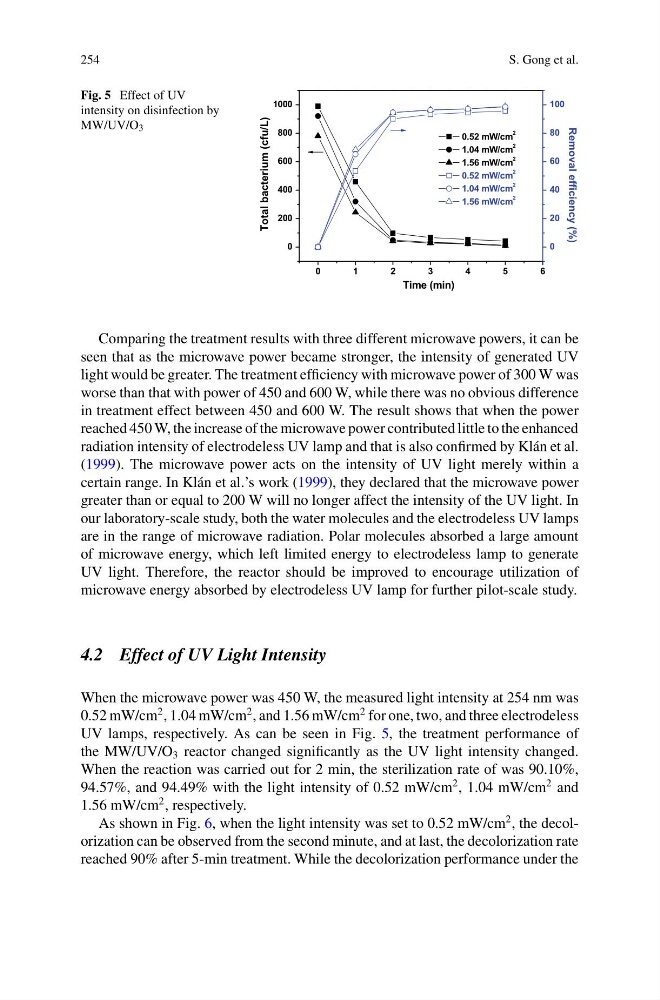
Fig. 5 Effect of UV
intensity on disinfection by
MW/UV/O 3
0
1
2
3
4
5
6
0
200
400
600
800
1000
0.52 mW/cm
2
1.04 mW/cm
2
1.56 mW/cm
2
0.52 mW/cm
2
1.04 mW/cm
2
1.56 mW/cm
2
Time (min)
Total bacterium (cfu/L)
0
20
40
60
80
100
Removal efficiency (%)
Comparing the treatment results with three different microwave powers, it can be
seen that as the microwave power became stronger, the intensity of generated UV
light would be greater. The treatment efficiency with microwave power of 300 W was
worse than that with power of 450 and 600 W, while there was no obvious difference
in treatment effect between 450 and 600 W. The result shows that when the power
reached 450 W, the increase of the microwave power contributed little to the enhanced
radiation intensity of electrodeless UV lamp and that is also confirmed by Klán et al.
(1999). The microwave power acts on the intensity of UV light merely within a
certain range. In Klán et al.’s work (1999), they declared that the microwave power
greater than or equal to 200 W will no longer affect the intensity of the UV light. In
our laboratory-scale study, both the water molecules and the electrodeless UV lamps
are in the range of microwave radiation. Polar molecules absorbed a large amount
of microwave energy, which left limited energy to electrodeless lamp to generate
UV light. Therefore, the reactor should be improved to encourage utilization of
microwave energy absorbed by electrodeless UV lamp for further pilot-scale study.
4.2 Effect of UV Light Intensity
When the microwave power was 450 W, the measured light intensity at 254 nm was
0.52 mW/cm
2 , 1.04 mW/cm
2 , and 1.56 mW/cm
2 for one, two, and three electrodeless
UV lamps, respectively. As can be seen in Fig. 5, the treatment performance of
the MW/UV/O 3 reactor changed significantly as the UV light intensity changed.
When the reaction was carried out for 2 min, the sterilization rate of was 90.10%,
94.57%, and 94.49% with the light intensity of 0.52 mW/cm
2 , 1.04 mW/cm
2 and
1.56 mW/cm
2 , respectively.
As shown in Fig. 6, when the light intensity was set to 0.52 mW/cm
2 , the decolorization can be observed from the second minute, and at last, the decolorization rate
reached 90% after 5-min treatment. While the decolorization performance under the
S. Gong et al.
Fig. 5 Effect of UV
intensity on disinfection by
MW/UV/O 3
0
1
2
3
4
5
6
0
200
400
600
800
1000
0.52 mW/cm
2
1.04 mW/cm
2
1.56 mW/cm
2
0.52 mW/cm
2
1.04 mW/cm
2
1.56 mW/cm
2
Time (min)
Total bacterium (cfu/L)
0
20
40
60
80
100
Removal efficiency (%)
Comparing the treatment results with three different microwave powers, it can be
seen that as the microwave power became stronger, the intensity of generated UV
light would be greater. The treatment efficiency with microwave power of 300 W was
worse than that with power of 450 and 600 W, while there was no obvious difference
in treatment effect between 450 and 600 W. The result shows that when the power
reached 450 W, the increase of the microwave power contributed little to the enhanced
radiation intensity of electrodeless UV lamp and that is also confirmed by Klán et al.
(1999). The microwave power acts on the intensity of UV light merely within a
certain range. In Klán et al.’s work (1999), they declared that the microwave power
greater than or equal to 200 W will no longer affect the intensity of the UV light. In
our laboratory-scale study, both the water molecules and the electrodeless UV lamps
are in the range of microwave radiation. Polar molecules absorbed a large amount
of microwave energy, which left limited energy to electrodeless lamp to generate
UV light. Therefore, the reactor should be improved to encourage utilization of
microwave energy absorbed by electrodeless UV lamp for further pilot-scale study.
4.2 Effect of UV Light Intensity
When the microwave power was 450 W, the measured light intensity at 254 nm was
0.52 mW/cm
2 , 1.04 mW/cm
2 , and 1.56 mW/cm
2 for one, two, and three electrodeless
UV lamps, respectively. As can be seen in Fig. 5, the treatment performance of
the MW/UV/O 3 reactor changed significantly as the UV light intensity changed.
When the reaction was carried out for 2 min, the sterilization rate of was 90.10%,
94.57%, and 94.49% with the light intensity of 0.52 mW/cm
2 , 1.04 mW/cm
2 and
1.56 mW/cm
2 , respectively.
As shown in Fig. 6, when the light intensity was set to 0.52 mW/cm
2 , the decolorization can be observed from the second minute, and at last, the decolorization rate
reached 90% after 5-min treatment. While the decolorization performance under the