

Advanced Treatment of Campus Sewage...
255
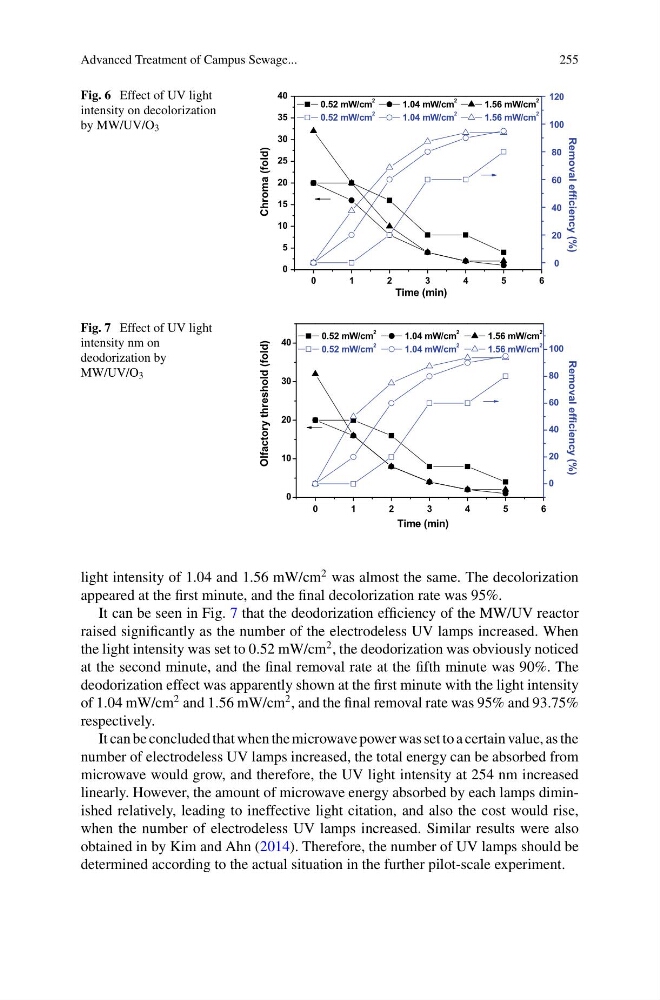
Fig. 6 Effect of UV light
intensity on decolorization
by MW/UV/O 3
0.52 mW/cm
2
1.04 mW/cm
2
1.56 mW/cm
2
0.52 mW/cm
2
1.04 mW/cm
2
1.56 mW/cm
2
0
1
2
3
4
5
6
0
5
10
15
20
25
30
35
40
Time (min)
Chroma (fold)
0
20
40
60
80
100
120
Removal efficiency (%)
Fig. 7 Effect of UV light
intensity nm on
deodorization by
MW/UV/O 3
0.52 mW/cm
2
1.04 mW/cm
2
1.56 mW/cm
2
0.52 mW/cm
2
1.04 mW/cm
2
1.56 mW/cm
2
0
1
2
3
4
5
6
0
10
20
30
40
Time (min)
Olfactory threshold (fold)
0
20
40
60
80
100
Removal efficiency (%)
light intensity of 1.04 and 1.56 mW/cm
2 was almost the same. The decolorization
appeared at the first minute, and the final decolorization rate was 95%.
It can be seen in Fig. 7 that the deodorization efficiency of the MW/UV reactor
raised significantly as the number of the electrodeless UV lamps increased. When
the light intensity was set to 0.52 mW/cm
2 , the deodorization was obviously noticed
at the second minute, and the final removal rate at the fifth minute was 90%. The
deodorization effect was apparently shown at the first minute with the light intensity
of 1.04 mW/cm
2 and 1.56 mW/cm
2 , and the final removal rate was 95% and 93.75%
respectively.
It can be concluded that when the microwave power was set to a certain value, as the
number of electrodeless UV lamps increased, the total energy can be absorbed from
microwave would grow, and therefore, the UV light intensity at 254 nm increased
linearly. However, the amount of microwave energy absorbed by each lamps diminished relatively, leading to ineffective light citation, and also the cost would rise,
when the number of electrodeless UV lamps increased. Similar results were also
obtained in by Kim and Ahn (2014). Therefore, the number of UV lamps should be
determined according to the actual situation in the further pilot-scale experiment.
255
Fig. 6 Effect of UV light
intensity on decolorization
by MW/UV/O 3
0.52 mW/cm
2
1.04 mW/cm
2
1.56 mW/cm
2
0.52 mW/cm
2
1.04 mW/cm
2
1.56 mW/cm
2
0
1
2
3
4
5
6
0
5
10
15
20
25
30
35
40
Time (min)
Chroma (fold)
0
20
40
60
80
100
120
Removal efficiency (%)
Fig. 7 Effect of UV light
intensity nm on
deodorization by
MW/UV/O 3
0.52 mW/cm
2
1.04 mW/cm
2
1.56 mW/cm
2
0.52 mW/cm
2
1.04 mW/cm
2
1.56 mW/cm
2
0
1
2
3
4
5
6
0
10
20
30
40
Time (min)
Olfactory threshold (fold)
0
20
40
60
80
100
Removal efficiency (%)
light intensity of 1.04 and 1.56 mW/cm
2 was almost the same. The decolorization
appeared at the first minute, and the final decolorization rate was 95%.
It can be seen in Fig. 7 that the deodorization efficiency of the MW/UV reactor
raised significantly as the number of the electrodeless UV lamps increased. When
the light intensity was set to 0.52 mW/cm
2 , the deodorization was obviously noticed
at the second minute, and the final removal rate at the fifth minute was 90%. The
deodorization effect was apparently shown at the first minute with the light intensity
of 1.04 mW/cm
2 and 1.56 mW/cm
2 , and the final removal rate was 95% and 93.75%
respectively.
It can be concluded that when the microwave power was set to a certain value, as the
number of electrodeless UV lamps increased, the total energy can be absorbed from
microwave would grow, and therefore, the UV light intensity at 254 nm increased
linearly. However, the amount of microwave energy absorbed by each lamps diminished relatively, leading to ineffective light citation, and also the cost would rise,
when the number of electrodeless UV lamps increased. Similar results were also
obtained in by Kim and Ahn (2014). Therefore, the number of UV lamps should be
determined according to the actual situation in the further pilot-scale experiment.