

Advanced Treatment of Campus Sewage...
253
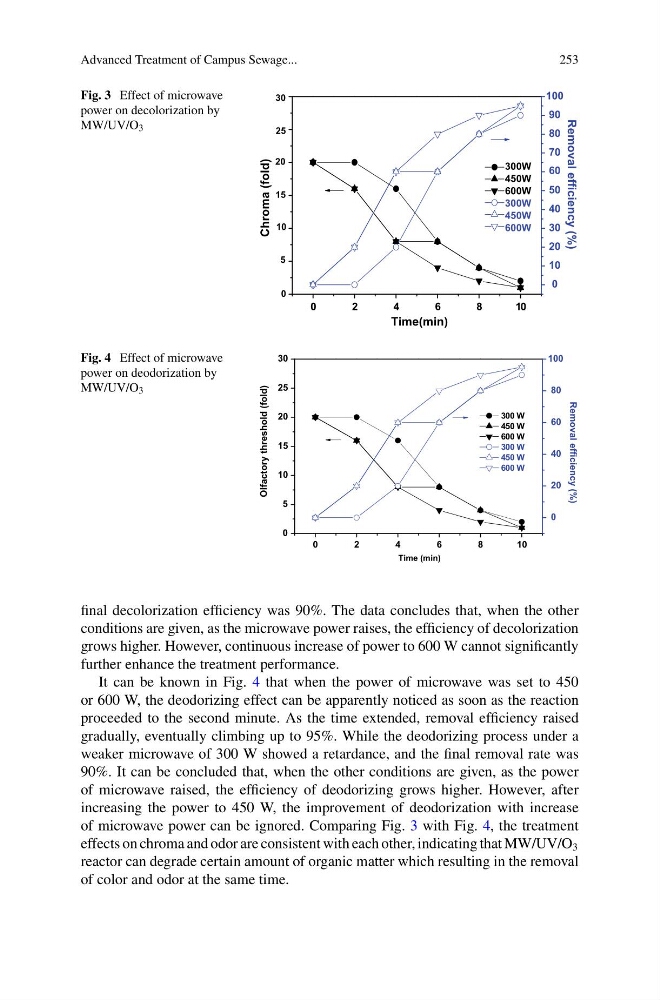
Fig. 3 Effect of microwave
power on decolorization by
MW/UV/O 3
0
2
4
6
8
1 0
Chroma (fold)
0
10
20
30
40
50
70
80
90
100
Removal efficiency (%)
Time(min)
0
5
10
15
20
25
30
300W
450W
600W
300W
450W
600W
60
Fig. 4 Effect of microwave
power on deodorization by
MW/UV/O 3
0
2
4
6
8
1 0
0
5
10
15
20
25
30
300 W
450 W
600 W
300 W
450 W
600 W
Olfactory threshold (fold)
0
20
40
60
80
100
Removal efficiency (%)
Time (min)
final decolorization efficiency was 90%. The data concludes that, when the other
conditions are given, as the microwave power raises, the efficiency of decolorization
grows higher. However, continuous increase of power to 600 W cannot significantly
further enhance the treatment performance.
It can be known in Fig. 4 that when the power of microwave was set to 450
or 600 W, the deodorizing effect can be apparently noticed as soon as the reaction
proceeded to the second minute. As the time extended, removal efficiency raised
gradually, eventually climbing up to 95%. While the deodorizing process under a
weaker microwave of 300 W showed a retardance, and the final removal rate was
90%. It can be concluded that, when the other conditions are given, as the power
of microwave raised, the efficiency of deodorizing grows higher. However, after
increasing the power to 450 W, the improvement of deodorization with increase
of microwave power can be ignored. Comparing Fig. 3 with Fig. 4, the treatment
effects on chroma and odor are consistent with each other, indicating that MW/UV/O 3
reactor can degrade certain amount of organic matter which resulting in the removal
of color and odor at the same time.
253
Fig. 3 Effect of microwave
power on decolorization by
MW/UV/O 3
0
2
4
6
8
1 0
Chroma (fold)
0
10
20
30
40
50
70
80
90
100
Removal efficiency (%)
Time(min)
0
5
10
15
20
25
30
300W
450W
600W
300W
450W
600W
60
Fig. 4 Effect of microwave
power on deodorization by
MW/UV/O 3
0
2
4
6
8
1 0
0
5
10
15
20
25
30
300 W
450 W
600 W
300 W
450 W
600 W
Olfactory threshold (fold)
0
20
40
60
80
100
Removal efficiency (%)
Time (min)
final decolorization efficiency was 90%. The data concludes that, when the other
conditions are given, as the microwave power raises, the efficiency of decolorization
grows higher. However, continuous increase of power to 600 W cannot significantly
further enhance the treatment performance.
It can be known in Fig. 4 that when the power of microwave was set to 450
or 600 W, the deodorizing effect can be apparently noticed as soon as the reaction
proceeded to the second minute. As the time extended, removal efficiency raised
gradually, eventually climbing up to 95%. While the deodorizing process under a
weaker microwave of 300 W showed a retardance, and the final removal rate was
90%. It can be concluded that, when the other conditions are given, as the power
of microwave raised, the efficiency of deodorizing grows higher. However, after
increasing the power to 450 W, the improvement of deodorization with increase
of microwave power can be ignored. Comparing Fig. 3 with Fig. 4, the treatment
effects on chroma and odor are consistent with each other, indicating that MW/UV/O 3
reactor can degrade certain amount of organic matter which resulting in the removal
of color and odor at the same time.