

252
S. Gong et al.
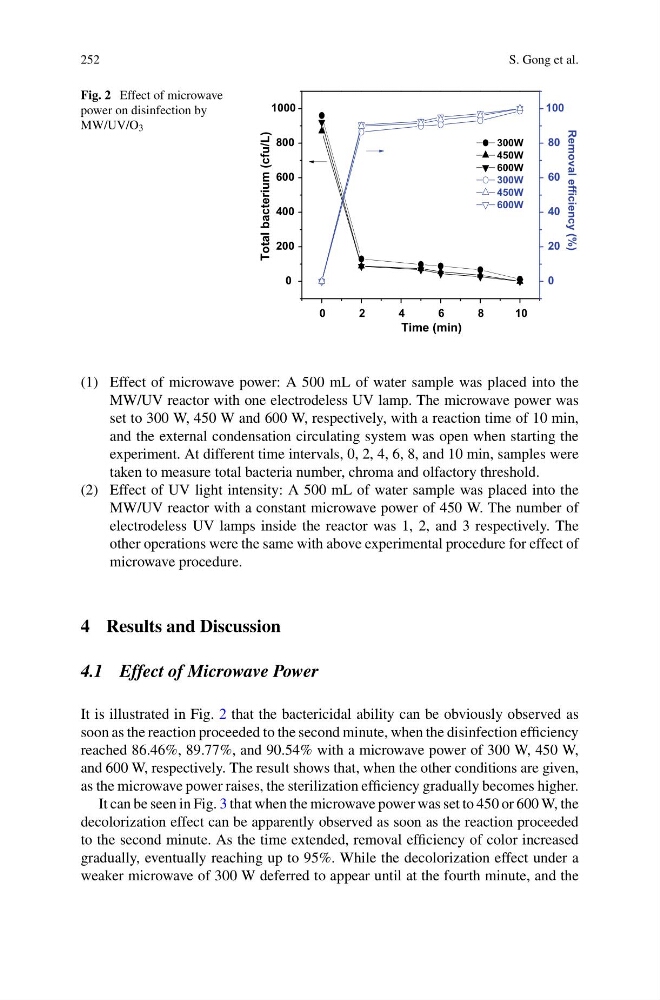
Fig. 2 Effect of microwave
power on disinfection by
MW/UV/O 3
0
2
4
6
8
1 0
0
200
400
600
800
1000
300W
450W
600W
300W
450W
600W
Time (min)
Total bacterium (cfu/L)
0
20
40
60
80
100
Removal efficiency (%)
(1) Effect of microwave power: A 500 mL of water sample was placed into the
MW/UV reactor with one electrodeless UV lamp. The microwave power was
set to 300 W, 450 W and 600 W, respectively, with a reaction time of 10 min,
and the external condensation circulating system was open when starting the
experiment. At different time intervals, 0, 2, 4, 6, 8, and 10 min, samples were
taken to measure total bacteria number, chroma and olfactory threshold.
(2) Effect of UV light intensity: A 500 mL of water sample was placed into the
MW/UV reactor with a constant microwave power of 450 W. The number of
electrodeless UV lamps inside the reactor was 1, 2, and 3 respectively. The
other operations were the same with above experimental procedure for effect of
microwave procedure.
4 Results and Discussion
4.1 Effect of Microwave Power
It is illustrated in Fig. 2 that the bactericidal ability can be obviously observed as
soon as the reaction proceeded to the second minute, when the disinfection efficiency
reached 86.46%, 89.77%, and 90.54% with a microwave power of 300 W, 450 W,
and 600 W, respectively. The result shows that, when the other conditions are given,
as the microwave power raises, the sterilization efficiency gradually becomes higher.
It can be seen in Fig. 3 that when the microwave power was set to 450 or 600 W, the
decolorization effect can be apparently observed as soon as the reaction proceeded
to the second minute. As the time extended, removal efficiency of color increased
gradually, eventually reaching up to 95%. While the decolorization effect under a
weaker microwave of 300 W deferred to appear until at the fourth minute, and the
S. Gong et al.
Fig. 2 Effect of microwave
power on disinfection by
MW/UV/O 3
0
2
4
6
8
1 0
0
200
400
600
800
1000
300W
450W
600W
300W
450W
600W
Time (min)
Total bacterium (cfu/L)
0
20
40
60
80
100
Removal efficiency (%)
(1) Effect of microwave power: A 500 mL of water sample was placed into the
MW/UV reactor with one electrodeless UV lamp. The microwave power was
set to 300 W, 450 W and 600 W, respectively, with a reaction time of 10 min,
and the external condensation circulating system was open when starting the
experiment. At different time intervals, 0, 2, 4, 6, 8, and 10 min, samples were
taken to measure total bacteria number, chroma and olfactory threshold.
(2) Effect of UV light intensity: A 500 mL of water sample was placed into the
MW/UV reactor with a constant microwave power of 450 W. The number of
electrodeless UV lamps inside the reactor was 1, 2, and 3 respectively. The
other operations were the same with above experimental procedure for effect of
microwave procedure.
4 Results and Discussion
4.1 Effect of Microwave Power
It is illustrated in Fig. 2 that the bactericidal ability can be obviously observed as
soon as the reaction proceeded to the second minute, when the disinfection efficiency
reached 86.46%, 89.77%, and 90.54% with a microwave power of 300 W, 450 W,
and 600 W, respectively. The result shows that, when the other conditions are given,
as the microwave power raises, the sterilization efficiency gradually becomes higher.
It can be seen in Fig. 3 that when the microwave power was set to 450 or 600 W, the
decolorization effect can be apparently observed as soon as the reaction proceeded
to the second minute. As the time extended, removal efficiency of color increased
gradually, eventually reaching up to 95%. While the decolorization effect under a
weaker microwave of 300 W deferred to appear until at the fourth minute, and the