

Advanced Treatment of Campus Sewage...
251
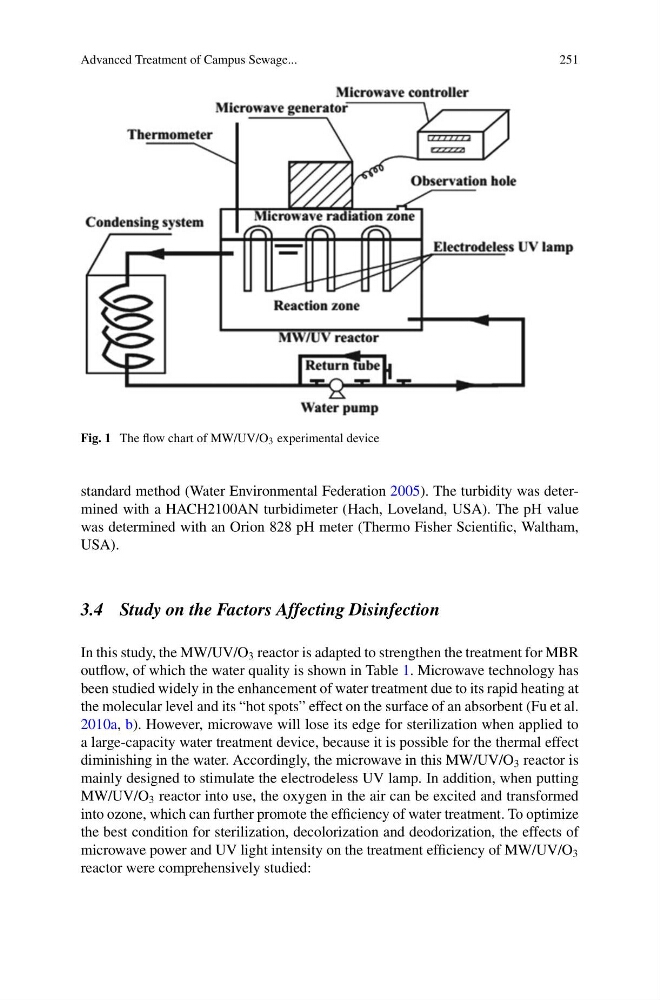
Fig. 1 The flow chart of MW/UV/O 3 experimental device
standard method (Water Environmental Federation 2005). The turbidity was determined with a HACH2100AN turbidimeter (Hach, Loveland, USA). The pH value
was determined with an Orion 828 pH meter (Thermo Fisher Scientific, Waltham,
USA).
3.4 Study on the Factors Affecting Disinfection
In this study, the MW/UV/O 3 reactor is adapted to strengthen the treatment for MBR
outflow, of which the water quality is shown in Table 1. Microwave technology has
been studied widely in the enhancement of water treatment due to its rapid heating at
the molecular level and its “hot spots” effect on the surface of an absorbent (Fu et al.
2010a, b). However, microwave will lose its edge for sterilization when applied to
a large-capacity water treatment device, because it is possible for the thermal effect
diminishing in the water. Accordingly, the microwave in this MW/UV/O 3 reactor is
mainly designed to stimulate the electrodeless UV lamp. In addition, when putting
MW/UV/O 3 reactor into use, the oxygen in the air can be excited and transformed
into ozone, which can further promote the efficiency of water treatment. To optimize
the best condition for sterilization, decolorization and deodorization, the effects of
microwave power and UV light intensity on the treatment efficiency of MW/UV/O 3
reactor were comprehensively studied:
251
Fig. 1 The flow chart of MW/UV/O 3 experimental device
standard method (Water Environmental Federation 2005). The turbidity was determined with a HACH2100AN turbidimeter (Hach, Loveland, USA). The pH value
was determined with an Orion 828 pH meter (Thermo Fisher Scientific, Waltham,
USA).
3.4 Study on the Factors Affecting Disinfection
In this study, the MW/UV/O 3 reactor is adapted to strengthen the treatment for MBR
outflow, of which the water quality is shown in Table 1. Microwave technology has
been studied widely in the enhancement of water treatment due to its rapid heating at
the molecular level and its “hot spots” effect on the surface of an absorbent (Fu et al.
2010a, b). However, microwave will lose its edge for sterilization when applied to
a large-capacity water treatment device, because it is possible for the thermal effect
diminishing in the water. Accordingly, the microwave in this MW/UV/O 3 reactor is
mainly designed to stimulate the electrodeless UV lamp. In addition, when putting
MW/UV/O 3 reactor into use, the oxygen in the air can be excited and transformed
into ozone, which can further promote the efficiency of water treatment. To optimize
the best condition for sterilization, decolorization and deodorization, the effects of
microwave power and UV light intensity on the treatment efficiency of MW/UV/O 3
reactor were comprehensively studied: