

214
A. Z. Yaser and N. N. Safie
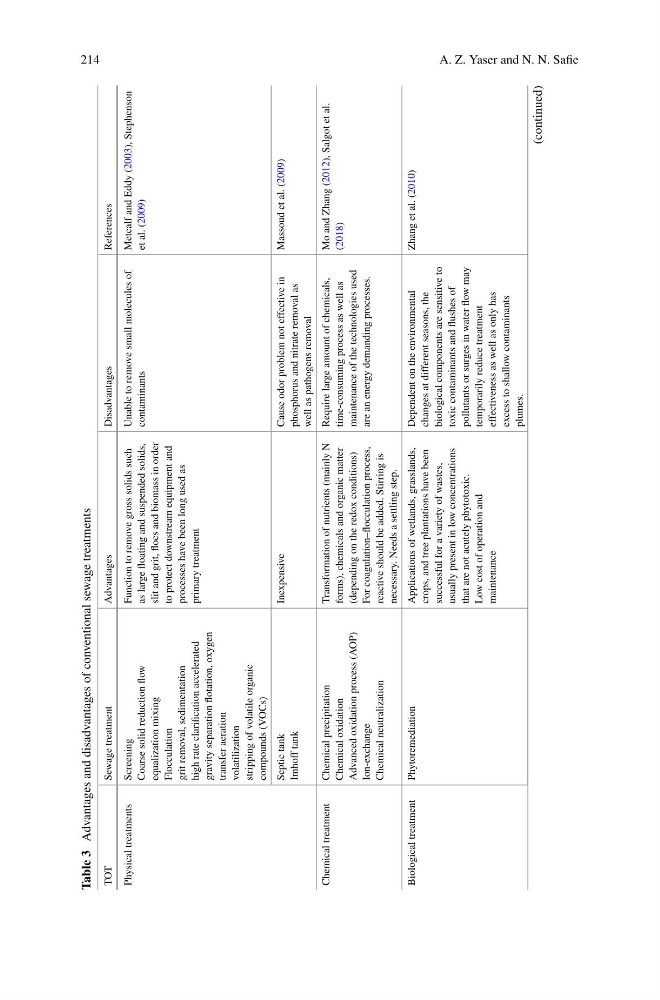
Table 3
Advantages and disadvantages of conventional sewage treatments
TOT
Sewage treatment
Advantages
Disadvantages
References
Physical treatments
Screening
Coarse solid reduction flow
equalization mixing
Flocculation
grit removal, sedimentation
high rate clarification accelerated
gravity separation flotation, oxygen
transfer aeration
volatilization
stripping of volatile organic
compounds (VOCs)
Function to remove gross solids such
as large floating and suspended solids,
slit and grit, flocs and biomass in order
to protect downstream equipment and
processes have been long used as
primary treatment
Unable to remove small molecules of
contaminants
Metcalf and Eddy (2003), Stephenson
et al. (2009)
Septic tank
Imhoff tank
Inexpensive
Cause odor problem not effective in
phosphorus and nitrate removal as
well as pathogens removal
Massoud et al. (2009)
Chemical treatment
Chemical precipitation
Chemical oxidation
Advanced oxidation process (AOP)
Ion-exchange
Chemical neutralization
Transformation of nutrients (mainly N
forms), chemicals and organic matter
(depending on the redox conditions)
For coagulation–flocculation process,
reactive should be added. Stirring is
necessary. Needs a settling step.
Require large amount of chemicals,
time-consuming process as well as
maintenance of the technologies used
are an energy demanding processes.
Mo and Zhang (2012), Salgot et al.
(2018)
Biological treatment
Phytoremediation
Applications of wetlands, grasslands,
crops, and tree plantations have been
successful for a variety of wastes,
usually present in low concentrations
that are not acutely phytotoxic.
Low cost of operation and
maintenance
Dependent on the environmental
changes at different seasons, the
biological components are sensitive to
toxic contaminants and flushes of
pollutants or surges in water flow may
temporarily reduce treatment
effectiveness as well as only has
excess to shallow contaminants
plumes.
Zhang et al. (2010)
(continued)
A. Z. Yaser and N. N. Safie
Table 3
Advantages and disadvantages of conventional sewage treatments
TOT
Sewage treatment
Advantages
Disadvantages
References
Physical treatments
Screening
Coarse solid reduction flow
equalization mixing
Flocculation
grit removal, sedimentation
high rate clarification accelerated
gravity separation flotation, oxygen
transfer aeration
volatilization
stripping of volatile organic
compounds (VOCs)
Function to remove gross solids such
as large floating and suspended solids,
slit and grit, flocs and biomass in order
to protect downstream equipment and
processes have been long used as
primary treatment
Unable to remove small molecules of
contaminants
Metcalf and Eddy (2003), Stephenson
et al. (2009)
Septic tank
Imhoff tank
Inexpensive
Cause odor problem not effective in
phosphorus and nitrate removal as
well as pathogens removal
Massoud et al. (2009)
Chemical treatment
Chemical precipitation
Chemical oxidation
Advanced oxidation process (AOP)
Ion-exchange
Chemical neutralization
Transformation of nutrients (mainly N
forms), chemicals and organic matter
(depending on the redox conditions)
For coagulation–flocculation process,
reactive should be added. Stirring is
necessary. Needs a settling step.
Require large amount of chemicals,
time-consuming process as well as
maintenance of the technologies used
are an energy demanding processes.
Mo and Zhang (2012), Salgot et al.
(2018)
Biological treatment
Phytoremediation
Applications of wetlands, grasslands,
crops, and tree plantations have been
successful for a variety of wastes,
usually present in low concentrations
that are not acutely phytotoxic.
Low cost of operation and
maintenance
Dependent on the environmental
changes at different seasons, the
biological components are sensitive to
toxic contaminants and flushes of
pollutants or surges in water flow may
temporarily reduce treatment
effectiveness as well as only has
excess to shallow contaminants
plumes.
Zhang et al. (2010)
(continued)