

Sewage Treatment in Campus for Recycling Purpose: A Review
215
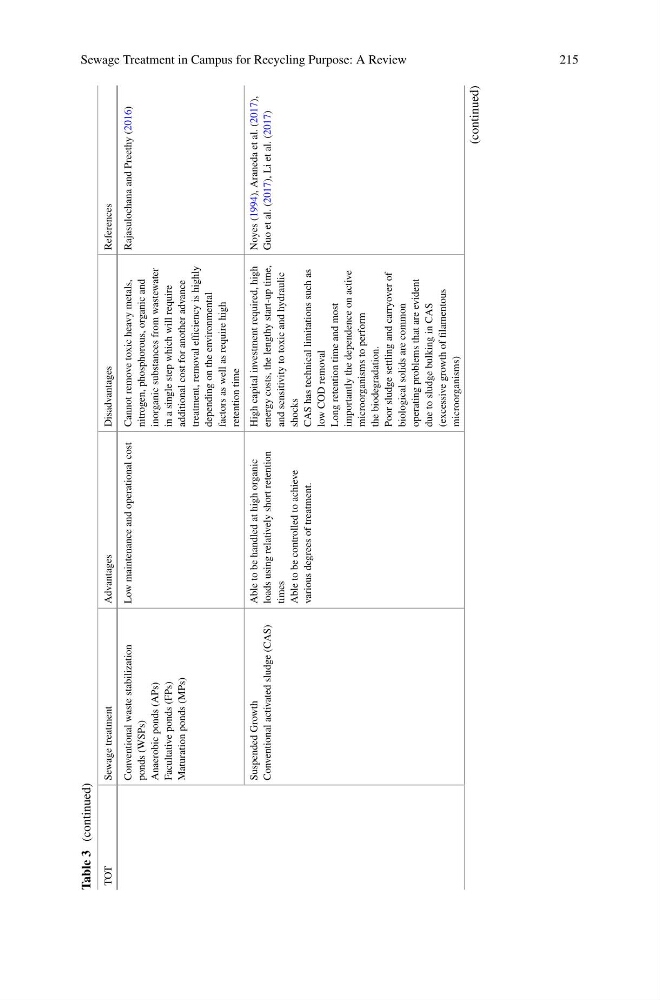
Table 3
(continued)
TOT
Sewage treatment
Advantages
Disadvantages
References
Conventional waste stabilization
ponds (WSPs)
Anaerobic ponds (APs)
Facultative ponds (FPs)
Maturation ponds (MPs)
Low maintenance and operational cost Cannot remove toxic heavy metals,
nitrogen, phosphorous, organic and
inorganic substances from wastewater
in a single step which will require
additional cost for another advance
treatment, removal efficiency is highly
depending on the environmental
factors as well as require high
retention time
Rajasulochana and Preethy (2016)
Suspended Growth
Conventional activated sludge (CAS)
Able to be handled at high organic
loads using relatively short retention
times
Able to be controlled to achieve
various degrees of treatment.
High capital investment required, high
energy costs, the lengthy start-up time,
and sensitivity to toxic and hydraulic
shocks
CAS has technical limitations such as
low COD removal
Long retention time and most
importantly the dependence on active
microorganisms to perform
the biodegradation.
Poor sludge settling and carryover of
biological solids are common
operating problems that are evident
due to sludge bulking in CAS
(excessive growth of filamentous
microorganisms)
Noyes (1994), Araneda et al. (2017),
Guo et al. (2017), Li et al. (2017)
(continued)
215
Table 3
(continued)
TOT
Sewage treatment
Advantages
Disadvantages
References
Conventional waste stabilization
ponds (WSPs)
Anaerobic ponds (APs)
Facultative ponds (FPs)
Maturation ponds (MPs)
Low maintenance and operational cost Cannot remove toxic heavy metals,
nitrogen, phosphorous, organic and
inorganic substances from wastewater
in a single step which will require
additional cost for another advance
treatment, removal efficiency is highly
depending on the environmental
factors as well as require high
retention time
Rajasulochana and Preethy (2016)
Suspended Growth
Conventional activated sludge (CAS)
Able to be handled at high organic
loads using relatively short retention
times
Able to be controlled to achieve
various degrees of treatment.
High capital investment required, high
energy costs, the lengthy start-up time,
and sensitivity to toxic and hydraulic
shocks
CAS has technical limitations such as
low COD removal
Long retention time and most
importantly the dependence on active
microorganisms to perform
the biodegradation.
Poor sludge settling and carryover of
biological solids are common
operating problems that are evident
due to sludge bulking in CAS
(excessive growth of filamentous
microorganisms)
Noyes (1994), Araneda et al. (2017),
Guo et al. (2017), Li et al. (2017)
(continued)