

202
N. Bolong and I. Saad
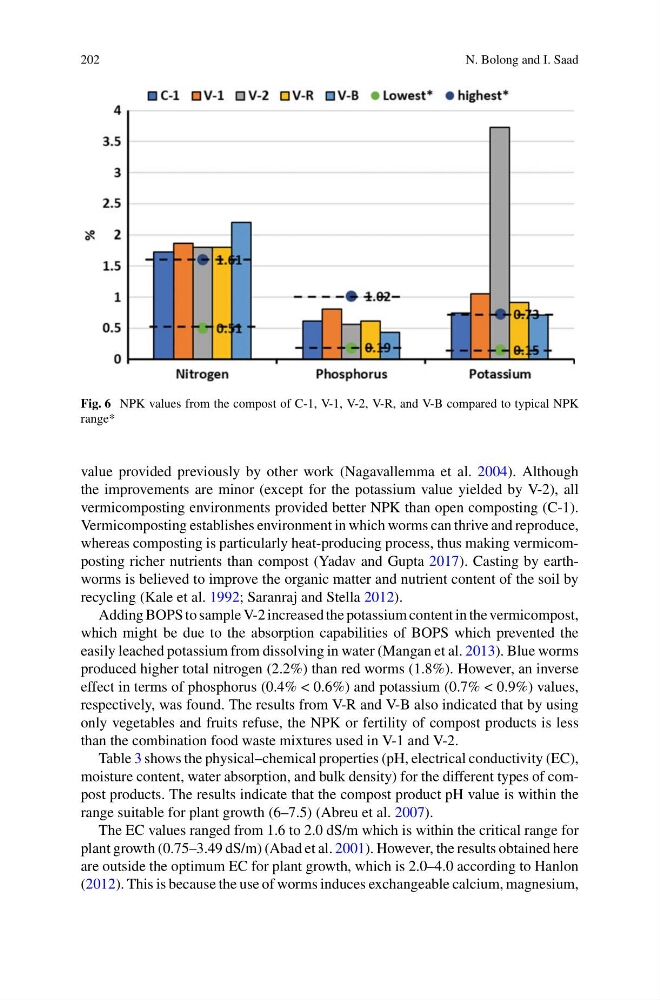
Fig. 6 NPK values from the compost of C-1, V-1, V-2, V-R, and V-B compared to typical NPK
range*
value provided previously by other work (Nagavallemma et al. 2004). Although
the improvements are minor (except for the potassium value yielded by V-2), all
vermicomposting environments provided better NPK than open composting (C-1).
Vermicomposting establishes environment in which worms can thrive and reproduce,
whereas composting is particularly heat-producing process, thus making vermicomposting richer nutrients than compost (Yadav and Gupta 2017). Casting by earthworms is believed to improve the organic matter and nutrient content of the soil by
recycling (Kale et al. 1992; Saranraj and Stella 2012).
Adding BOPS to sample V-2 increased the potassium content in the vermicompost,
which might be due to the absorption capabilities of BOPS which prevented the
easily leached potassium from dissolving in water (Mangan et al. 2013). Blue worms
produced higher total nitrogen (2.2%) than red worms (1.8%). However, an inverse
effect in terms of phosphorus (0.4% < 0.6%) and potassium (0.7% < 0.9%) values,
respectively, was found. The results from V-R and V-B also indicated that by using
only vegetables and fruits refuse, the NPK or fertility of compost products is less
than the combination food waste mixtures used in V-1 and V-2.
Table 3 shows the physical–chemical properties (pH, electrical conductivity (EC),
moisture content, water absorption, and bulk density) for the different types of compost products. The results indicate that the compost product pH value is within the
range suitable for plant growth (6–7.5) (Abreu et al. 2007).
The EC values ranged from 1.6 to 2.0 dS/m which is within the critical range for
plant growth (0.75–3.49 dS/m) (Abad et al. 2001). However, the results obtained here
are outside the optimum EC for plant growth, which is 2.0–4.0 according to Hanlon
(2012). This is because the use of worms induces exchangeable calcium, magnesium,
N. Bolong and I. Saad
Fig. 6 NPK values from the compost of C-1, V-1, V-2, V-R, and V-B compared to typical NPK
range*
value provided previously by other work (Nagavallemma et al. 2004). Although
the improvements are minor (except for the potassium value yielded by V-2), all
vermicomposting environments provided better NPK than open composting (C-1).
Vermicomposting establishes environment in which worms can thrive and reproduce,
whereas composting is particularly heat-producing process, thus making vermicomposting richer nutrients than compost (Yadav and Gupta 2017). Casting by earthworms is believed to improve the organic matter and nutrient content of the soil by
recycling (Kale et al. 1992; Saranraj and Stella 2012).
Adding BOPS to sample V-2 increased the potassium content in the vermicompost,
which might be due to the absorption capabilities of BOPS which prevented the
easily leached potassium from dissolving in water (Mangan et al. 2013). Blue worms
produced higher total nitrogen (2.2%) than red worms (1.8%). However, an inverse
effect in terms of phosphorus (0.4% < 0.6%) and potassium (0.7% < 0.9%) values,
respectively, was found. The results from V-R and V-B also indicated that by using
only vegetables and fruits refuse, the NPK or fertility of compost products is less
than the combination food waste mixtures used in V-1 and V-2.
Table 3 shows the physical–chemical properties (pH, electrical conductivity (EC),
moisture content, water absorption, and bulk density) for the different types of compost products. The results indicate that the compost product pH value is within the
range suitable for plant growth (6–7.5) (Abreu et al. 2007).
The EC values ranged from 1.6 to 2.0 dS/m which is within the critical range for
plant growth (0.75–3.49 dS/m) (Abad et al. 2001). However, the results obtained here
are outside the optimum EC for plant growth, which is 2.0–4.0 according to Hanlon
(2012). This is because the use of worms induces exchangeable calcium, magnesium,