

Characterization of University Residential and Canteen …
201
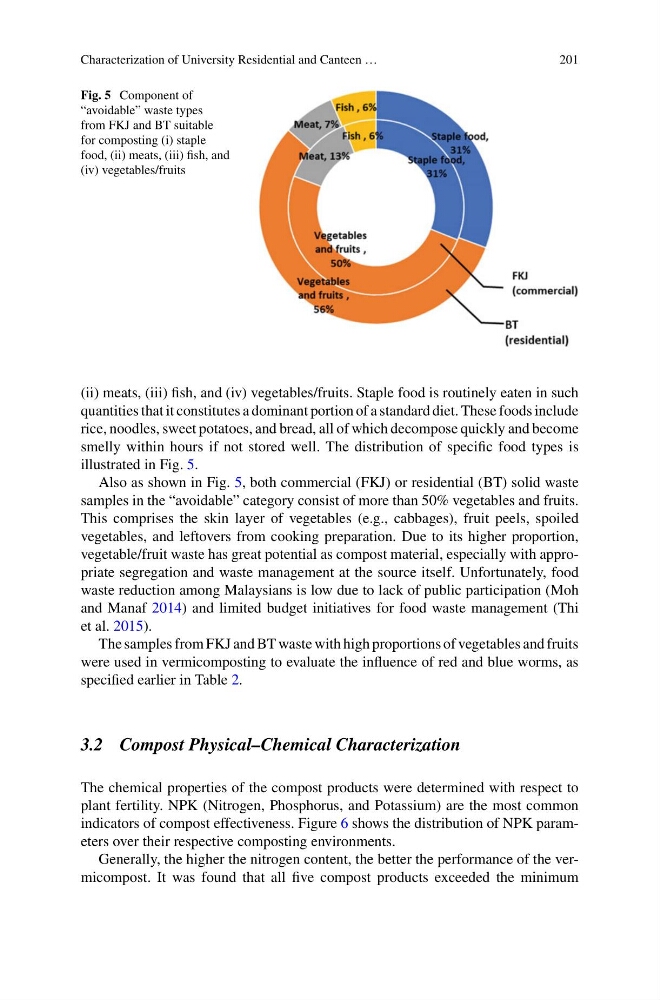
Fig. 5 Component of
“avoidable” waste types
from FKJ and BT suitable
for composting (i) staple
food, (ii) meats, (iii) fish, and
(iv) vegetables/fruits
(ii) meats, (iii) fish, and (iv) vegetables/fruits. Staple food is routinely eaten in such
quantities that it constitutes a dominant portion of a standard diet. These foods include
rice, noodles, sweet potatoes, and bread, all of which decompose quickly and become
smelly within hours if not stored well. The distribution of specific food types is
illustrated in Fig. 5.
Also as shown in Fig. 5, both commercial (FKJ) or residential (BT) solid waste
samples in the “avoidable” category consist of more than 50% vegetables and fruits.
This comprises the skin layer of vegetables (e.g., cabbages), fruit peels, spoiled
vegetables, and leftovers from cooking preparation. Due to its higher proportion,
vegetable/fruit waste has great potential as compost material, especially with appropriate segregation and waste management at the source itself. Unfortunately, food
waste reduction among Malaysians is low due to lack of public participation (Moh
and Manaf 2014) and limited budget initiatives for food waste management (Thi
et al. 2015).
The samples from FKJ and BT waste with high proportions of vegetables and fruits
were used in vermicomposting to evaluate the influence of red and blue worms, as
specified earlier in Table 2.
3.2 Compost Physical–Chemical Characterization
The chemical properties of the compost products were determined with respect to
plant fertility. NPK (Nitrogen, Phosphorus, and Potassium) are the most common
indicators of compost effectiveness. Figure 6 shows the distribution of NPK parameters over their respective composting environments.
Generally, the higher the nitrogen content, the better the performance of the vermicompost. It was found that all five compost products exceeded the minimum
201
Fig. 5 Component of
“avoidable” waste types
from FKJ and BT suitable
for composting (i) staple
food, (ii) meats, (iii) fish, and
(iv) vegetables/fruits
(ii) meats, (iii) fish, and (iv) vegetables/fruits. Staple food is routinely eaten in such
quantities that it constitutes a dominant portion of a standard diet. These foods include
rice, noodles, sweet potatoes, and bread, all of which decompose quickly and become
smelly within hours if not stored well. The distribution of specific food types is
illustrated in Fig. 5.
Also as shown in Fig. 5, both commercial (FKJ) or residential (BT) solid waste
samples in the “avoidable” category consist of more than 50% vegetables and fruits.
This comprises the skin layer of vegetables (e.g., cabbages), fruit peels, spoiled
vegetables, and leftovers from cooking preparation. Due to its higher proportion,
vegetable/fruit waste has great potential as compost material, especially with appropriate segregation and waste management at the source itself. Unfortunately, food
waste reduction among Malaysians is low due to lack of public participation (Moh
and Manaf 2014) and limited budget initiatives for food waste management (Thi
et al. 2015).
The samples from FKJ and BT waste with high proportions of vegetables and fruits
were used in vermicomposting to evaluate the influence of red and blue worms, as
specified earlier in Table 2.
3.2 Compost Physical–Chemical Characterization
The chemical properties of the compost products were determined with respect to
plant fertility. NPK (Nitrogen, Phosphorus, and Potassium) are the most common
indicators of compost effectiveness. Figure 6 shows the distribution of NPK parameters over their respective composting environments.
Generally, the higher the nitrogen content, the better the performance of the vermicompost. It was found that all five compost products exceeded the minimum