

196
N. Bolong and I. Saad
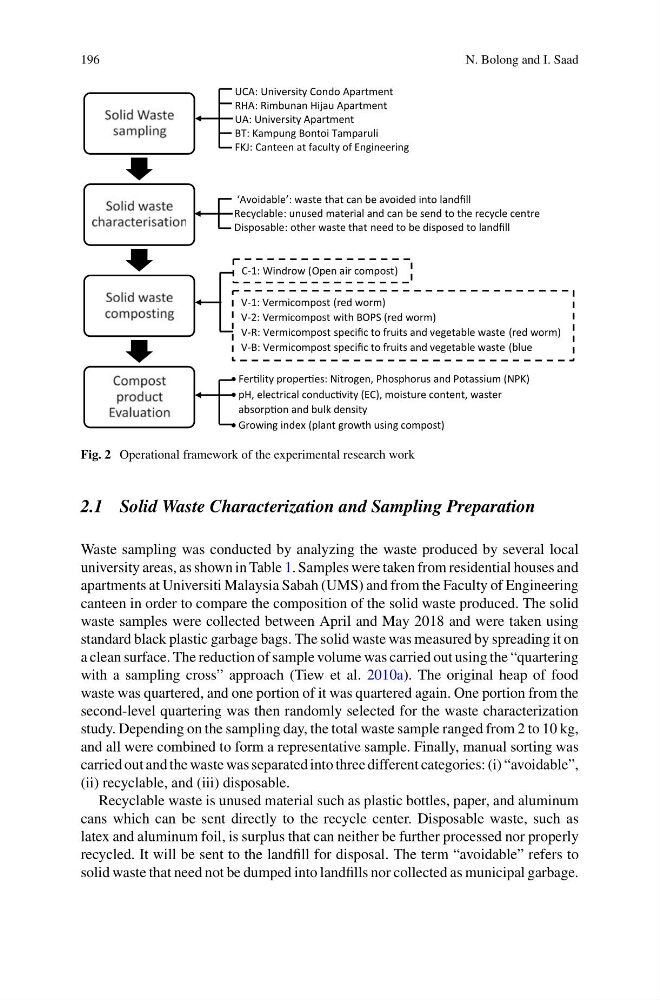
UCA: University Condo Apartment
RHA: Rimbunan Hijau Apartment
UA: University Apartment
BT: Kampung Bontoi Tamparuli
FKJ: Canteen at faculty of Engineering
‘Avoidable’: waste that can be avoided into landfill
Recyclable: unused material and can be send to the recycle centre
Disposable: other waste that need to be disposed to landfill
C-1: Windrow (Open air compost)
V-1: Vermicompost (red worm)
V-2: Vermicompost with BOPS (red worm)
V-R: Vermicompost specific to fruits and vegetable waste (red worm)
V-B: Vermicompost specific to fruits and vegetable waste (blue
• FerƟlity properƟes: Nitrogen, Phosphorus and Potassium (NPK)
• pH, electrical conducƟvity (EC), moisture content, waster
absorpƟon and bulk density
• Growing index (plant growth using compost)
Fig. 2 Operational framework of the experimental research work
2.1 Solid Waste Characterization and Sampling Preparation
Waste sampling was conducted by analyzing the waste produced by several local
university areas, as shown in Table 1. Samples were taken from residential houses and
apartments at Universiti Malaysia Sabah (UMS) and from the Faculty of Engineering
canteen in order to compare the composition of the solid waste produced. The solid
waste samples were collected between April and May 2018 and were taken using
standard black plastic garbage bags. The solid waste was measured by spreading it on
a clean surface. The reduction of sample volume was carried out using the “quartering
with a sampling cross” approach (Tiew et al. 2010a). The original heap of food
waste was quartered, and one portion of it was quartered again. One portion from the
second-level quartering was then randomly selected for the waste characterization
study. Depending on the sampling day, the total waste sample ranged from 2 to 10 kg,
and all were combined to form a representative sample. Finally, manual sorting was
carried out and the waste was separated into three different categories: (i) “avoidable”,
(ii) recyclable, and (iii) disposable.
Recyclable waste is unused material such as plastic bottles, paper, and aluminum
cans which can be sent directly to the recycle center. Disposable waste, such as
latex and aluminum foil, is surplus that can neither be further processed nor properly
recycled. It will be sent to the landfill for disposal. The term “avoidable” refers to
solid waste that need not be dumped into landfills nor collected as municipal garbage.
N. Bolong and I. Saad
UCA: University Condo Apartment
RHA: Rimbunan Hijau Apartment
UA: University Apartment
BT: Kampung Bontoi Tamparuli
FKJ: Canteen at faculty of Engineering
‘Avoidable’: waste that can be avoided into landfill
Recyclable: unused material and can be send to the recycle centre
Disposable: other waste that need to be disposed to landfill
C-1: Windrow (Open air compost)
V-1: Vermicompost (red worm)
V-2: Vermicompost with BOPS (red worm)
V-R: Vermicompost specific to fruits and vegetable waste (red worm)
V-B: Vermicompost specific to fruits and vegetable waste (blue
• FerƟlity properƟes: Nitrogen, Phosphorus and Potassium (NPK)
• pH, electrical conducƟvity (EC), moisture content, waster
absorpƟon and bulk density
• Growing index (plant growth using compost)
Fig. 2 Operational framework of the experimental research work
2.1 Solid Waste Characterization and Sampling Preparation
Waste sampling was conducted by analyzing the waste produced by several local
university areas, as shown in Table 1. Samples were taken from residential houses and
apartments at Universiti Malaysia Sabah (UMS) and from the Faculty of Engineering
canteen in order to compare the composition of the solid waste produced. The solid
waste samples were collected between April and May 2018 and were taken using
standard black plastic garbage bags. The solid waste was measured by spreading it on
a clean surface. The reduction of sample volume was carried out using the “quartering
with a sampling cross” approach (Tiew et al. 2010a). The original heap of food
waste was quartered, and one portion of it was quartered again. One portion from the
second-level quartering was then randomly selected for the waste characterization
study. Depending on the sampling day, the total waste sample ranged from 2 to 10 kg,
and all were combined to form a representative sample. Finally, manual sorting was
carried out and the waste was separated into three different categories: (i) “avoidable”,
(ii) recyclable, and (iii) disposable.
Recyclable waste is unused material such as plastic bottles, paper, and aluminum
cans which can be sent directly to the recycle center. Disposable waste, such as
latex and aluminum foil, is surplus that can neither be further processed nor properly
recycled. It will be sent to the landfill for disposal. The term “avoidable” refers to
solid waste that need not be dumped into landfills nor collected as municipal garbage.